Imagine finishing an eight-hour workday feeling completely exhausted, yet struggling to identify one meaningful thing you accomplished.
You attended meetings. Answered emails. Replied to messages. Checked notifications. Switched between tasks dozens of times.
You were busy all day.
But were you productive?
That is the uncomfortable question at the heart of Deep Work: Rules for Focused Success in a Distracted World by Cal Newport.
Newport argues that the ability to concentrate deeply is becoming increasingly valuable precisely because our workplaces and digital habits make sustained concentration so difficult.
His solution isn’t simply to work harder or eliminate every distraction. It’s to deliberately create the conditions in which your brain can do its most demanding, valuable work.
In this Deep Work summary, we’ll explore eight powerful lessons, the book’s most useful frameworks, real-world examples, common mistakes, and a practical seven-day plan to help you reclaim your focus.
Editorial note: This is an original synthesis of the book’s ideas and practical applications, not a substitute for the complete text. Examples and exercises developed for this article are distinguished from Newport’s original frameworks.
Deep Work in 60 Seconds
The central message
Your most valuable work often requires uninterrupted concentration. Protecting time for that work can improve the quality of your results, accelerate learning, and create greater professional satisfaction.
The five ideas worth remembering:
- Deep work produces more value than simply staying busy.
- Every interruption can make it harder to return to demanding work.
- Focus is a skill that improves with deliberate practice.
- You need boundaries, routines, and a realistic schedule.
- Not all digital tools and shallow tasks deserve equal attention.
What Is Deep Work?
Newport defines deep work as professional activity performed in a state of distraction-free concentration that pushes your cognitive abilities toward their limits.
Examples include writing a difficult chapter, solving a complex software problem, developing a business strategy, studying a challenging subject, or designing a new product.
The opposite is shallow work: relatively undemanding tasks, often performed while distracted, that generally create less new value and are easier to replicate.
Answering routine emails, arranging meetings, updating status trackers, and handling administrative requests are common examples.
The distinction isn’t that shallow work is useless. Most jobs require some of it. The problem begins when shallow work consumes so much of your day that you have no time left for anything demanding.
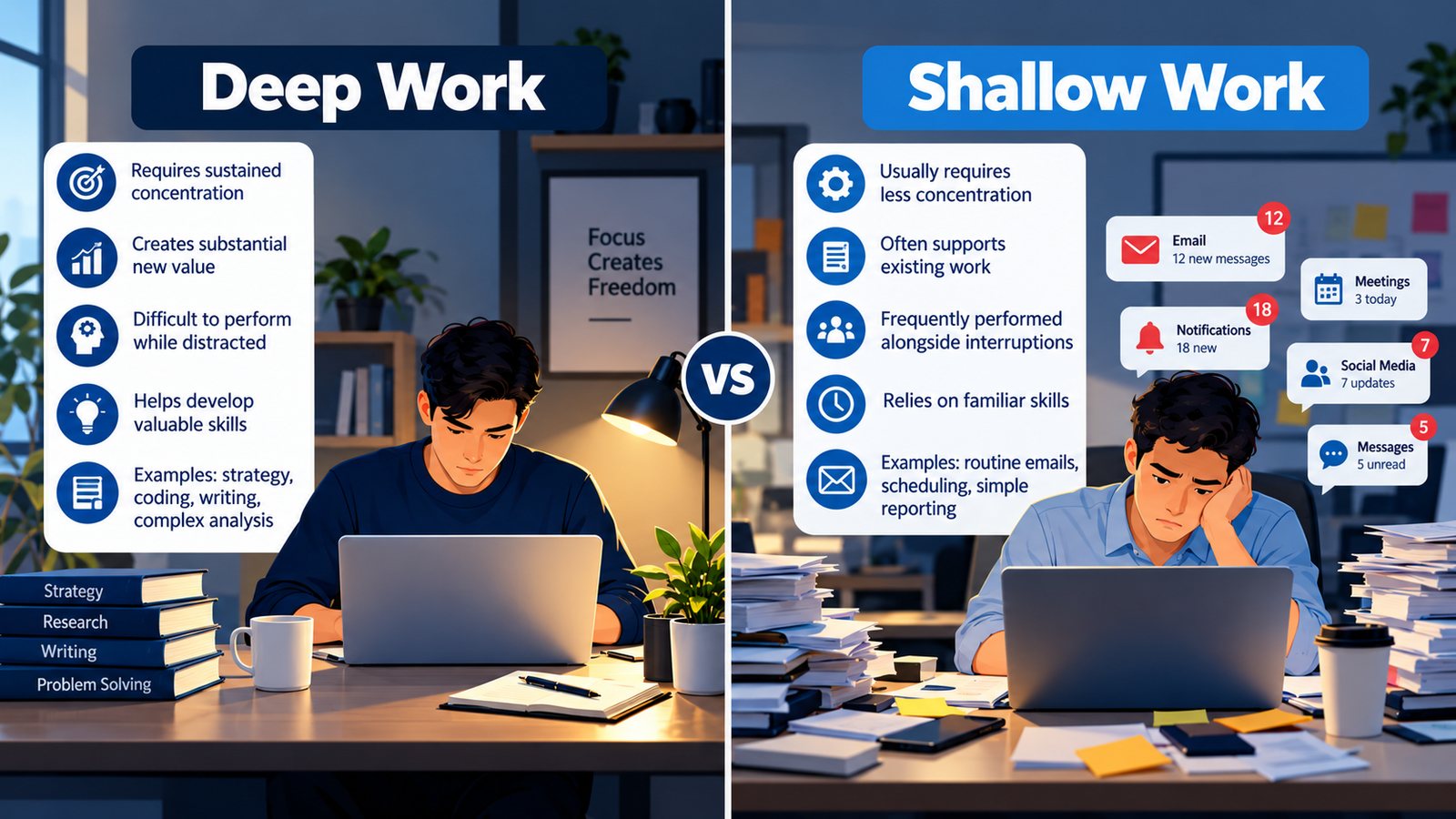
Deep Work vs. Shallow Work
| Deep Work | Shallow Work |
|---|---|
| Requires sustained concentration | Usually requires less concentration |
| Creates substantial new value | Often supports existing work |
| Difficult to perform while distracted | Frequently performed alongside interruptions |
| Helps develop difficult skills | Usually relies on familiar skills |
| Examples: strategy, coding, writing, complex analysis | Examples: routine emails, scheduling, simple reporting |
Lesson 1: Being Busy Is Not the Same as Being Productive
A manager can spend an entire day responding to messages and still fail to address the biggest problem facing the team.
A student can study for six hours while repeatedly checking a phone and retain less than expected.
A writer can sit at a desk all afternoon and produce only a few useful paragraphs.
The issue isn’t necessarily effort. It’s how that effort is directed.
Newport challenges the workplace tendency to treat visible activity—rapid replies, crowded calendars, constant availability—as evidence of meaningful productivity.
Why this matters
Many valuable outcomes are difficult to produce in small fragments of time.
Developing a strategy requires connecting ideas. Solving an unfamiliar problem requires holding several pieces of information in your mind. Writing a thoughtful report requires organizing arguments.
Constant interruptions break that continuity.
How to apply it
At the beginning of each workday, identify one important outcome that would make the day worthwhile.
Ask yourself:
If I complete only one demanding task today, which one would create the most value?
Then reserve your best concentration period for that task before allowing routine requests to take over.
Lesson 2: Attention Residue Makes Task Switching Expensive
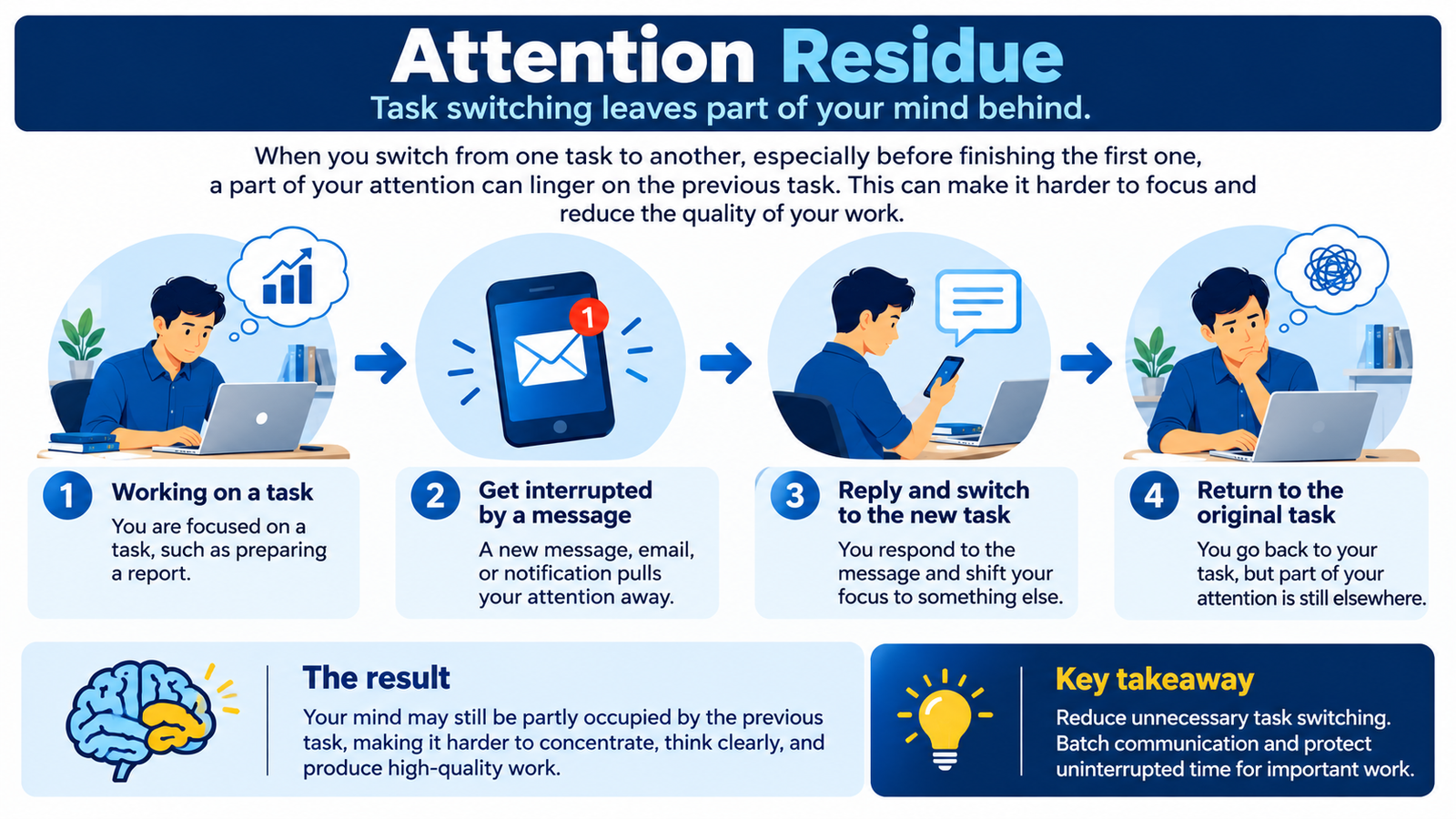
Imagine working on a financial forecast when a message arrives.
You open it, reply, and return to the spreadsheet.
Physically, you’re back at the original task. Mentally, part of your attention may still be occupied by the message.
Newport discusses this phenomenon as attention residue, drawing on research by organizational psychologist Sophie Leroy.
When you switch tasks, especially before reaching a natural stopping point, thoughts about the previous task can linger and interfere with the next one.
This helps explain why a day filled with small interruptions can feel mentally exhausting even when individual interruptions seem harmless.
How to apply it
Instead of responding to every notification immediately, create communication windows.
For example, check routine email at 11:30 a.m., 2:30 p.m., and 4:30 p.m., while keeping a separate route open for genuinely urgent issues.
The objective is not to ignore people. It is to reduce unnecessary switching while preserving dependable communication.
Lesson 3: Focus Is a Skill You Can Train
Most people approach concentration as something that should happen automatically.
They sit down, open a laptop, and expect their brain to focus.
But if they have spent years switching between notifications, social feeds, and short bursts of activity, sustained concentration may initially feel uncomfortable.
Newport argues that the ability to work deeply must be developed through practice.
A simple starting exercise
Choose one cognitively demanding task.
Set a timer for 30 minutes. Put your phone away, close unrelated browser tabs, and work on that task alone.
When the timer ends, record how many times you felt tempted to switch activities.
Repeat the exercise over several days, gradually increasing the duration when you can sustain useful concentration.
This 30-minute progression is a practical adaptation, not a fixed training schedule prescribed by Newport.
The goal is not to eliminate every distracting thought. It’s to become better at returning your attention to the work that matters.
Lesson 4: Schedule Deep Work Instead of Waiting for Free Time
One of the book’s most useful ideas is that deep work should be planned deliberately.
If you wait until your inbox is empty, your meetings are finished, and everyone has stopped requesting your attention, you may never begin.
Newport describes four philosophies for integrating deep work into professional life.
| Philosophy | How it works | Best suited to |
|---|---|---|
| Monastic | Eliminate or drastically reduce shallow obligations for extended periods | People whose work allows substantial isolation |
| Bimodal | Divide time into distinct periods of deep and ordinary work | Researchers, writers, and professionals with flexible schedules |
| Rhythmic | Establish a consistent daily deep work habit | Most professionals and students |
| Journalistic | Fit deep work into available openings whenever possible | Experienced practitioners with unpredictable schedules |
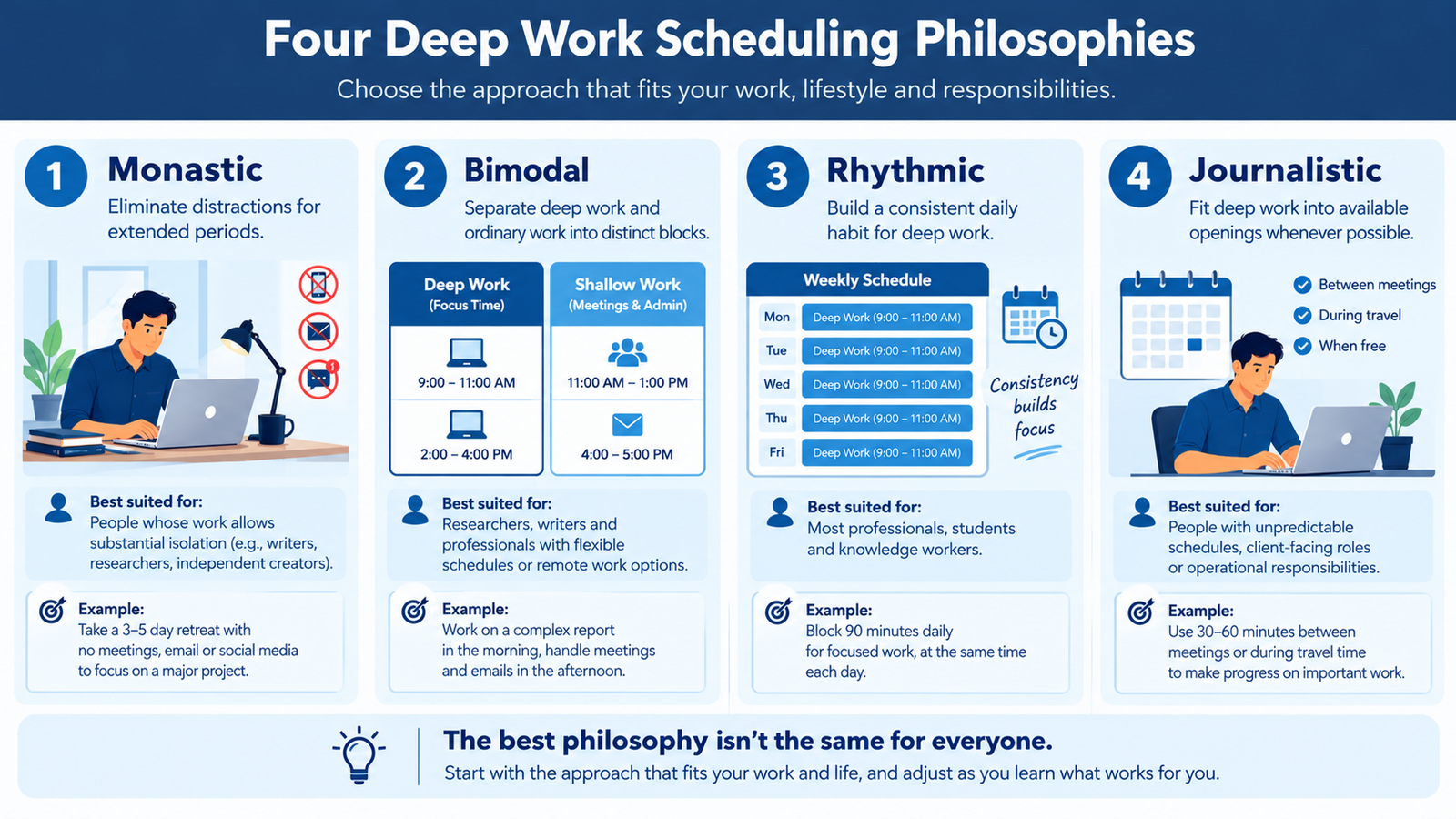
For most professionals, the rhythmic philosophy is a practical starting point.
For example, a project manager could protect 9:00–10:30 a.m. on three mornings each week for project planning, risk analysis, or strategic problem-solving.
The exact timing matters less than the consistency.
However, the plan must account for real responsibilities. Someone handling live operations or emergency escalations may need shorter sessions, delegated coverage, or carefully selected days.
Lesson 5: Embrace Boredom Instead of Escaping It
Think about what happens when you’re standing in a queue or waiting for an elevator.
Do you immediately reach for your phone?
These small moments reveal how accustomed we’ve become to instant stimulation.
Newport argues that constantly giving in to the urge for distraction undermines our ability to tolerate sustained attention.
His recommendation is not simply to take occasional breaks from digital devices. He suggests deliberately scheduling periods when we may use distracting technologies, rather than treating distraction as the default.
How to apply it
Try leaving your phone untouched during short waiting periods.
When working, schedule your next internet break rather than opening distracting websites whenever the urge appears.
Another exercise from the book is productive meditation: while walking or doing another physically undemanding activity, focus on a clearly defined professional problem and repeatedly bring your mind back when it wanders.
This can help turn otherwise unstructured time into an opportunity for concentrated thinking.
Lesson 6: Be Selective About Social Media and Digital Tools
Newport’s third rule, Quit Social Media, is more nuanced than a universal demand to abandon every platform.
His broader argument is that digital tools should be evaluated according to whether they meaningfully support your most important goals.
A tool may offer some benefits without deserving a permanent place in your daily routine.
For example, a marketing professional might rely on social media for customer research and distribution. A software architect may gain relatively little professional value from frequently checking the same feeds.
The decision should depend on the individual’s goals, not simply on whether a platform is popular or occasionally entertaining.
The craftsman approach
Newport encourages a selective approach to technology: identify the activities that matter most, then choose tools based on their contribution to those activities.
Before adopting or continuing a digital habit, ask:
- Does this tool meaningfully support an important professional or personal goal?
- Are its benefits greater than its costs in time and attention?
- Could I achieve most of the same benefit through a less distracting alternative?
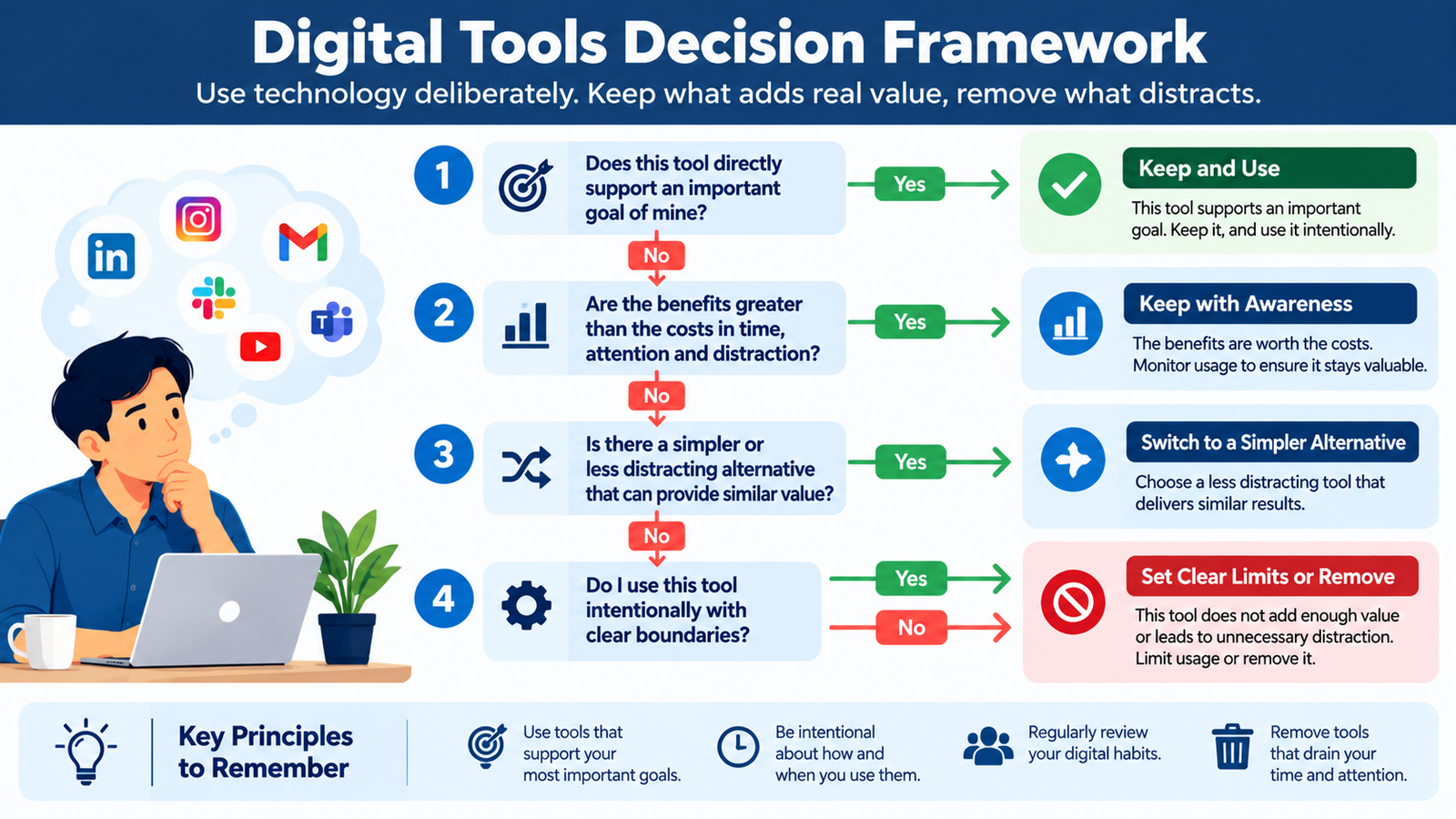
The lesson is not that technology is bad. It is that attention is valuable enough to justify deliberate choices.
Lesson 7: Drain the Shallows Without Neglecting Responsibilities
Shallow work cannot always be eliminated.
Customers still need replies. Teams need coordination. Reports must be submitted. Administrative tasks keep organizations functioning.
Newport’s recommendation is to recognize these demands, measure their impact, and prevent them from expanding indefinitely.
Try a shallow work audit
For three workdays, record how you spend your time.
Classify each activity as deep work, shallow work, or a necessary break.
Then examine the patterns.
Could some meetings become concise written updates? Could routine questions be answered through shared documentation? Could similar administrative tasks be grouped together?
If you manage a team, consider establishing clear communication expectations so colleagues know when immediate responses are required and when asynchronous communication is appropriate.
The objective isn’t to make yourself inaccessible. It is to design a working environment where important thinking and reliable collaboration can coexist.
Lesson 8: Create a Shutdown Ritual to Protect Your Energy
One surprising theme in Deep Work is that rest supports demanding cognitive performance.
Newport argues that professionals benefit from creating a clear boundary between work and leisure.
Without that boundary, unfinished tasks can continue occupying mental space long after the workday ends.
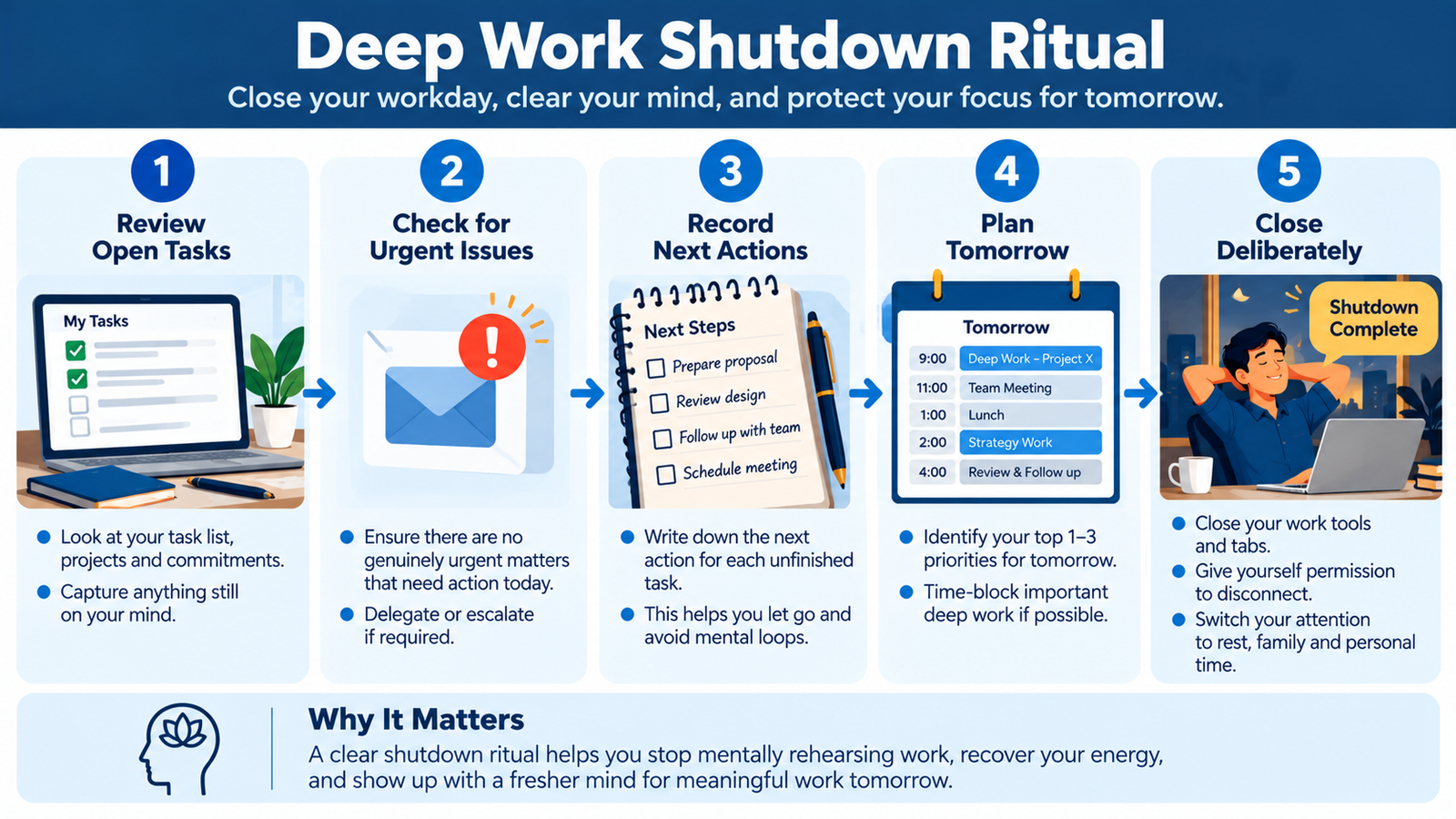
His solution includes a structured shutdown ritual.
A practical five-minute shutdown
At the end of your workday:
- Review outstanding tasks and commitments.
- Check whether anything genuinely urgent remains.
- Record the next action for unfinished work.
- Review tomorrow’s priorities.
- Close your workday deliberately.
Newport describes ending his ritual with the phrase shutdown complete.
The purpose is to give yourself confidence that your responsibilities have been captured and that you can stop mentally rehearsing them.
The Deep Work Formula: What Actually Produces Better Results?
Newport uses a simple relationship to illustrate how high-quality work depends on both time and intensity of focus:
High-Quality Work Produced = Time Spent × Intensity of Focus
This is a conceptual productivity model, not a scientifically validated equation that assigns measurable units to attention.
Its practical message is straightforward.
Spending four distracted hours on a task does not necessarily produce better results than spending two highly focused hours.
But the formula shouldn’t be interpreted as a promise that every task can be completed in half the time. Complex work also depends on skill, resources, collaboration, and the nature of the problem.
A Practical Seven-Day Deep Work Challenge
You don’t need to redesign your entire life overnight. Start with one week of deliberate experimentation.
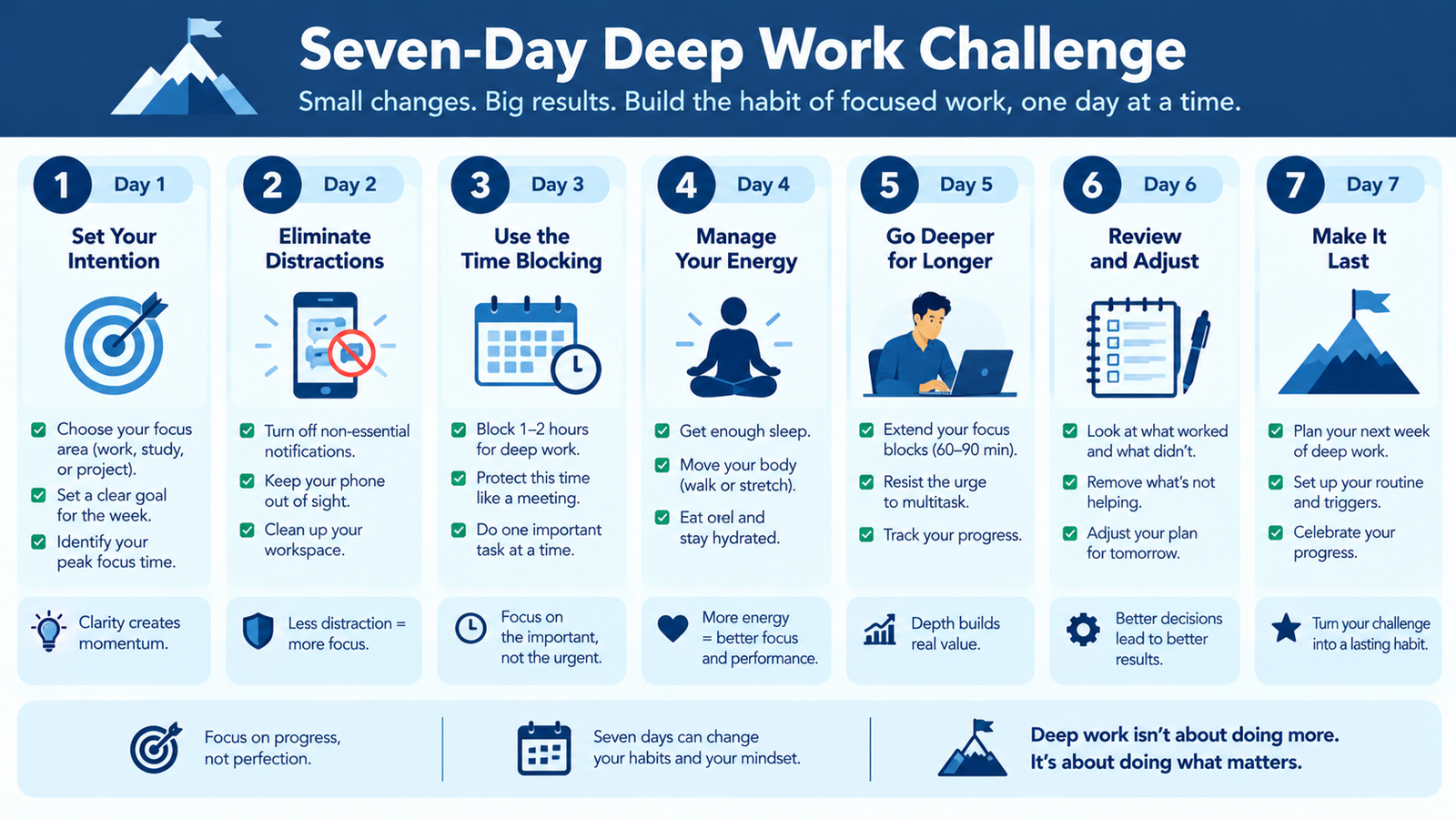
| Day | Action | Desired result |
|---|---|---|
| 1 | Audit your current workday | Identify major distractions |
| 2 | Complete one 30-minute focus session | Establish a baseline |
| 3 | Silence nonessential notifications | Reduce interruptions |
| 4 | Schedule a 60-minute deep work block | Build consistency |
| 5 | Batch routine communication | Reduce task switching |
| 6 | Practice productive meditation | Strengthen deliberate attention |
| 7 | Review results and plan next week | Create a sustainable routine |
Track three things: minutes of focused work completed, meaningful outputs produced, and interruptions experienced.
Avoid measuring success solely by hours. A completed proposal, a resolved technical issue, or a well-understood concept may matter more than the duration of the session.
Common Mistakes When Practicing Deep Work
Mistake 1: Trying to work deeply for eight hours immediately. Start with a realistic block and build capacity gradually.
Mistake 2: Treating every interruption as a failure. Some roles require responsiveness. Build protected time around those responsibilities.
Mistake 3: Confusing isolation with productivity. Collaboration can be essential to solving difficult problems. Deep work and teamwork are complementary rather than mutually exclusive.
Mistake 4: Measuring only time spent. Evaluate the quality and value of what you produce.
Mistake 5: Eliminating useful tools indiscriminately. Assess digital tools against your actual goals and responsibilities.
Deep Work Cheat Sheet
| Concept | Key takeaway | Action |
|---|---|---|
| Deep work | Focus on cognitively demanding tasks | Protect uninterrupted time |
| Attention residue | Switching tasks can impair concentration | Batch communications |
| Rhythmic philosophy | Consistency makes deep work easier to maintain | Use recurring calendar blocks |
| Embrace boredom | Resist automatic distraction | Schedule internet breaks |
| Digital minimalism in practice | Use tools deliberately | Audit attention costs |
| Drain the shallows | Reduce low-value obligations | Review meetings and admin tasks |
| Shutdown ritual | Establish an end to the workday | Capture open tasks and disconnect |
Who Should Read Deep Work?
This book is especially valuable for knowledge workers, managers, entrepreneurs, writers, developers, students, researchers, and anyone whose professional success depends on learning difficult things or producing thoughtful work.
Its strongest contribution is that it turns concentration from a vague personal ambition into a professional practice that can be scheduled, protected, and improved.
However, not everyone has the autonomy to control their calendar. Customer-facing employees, caregivers, operational leaders, and workers with tightly structured schedules may find some recommendations difficult to implement without organizational support.
The book is also more concerned with cognitively demanding knowledge work than with other forms of valuable labor. Its distinction between deep and shallow work should not become a judgment about the importance of different professions.
For readers interested in exploring the complete framework, the official publisher’s page for Deep Work provides additional information about the book.
My Takeaways: What Deep Work Gets Right—and What It Misses
The most useful idea in this book is that attention deserves the same deliberate management as time.
We often plan what we intend to do without planning the conditions required to do it well.
A calendar filled with tasks may look organized, but if every task is surrounded by interruptions, the schedule doesn’t necessarily protect meaningful progress.
Newport offers a compelling alternative: decide which work deserves your best thinking, then structure your environment accordingly.
There is also an important leadership lesson here.
If a manager expects employees to respond instantly to every message while simultaneously demanding innovative thinking and high-quality results, the organization may be creating the very conditions that undermine those outcomes.
Focus is partly an individual skill, but it is also influenced by team norms, meeting culture, staffing, and leadership expectations.
That is one area where the book’s advice benefits from additional organizational thinking.
Another limitation is that not every valuable professional outcome comes from solitary concentration. Some breakthroughs emerge through conversation, collaboration, experimentation, and feedback.
A balanced approach makes room for both.
The goal isn’t to eliminate shallow work or maximize isolation. It’s to make sure the demands of everyday work don’t crowd out the thinking that moves your goals forward.
Final Takeaway
Deep Work challenges a familiar assumption: that being constantly connected, responsive, and busy makes us more effective.
Sometimes, the opposite is true.
Your most important contribution may come from the hour when you stop responding to everything around you and give one difficult problem your full attention.
You don’t need a perfect schedule, a distraction-free life, or four uninterrupted hours every morning to begin.
Start with one important task. Protect a realistic block of time. Work with deliberate attention. Repeat.
Because the real question isn’t how much you can fit into your day.
It’s how much meaningful work you can accomplish with the attention you have.
Frequently Asked Questions About Deep Work
What is the main message of Deep Work?
The main message is that sustained, distraction-free concentration is a valuable professional skill that helps people learn difficult things and produce high-quality work.
What are the four rules of Deep Work?
Cal Newport’s four rules are Work Deeply, Embrace Boredom, Quit Social Media, and Drain the Shallows.
How many hours of deep work should I do daily?
There is no universal requirement. Newport discusses the limits of sustained concentration, but the appropriate amount depends on your experience, responsibilities, and type of work. Beginners can start with 30–60 minutes and increase gradually.
Is Deep Work worth reading?
Yes, particularly if your work involves writing, analysis, problem-solving, learning, or creative thinking. The full book provides additional stories, explanations, and techniques beyond a summary.
What is the difference between Deep Work and Atomic Habits?
Deep Work focuses on protecting concentration for demanding tasks. Atomic Habits focuses on understanding and changing behavior through small, repeated actions. Together, they offer complementary approaches to building a consistent focus practice.
Can managers practice deep work?
Yes, but they often need to coordinate availability, delegate appropriate decisions, establish escalation channels, and protect limited periods for strategic thinking.
Does Deep Work recommend quitting social media completely?
Not necessarily. Newport advocates carefully evaluating whether particular digital tools support your important goals enough to justify their costs.