
Imagine two people earning exactly the same salary.
Both have similar jobs, similar responsibilities, and similar opportunities.
The first person enjoys a comfortable lifestyle. Every salary increase brings a better car, a more expensive phone, more shopping, and more dining out.
The second person also enjoys life but follows a different approach. Every month, they save a portion of their income, avoid unnecessary expenses, and invest carefully.
Twenty years later, their financial situations could look completely different.
One may still depend entirely on their next paycheck. The other may have accumulated meaningful savings and investments.
What made the difference?
Not necessarily how much they earned, but what they did with the money they received.
This is the central message of The Richest Man in Babylon by George S. Clason.
First published in book form in 1926, this personal finance classic teaches timeless principles of saving, investing, managing expenses, avoiding debt, and building wealth through stories set in ancient Babylon.
In this The Richest Man in Babylon Summary, we’ll explore 10 powerful financial lessons, the Seven Cures for a Lean Purse, the Five Laws of Gold, and practical ways to apply these ideas to modern life.
Whether you’re beginning your career, managing a family, running a business, or preparing for retirement, these lessons can help you make more intentional financial decisions.
The Richest Man in Babylon in 60 Seconds
| Book details | Information |
|---|---|
| Book | The Richest Man in Babylon |
| Author | George S. Clason |
| Originally published | 1926 |
| Genre | Personal Finance, Wealth Building, Self-Improvement |
| Main theme | Building wealth through disciplined saving, wise investing, and financial responsibility |
| Key frameworks | Seven Cures for a Lean Purse and Five Laws of Gold |
| Best for | Students, professionals, entrepreneurs, and personal finance beginners |
| Biggest takeaway | Save a portion of everything you earn and make your money work for you |
The book’s central message: Financial security is not determined by income alone. It depends on how consistently you save, manage expenses, invest, and protect your money.
Here are five principles worth remembering:
- Keep at least 10% of your earnings.
- Control expenses instead of allowing your lifestyle to consume every salary increase.
- Put your savings to productive use.
- Protect your wealth from unnecessary risks and poor decisions.
- Keep improving your ability to earn.
The ideas are straightforward. The challenge is practicing them consistently.
What Is The Richest Man in Babylon About?
The Richest Man in Babylon is a collection of fictional stories set in ancient Babylon, one of history’s great commercial centers.
Rather than explaining financial management through complicated formulas, George S. Clason uses characters such as merchants, craftsmen, lenders, and ordinary workers to illustrate how people earn, spend, save, lose, and accumulate money.
One of the most important characters is Arkad, a wealthy Babylonian who shares the principles behind his financial success.
Arkad begins with a simple observation: many people work hard throughout their lives but never accumulate meaningful wealth.
Why?
Because earning money and keeping money are two different skills.
Someone earning ₹2 lakh per month can struggle financially if they spend ₹2.1 lakh.
Meanwhile, someone earning ₹60,000 per month may gradually build financial security if they consistently spend less than they earn and invest the difference.
The book challenges readers to think beyond their next paycheck.
Instead of asking only, “How can I earn more money?” it encourages another question:
“How can I make the money I earn improve my future?”
Who Was George S. Clason?
George Samuel Clason was an American writer and businessman best known for his financial education pamphlets published during the 1920s.
His stories used the setting of ancient Babylon to make personal finance principles understandable and memorable.
These pamphlets were eventually collected into The Richest Man in Babylon.
Although the characters are fictional, their financial problems remain recognizable.
People still struggle with unnecessary spending, debt, risky investments, delayed savings, and the belief that a higher income will automatically solve their financial problems.
That is one reason the book continues to attract readers nearly a century after publication.
10 Powerful Lessons from The Richest Man in Babylon Summary
The following lessons combine Clason’s original principles with practical modern applications.
1. Pay Yourself First: Save at Least 10% of Everything You Earn
Imagine receiving your salary on the first day of the month.
You pay your rent.
You pay your electricity bill.
You pay your credit card.
You buy groceries.
You pay for subscriptions, entertainment, transportation, and other expenses.
At the end of the month, you check your bank balance.
Almost nothing remains.
You worked an entire month, but none of that income has been set aside for your future.
This is the first financial habit Arkad wants readers to change.
His advice is simple: retain at least one-tenth of everything you earn.
The important idea is to save before spending, rather than hoping money will remain afterward.
Practical example
Suppose your monthly take-home salary is ₹80,000.
| Allocation | Amount |
|---|---|
| Monthly income | ₹80,000 |
| Savings and investments (10%) | ₹8,000 |
| Available for living expenses (90%) | ₹72,000 |
| Savings after 12 months | ₹96,000 |
| Savings after 10 years | ₹9,60,000 |
These savings figures exclude investment returns, inflation, taxes, and income changes.
Even without investment growth, consistently setting aside ₹8,000 per month would accumulate ₹9.6 lakh over ten years.
The most valuable part of this habit is not the amount.
It is the discipline.
How to apply this lesson
Arrange an automatic transfer to a separate savings account immediately after receiving your salary.
Treat that transfer as a regular financial commitment.
If saving 10% is unrealistic because of essential expenses or high-interest debt, start with an amount you can sustain and increase it as your circumstances improve.

Key takeaway: Don’t save what is left after spending. Make saving part of your financial plan from the beginning.
2. Control Your Expenses: Don’t Let Your Lifestyle Grow Faster Than Your Income
Have you ever noticed how quickly a salary increase can disappear?
You receive a promotion.
Your income increases by ₹20,000 per month.
Initially, you feel financially comfortable.
Then you upgrade your phone, increase your shopping budget, subscribe to additional services, and begin spending more on entertainment.
Within a few months, your expenses have increased by almost the same amount as your salary.
You’re earning more but saving almost nothing extra.
This is lifestyle inflation.
Clason teaches that people must distinguish between necessary expenses and desires.
The challenge is that our desires tend to expand as our purchasing power increases.
A better income can improve your life, but it doesn’t require every expense to increase.
Practical example
Imagine receiving a ₹15,000 monthly salary increase.
Instead of spending the entire amount, you decide to:
- Save or invest an additional ₹10,000.
- Use ₹5,000 for lifestyle improvements.
You enjoy the benefits of your promotion while strengthening your financial future.
Over one year, that additional ₹10,000 monthly allocation becomes ₹1.2 lakh before any investment returns.
How to apply this lesson
Review your expenses from the previous 30 days.
Separate them into essential expenses, meaningful discretionary spending, and expenses that provide little value.
Look for recurring costs that can be reduced without significantly affecting your quality of life.
Key takeaway: Wealth grows more easily when your expenses increase more slowly than your income.
3. Make Your Money Multiply: Put Your Savings to Work
Saving money is the beginning of financial progress.
But saving alone may not be sufficient for long-term wealth creation.
Imagine keeping ₹5 lakh in a cupboard for 20 years.
The amount remains ₹5 lakh.
However, inflation gradually reduces its purchasing power.
Now imagine investing money in suitable assets that may generate returns over time.
Those returns can potentially create additional returns when reinvested.
This is the principle of compound growth.
Clason illustrates the idea through money producing more money.
Practical example
Suppose you invest ₹5,000 every month for 20 years.
Your total contributions would be:
₹5,000 × 12 × 20 = ₹12,00,000.
At a hypothetical 8% annual return, compounded monthly, the accumulated amount could be approximately ₹29.5 lakh.
That is considerably more than the amount contributed.
However, this is an illustration, not a prediction. Real investment returns fluctuate, and losses are possible. Taxes, costs, and inflation also affect the outcome.
How to apply this lesson
Before investing, understand your financial goals, risk tolerance, and time horizon.
Build suitable emergency savings and evaluate expensive debt.
Then consider diversified investments that match your circumstances.
For an introduction to investment risk and diversification, the U.S. Securities and Exchange Commission’s investor education resources provide useful guidance.

Key takeaway: Saving gives your money a purpose. Sensible investing gives it the opportunity to grow.
4. Guard Your Wealth Against Loss: Protect What You’ve Worked Hard to Build
Imagine spending five years accumulating ₹5 lakh.
Then someone approaches you with an exciting investment opportunity.
They promise to double your money within three months.
They claim the investment is completely safe.
They tell you that successful investors are already making enormous profits.
You feel tempted.
After all, doubling ₹5 lakh sounds much more attractive than waiting years for gradual growth.
But what happens if the opportunity is fraudulent or much riskier than advertised?
You could lose years of savings.
Clason repeatedly warns readers against investing money in ventures they do not understand or trusting people who lack the relevant expertise.
His advice is especially valuable in a world of speculative investment schemes, misleading social media promotions, and unrealistic profit promises.
How to apply this lesson
Before investing, ask yourself:
- How does this investment generate returns?
- What could cause me to lose money?
- Do I understand the underlying business or asset?
- Is the person providing advice knowledgeable and trustworthy?
- Is the promised return realistic?
- Can I afford the potential loss?
Be especially cautious when someone guarantees unusually high returns with little or no risk.
Key takeaway: Protecting your money is just as important as earning and growing it.
5. Make Your Home a Beneficial Investment: Choose Housing Wisely
Clason encourages readers to make their dwelling a beneficial investment.
In the book’s context, homeownership represents stability, independence, and a way to improve one’s living conditions.
But this principle requires careful interpretation today.
Buying a house is not automatically better than renting.
A home may provide security and long-term value, but it also involves financial commitments.
These can include mortgage interest, maintenance, insurance, taxes, and transaction costs.
Practical example
Consider two professionals.
The first expects to remain in the same city for 20 years and has sufficient savings for a down payment without exhausting emergency reserves.
The second expects to relocate frequently and would need to stretch their finances considerably to purchase a home.
Buying may be suitable for the first person.
Renting may offer greater flexibility and financial stability for the second.
Neither decision is automatically correct.
How to apply this lesson
Before buying property, compare the complete costs of renting and owning.
Consider your career plans, family needs, affordability, loan terms, and alternative uses for your savings.
Key takeaway: A home should support your financial well-being, not become a burden that prevents you from building it.
6. Ensure a Future Income: Prepare for the Years Ahead
There may come a time when you no longer want to work full-time.
Or perhaps unexpected circumstances will temporarily reduce your earning ability.
What happens to your lifestyle and family responsibilities when regular income stops?
Clason encourages readers to prepare for the future while they still have the capacity to earn.
Today, this principle applies to retirement planning, emergency funds, appropriate insurance, and long-term financial security.
Practical example
Imagine two professionals planning to retire at age 60.
One begins investing for retirement at 30.
The other begins at 50.
Even if both invest in similar assets, the person who starts later generally needs to contribute much more each month to pursue the same target.
Time is valuable because it allows savings and potential investment returns to accumulate over longer periods.
How to apply this lesson
Estimate your retirement needs and review your current savings.
Maintain appropriate emergency reserves.
Evaluate insurance coverage based on your responsibilities and dependents.
Review your long-term financial plan periodically as your circumstances change.
Key takeaway: Financial security becomes easier to pursue when you prepare before the money is needed.
7. Increase Your Ability to Earn: Invest in Yourself
One of the book’s most valuable lessons is that improving your earning ability can be as important as managing existing income.
Clason encourages readers to become more capable, knowledgeable, and valuable in their work.
This idea is especially relevant in today’s rapidly changing professional environment.
Practical example
Imagine two professionals beginning their careers at similar salaries.
One relies entirely on existing knowledge.
The other continually improves technical skills, communication, leadership, business understanding, and problem-solving ability.
Over time, the second professional may become eligible for more demanding and better-paying opportunities.
Of course, skill development does not guarantee higher earnings. Market conditions, industry demand, and access to opportunities also matter.
But developing useful skills can increase your options.
How to apply this lesson
Identify one skill that could improve your professional value.
Create a 90-day learning plan.
Apply the skill through practical work rather than relying only on courses.
Track your progress and seek feedback.
Key takeaway: Your knowledge, skills, and ability to create value are important financial assets.
8. Follow the Five Laws of Gold: Understand How Wealth Is Built and Protected
One of the most memorable sections of The Richest Man in Babylon introduces the Five Laws of Gold.
These laws explain how money can be accumulated, put to productive use, and protected from poor decisions.
They emphasize saving, knowledgeable investing, and avoiding unrealistic opportunities.
The laws also highlight an important distinction.
Building wealth and protecting wealth are different skills.
Someone may earn substantial money through a successful business or career but lose it through reckless investments.
The Five Laws remind readers that financial progress depends on both growth and preservation.
We’ll explore the complete framework later in this article.
9. Escape Debt Through Discipline and a Clear Repayment Plan
Debt can become a major obstacle to financial security.
When a large portion of your monthly income goes toward repayments and interest, less money remains available for saving and investing.
Clason explores this problem through the story of Dabasir, a man who learns to repay his debts while rebuilding his financial position.
His approach involves allocating income among essential living expenses, savings, and debt repayment.
The deeper lesson is that debt becomes more manageable when repayment follows a deliberate plan.
Practical example
Suppose someone has three outstanding debts:
| Debt | Balance | Annual interest rate |
|---|---|---|
| Credit card | ₹80,000 | 36% |
| Personal loan | ₹2,00,000 | 15% |
| Education loan | ₹3,00,000 | 9% |
All else being equal, prioritizing the highest-interest debt can reduce total interest costs.
This is commonly called the debt avalanche method.
Another approach, the debt snowball method, prioritizes smaller balances to build motivation.
Both approaches require making necessary payments and avoiding additional unaffordable borrowing.
How to apply this lesson
List every outstanding debt, including the balance, interest rate, minimum payment, and repayment deadline.
Create a realistic budget and choose a repayment approach you can sustain.
If you’re struggling to meet essential expenses or minimum payments, seek qualified debt guidance rather than following a rigid savings percentage.
Key takeaway: Debt repayment should be planned, measured, and consistent.
10. Create Your Own Luck Through Preparation and Action
Many people believe financial success depends primarily on luck.
They wait for the perfect business opportunity, investment, promotion, or salary increase.
Clason offers a different perspective.
He associates good fortune with preparation, initiative, and the willingness to act when reasonable opportunities arise.
Practical example
Imagine a professional who wants to become a manager.
They spend years waiting for someone to offer them a leadership position.
Another professional actively develops leadership skills, takes responsibility for difficult assignments, mentors colleagues, and builds professional relationships.
When a management opportunity becomes available, the second professional may be better prepared.
This doesn’t mean hard work guarantees success.
Economic conditions, timing, relationships, and circumstances still matter.
But preparation can improve your ability to recognize and pursue opportunities.
How to apply this lesson
Think about one financial or career opportunity you have been postponing.
Perhaps you want to begin saving, learn investing fundamentals, negotiate a salary, improve a professional skill, or launch a small business.
Identify one manageable action you can take this week.
Key takeaway: Preparation and action can improve your chances of benefiting from opportunities.
The Seven Cures for a Lean Purse Explained
The Seven Cures for a Lean Purse are among the most important teachings in The Richest Man in Babylon.
They provide a practical foundation for building financial stability.
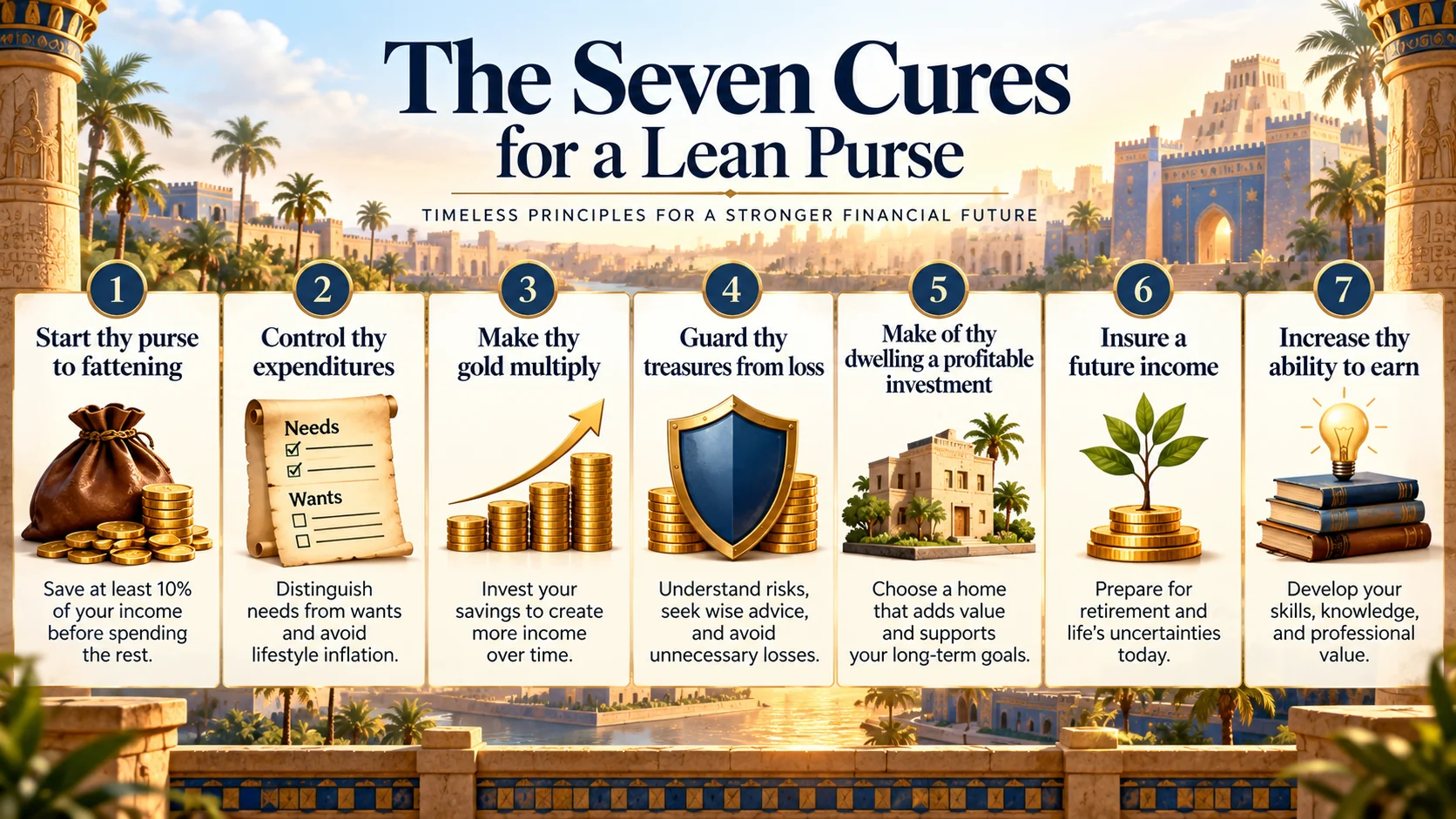
| Cure | Clason’s principle | Modern application |
|---|---|---|
| 1 | Start thy purse to fattening | Save a portion of your earnings |
| 2 | Control thy expenditures | Budget and manage lifestyle inflation |
| 3 | Make thy gold multiply | Invest savings productively |
| 4 | Guard thy treasures from loss | Understand risk and protect capital |
| 5 | Make of thy dwelling a profitable investment | Make informed housing decisions |
| 6 | Insure a future income | Prepare for retirement and financial uncertainty |
| 7 | Increase thy ability to earn | Continuously develop valuable skills |
What makes this framework useful is the sequence.
First, you learn to keep money.
Then you control spending.
Next, you put accumulated savings to productive use.
You protect your wealth, plan for major financial needs, prepare for the future, and improve your earning ability.
These principles reinforce one another.
However, they should be adapted to individual circumstances rather than treated as a complete modern financial plan.
The Five Laws of Gold: How to Build and Protect Wealth
The Five Laws of Gold focus on what happens after you begin accumulating savings.
They encourage disciplined saving and productive investing while warning against poor advice, unfamiliar ventures, and unrealistic promises.
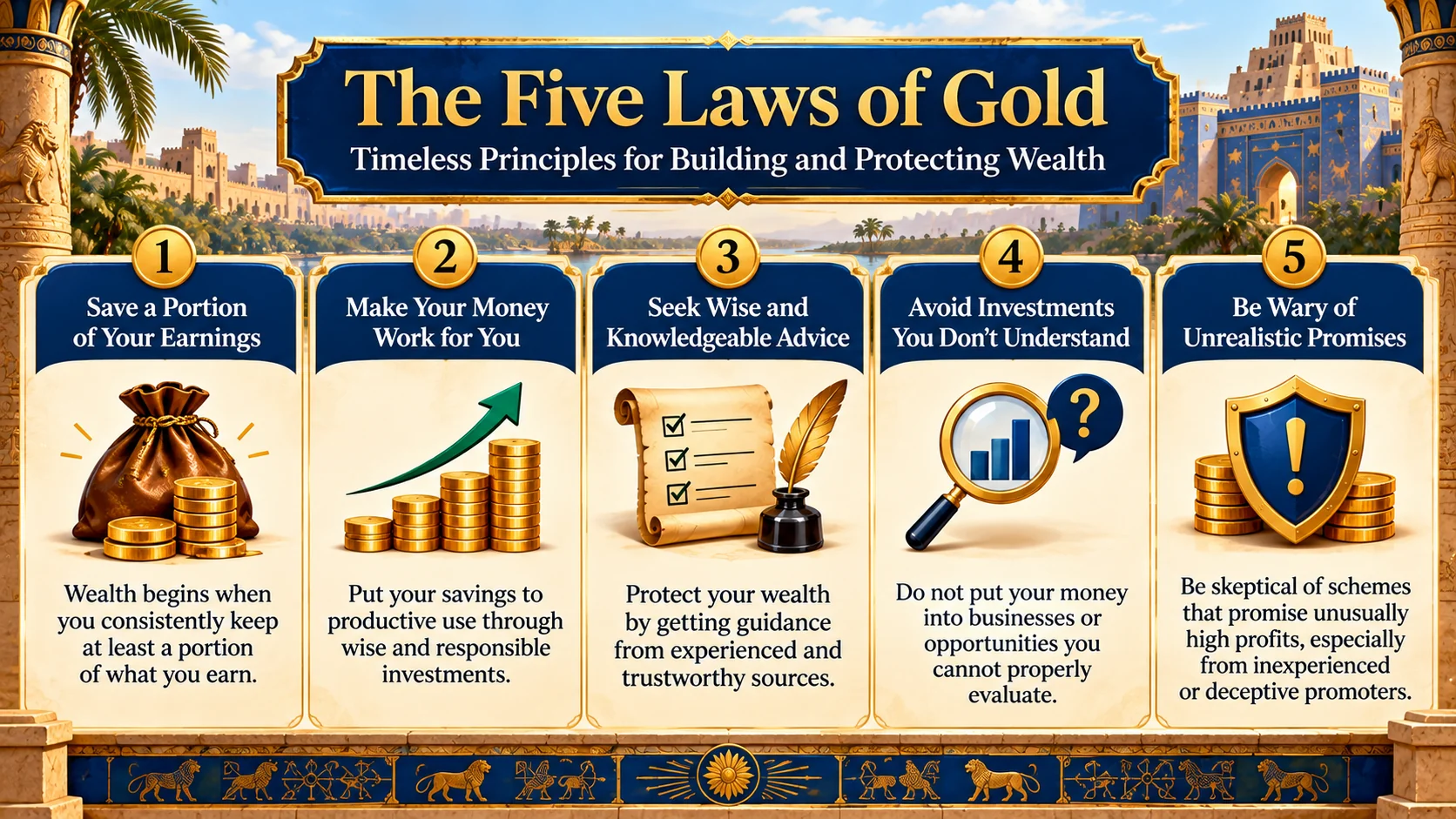
Law 1: Gold Comes to Those Who Save Consistently
The first law emphasizes setting aside a meaningful portion of earnings.
In the book, one-tenth is the recommended starting point.
Modern lesson: Make saving a regular commitment rather than an occasional activity.
Law 2: Gold Works for Those Who Invest Wisely
Money that is saved can potentially generate additional income when invested productively.
Modern lesson: Understand appropriate investments and allow time for potential long-term growth.
Law 3: Gold Remains With Those Who Seek Knowledgeable Advice
Clason warns against making financial decisions without relevant expertise.
Modern lesson: Research investments carefully and seek advice from qualified, trustworthy professionals when appropriate.
Law 4: Gold Slips Away From Unfamiliar Investments
Investing in something you do not understand can expose your savings to unnecessary risks.
Modern lesson: Understand the investment, its costs, liquidity, and potential losses before committing money.
Law 5: Gold Flees Unrealistic Promises
Offers of extraordinary profits with little apparent risk should raise concerns.
Modern lesson: Avoid speculative schemes, misleading guarantees, and promoters whose claims cannot be independently verified.
Together, these laws offer a valuable reminder:
It takes discipline to accumulate wealth, but it also takes judgment to keep it.
Common Financial Mistakes the Book Helps You Avoid
Understanding financial principles is one thing.
Applying them correctly is another.
Here are six common mistakes worth avoiding.
Mistake 1: Saving Only What Remains
If you wait until the end of the month to save, discretionary spending may consume everything.
A better approach is to establish savings as a planned budget item.
Mistake 2: Assuming a Higher Salary Automatically Creates Wealth
A salary increase improves your earning capacity.
But if expenses increase at the same rate, your financial position may not improve significantly.
Mistake 3: Treating Every Investment as an Opportunity
Not every investment is suitable.
An opportunity that appears profitable may carry substantial risk, high costs, or limited liquidity.
Mistake 4: Believing Homeownership Is Always Better Than Renting
Buying a home can provide stability, but affordability and flexibility matter.
The best decision depends on your circumstances.
Mistake 5: Ignoring High-Interest Debt
Expensive debt can weaken financial progress.
Review interest costs and repayment priorities before pursuing additional investment risk.
Mistake 6: Believing Financial Discipline Alone Guarantees Success
Financial habits matter, but outcomes are also influenced by income, health, family responsibilities, economic conditions, and access to opportunities.
The most useful approach is to improve what you can control while recognizing the constraints you face.
The 30-Day Babylon Wealth Challenge
Reading about financial discipline can change how you think.
Practicing it can change how you behave.
This 30-day challenge translates the book’s principles into a manageable action plan.

Week 1: Understand Your Money
Your first goal is financial clarity.
- Calculate your monthly take-home income.
- Review your previous 30 days of spending.
- List your debts, savings, and assets.
- Identify three unnecessary expenses you could reduce.
At the end of the week, you should have a clearer understanding of where your money goes.
Week 2: Build Your Savings Habit
Your second goal is consistency.
- Choose a sustainable savings percentage.
- Create a separate savings account or savings goal.
- Automate a transfer after payday.
- Set an initial emergency fund target.
The purpose is to make saving a regular part of your financial routine.
Week 3: Protect and Grow Your Money
Your third goal is financial awareness.
- Review interest rates on outstanding debts.
- Learn the basics of investment risk and diversification.
- Check whether existing investments align with your goals.
- Review insurance coverage and emergency reserves.
Avoid rushing into investments before understanding their risks.
Week 4: Plan Your Financial Future
Your final goal is long-term direction.
- Define one short-term financial goal.
- Define one long-term wealth-building goal.
- Identify one skill that could improve your earning capacity.
- Schedule a monthly financial review.
By the end of the challenge, you may not be significantly wealthier.
But you should have greater clarity, stronger habits, and a practical system for making better financial decisions.
The Richest Man in Babylon Cheat Sheet
Here is a quick reference guide to the book’s most useful lessons.
| Financial challenge | Lesson to apply | First action |
|---|---|---|
| Nothing remains after payday | Pay yourself first | Automate savings |
| Expenses increase with income | Control spending | Review monthly expenses |
| Savings are not growing | Make money multiply | Learn investment fundamentals |
| Fear of losing money | Guard your wealth | Understand investment risks |
| Confusion about buying property | Evaluate housing carefully | Compare renting and buying |
| Uncertainty about retirement | Ensure future income | Review retirement planning |
| Limited career growth | Improve earning ability | Develop a valuable skill |
| High-interest debt | Create a repayment plan | List and prioritize debts |
| Too many investment offers | Follow the Five Laws of Gold | Research before investing |
| Waiting for opportunities | Prepare and act | Take one meaningful step |
Is The Richest Man in Babylon Still Relevant Today?
Yes, particularly for readers who want to improve their financial habits.
The book’s core principles remain useful because people still face the same basic financial decisions.
How much should I spend?
How much should I save?
What should I do with my savings?
How can I protect my family?
How can I prepare for retirement?
However, modern financial life is more complex than the world described in Clason’s stories.
Today, investors must consider inflation, taxes, asset allocation, investment regulations, retirement products, insurance, and digital financial risks.
The book does not provide detailed guidance on all these topics.
For example, its advice to save 10% is useful as a behavioral starting point, but the appropriate savings rate varies depending on income, age, obligations, and financial goals.
Similarly, its encouragement to invest must be supported by an understanding of diversification and risk.
The SEC’s guide to asset allocation and diversification offers additional information about modern investment considerations.
The best way to approach the book is to treat it as a foundation for financial thinking rather than a complete financial planning manual.
Strengths and Limitations of The Richest Man in Babylon
What the Book Does Well
1. Makes personal finance easy to understand
The book avoids complicated financial terminology and teaches through memorable stories.
2. Encourages financial discipline
Its repeated emphasis on saving and controlling expenses helps readers recognize the importance of consistent habits.
3. Promotes long-term thinking
Instead of encouraging quick profits, it focuses on gradual accumulation and protecting wealth.
4. Warns against financial mistakes
The lessons about risky investments and unrealistic promises remain particularly relevant.
5. Appeals to readers at different career stages
Students, professionals, entrepreneurs, and people approaching retirement can all find useful principles.
Where the Book Falls Short
1. Limited modern investment guidance
The book does not explain contemporary investment products, portfolio construction, or tax planning in detail.
2. Some advice is overly generalized
A fixed savings percentage may not suit every financial situation.
3. Homeownership advice requires context
Owning a home is not automatically the best financial choice.
4. Limited discussion of structural barriers
The stories place considerable emphasis on personal responsibility while giving less attention to circumstances such as low wages, economic inequality, and limited financial opportunity.
5. Several ideas are repeated
The repetition reinforces the lessons but may feel unnecessary to experienced readers.
Despite these limitations, the book remains a valuable introduction to personal finance.
Who Should Read The Richest Man in Babylon?
This book is especially useful for people who want to develop better financial habits.
Students and young professionals can learn the importance of saving early and avoiding unnecessary lifestyle inflation.
Mid-career professionals may benefit from its reminders about financial discipline, particularly when rising income has not translated into meaningful savings.
Entrepreneurs can appreciate its emphasis on protecting capital and making thoughtful financial decisions.
People struggling with spending habits may find the stories helpful for understanding why earning more does not automatically solve money problems.
Readers new to investing can develop a basic financial mindset before exploring more advanced resources.
Experienced investors looking for detailed investment analysis, tax strategies, or portfolio optimization will probably need additional books.
My Take: The Real Lesson Is Financial Independence, Not Becoming Rich
The most interesting lesson in The Richest Man in Babylon is not about gold, property, or investment returns.
It is about the relationship between money and personal freedom.
Many people assume financial security begins when they earn a sufficiently high salary.
But earning more does not automatically create security.
A person earning ₹3 lakh per month and spending ₹3.2 lakh may face greater financial pressure than someone earning ₹1 lakh and consistently living within their means.
Income matters enormously, but spending decisions and accumulated assets matter too.
At the same time, it would be unrealistic to suggest that every financial problem can be solved through discipline alone.
Someone struggling to afford essential expenses may need income stability and immediate financial support before focusing on long-term investing.
The principles work best when adapted to real circumstances.
What I find most valuable about Clason’s approach is the shift in perspective.
Instead of viewing money only as something to spend, he encourages readers to see it as something that can create future options.
Savings can provide breathing room during difficult periods.
Investments may help support long-term goals.
Reduced debt can create flexibility.
Improved skills can open new opportunities.
Ultimately, financial freedom is not simply about having a large bank balance.
It is about having greater control over your choices.
Final Thoughts: Small Financial Habits Can Create Lasting Change
You don’t need to become a financial expert overnight.
You don’t need to understand every investment product or predict what markets will do next.
You can begin with a few simple decisions.
Understand where your money goes.
Save a portion of your earnings when possible.
Control unnecessary expenses.
Learn before investing.
Protect yourself from avoidable financial risks.
Keep improving your ability to earn.
These are the principles that make The Richest Man in Babylon worth reading.
The stories may be set in an ancient civilization, but the financial challenges remain familiar.
This The Richest Man in Babylon Summary ultimately comes down to one idea:
Build a financial system in which part of today’s earnings consistently supports tomorrow’s freedom.
Start with what you can afford.
Make progress gradually.
And remember that financial security is usually built through repeated decisions rather than one extraordinary opportunity.
Frequently Asked Questions About The Richest Man in Babylon
1. What is the main message of The Richest Man in Babylon?
The main message is that financial security comes from consistently saving part of your income, controlling expenses, investing wisely, protecting wealth, and improving your earning ability.
2. What is the 10% rule in The Richest Man in Babylon?
The 10% rule recommends saving at least one-tenth of your earnings before spending the remainder. It is a useful starting principle, although individual savings targets depend on personal financial circumstances.
3. What are the Seven Cures for a Lean Purse?
The Seven Cures are saving regularly, controlling expenses, investing productively, protecting capital, making housing beneficial, preparing for future income needs, and increasing earning ability.
4. What are the Five Laws of Gold?
The Five Laws of Gold emphasize accumulating savings, investing productively, seeking knowledgeable advice, avoiding unfamiliar investments, and rejecting unrealistic profit promises.
5. Is The Richest Man in Babylon based on a true story?
No. The book uses fictional parables set in ancient Babylon to communicate financial principles. Its characters are literary teaching devices rather than documented historical individuals.
6. Is The Richest Man in Babylon worth reading in 2026?
Yes. Its lessons about saving, spending, debt, and financial responsibility remain useful. However, readers should supplement the book with current information about modern investments, taxes, insurance, and financial planning.
7. How long does it take to read The Richest Man in Babylon?
Depending on the edition and reading speed, many readers can finish the book in approximately three to five hours.
8. Can The Richest Man in Babylon make you rich?
No book can guarantee wealth. Its principles may help improve financial habits, but financial outcomes depend on income, expenses, investment performance, economic conditions, and individual circumstances.
9. What is the most important lesson from The Richest Man in Babylon?
One of its most important lessons is to save a portion of everything you earn before allocating the rest to expenses. This habit creates a foundation for building financial security.
10. Is The Richest Man in Babylon suitable for beginners?
Yes. Its simple language, storytelling approach, and practical financial principles make it especially accessible to people beginning their personal finance journey.
Disclaimer: This article is for general educational purposes and does not constitute personalized financial, investment, tax, or legal advice.