Imagine walking into your office tomorrow and discovering that everything you rely on has changed.
Your company has introduced artificial intelligence into your department. Your responsibilities are different. The skills that made you successful yesterday are no longer enough.
What would you do?
Would you complain, resist, and hope everything returns to normal? Or would you accept the situation, learn new skills, and start looking for opportunities?
Most of us know which answer sounds better. But when change actually happens, responding positively isn’t always easy.
We become attached to familiar routines, comfortable jobs, predictable relationships, and the way things have always worked.
Even when we know something needs to change, taking that first step can feel frightening.
That is the central message of Who Moved My Cheese? by Spencer Johnson.
In this Who Moved My Cheese Summary, we’ll explore a surprisingly powerful story about four characters searching for cheese, seven important lessons about handling change, and practical ways to apply those lessons to your career, leadership, business, and personal life.
We’ll also explore something the book doesn’t fully address: When should you adapt to change, and when should you challenge it?
Who Moved My Cheese in 60 Seconds
Book: Who Moved My Cheese? An A-Mazing Way to Deal with Change in Your Work and in Your Life
Author: Spencer Johnson
First published: 1998
Genre: Personal Development, Leadership, Change Management
Main idea: Change is inevitable. The sooner we recognize it, overcome unnecessary fear, and respond constructively, the better prepared we become to move forward.
The four characters: Sniff, Scurry, Hem, and Haw.
The cheese: Something we value, such as success, money, security, relationships, recognition, or happiness.
The maze: The environment where we search for what we want, such as our workplace, business, or personal life.
The conflict: The cheese disappears, and each character responds differently.
The biggest lesson: Holding on to yesterday’s circumstances can prevent us from discovering tomorrow’s opportunities.
Best for: Professionals experiencing career transitions, managers leading change, entrepreneurs facing uncertainty, and anyone struggling to leave their comfort zone.
Our verdict: A short, memorable introduction to adapting to change, especially useful when its lessons are combined with critical thinking and practical action.
What Is Who Moved My Cheese About?
Who Moved My Cheese? was first published in 1998.
Its author, Spencer Johnson, was also known for coauthoring The One Minute Manager with Kenneth Blanchard.
Rather than explaining change through complicated psychological theories or management frameworks, Johnson tells a simple story.
Four characters live in a maze and spend their days searching for cheese.
The cheese represents whatever makes their lives feel successful, secure, or satisfying.
Eventually, they discover a large supply of cheese at Cheese Station C.
Life becomes comfortable.
They know where to find what they need. Their routines become predictable. There seems to be little reason to explore the maze.
But then something unexpected happens.
The cheese disappears.
What follows reveals how differently people respond when their familiar world changes.
Some recognize the situation and move forward.
Others resist, complain, and hope the past will return.
The story may sound simple, but it raises an important question:
Are we making decisions based on the world as it exists today, or the world we wish still existed?
Meet the Four Characters in Who Moved My Cheese
The book introduces two mice and two Littlepeople.
Although they live in the same maze and face the same disruption, they react differently.
These characters represent different ways people respond to change.
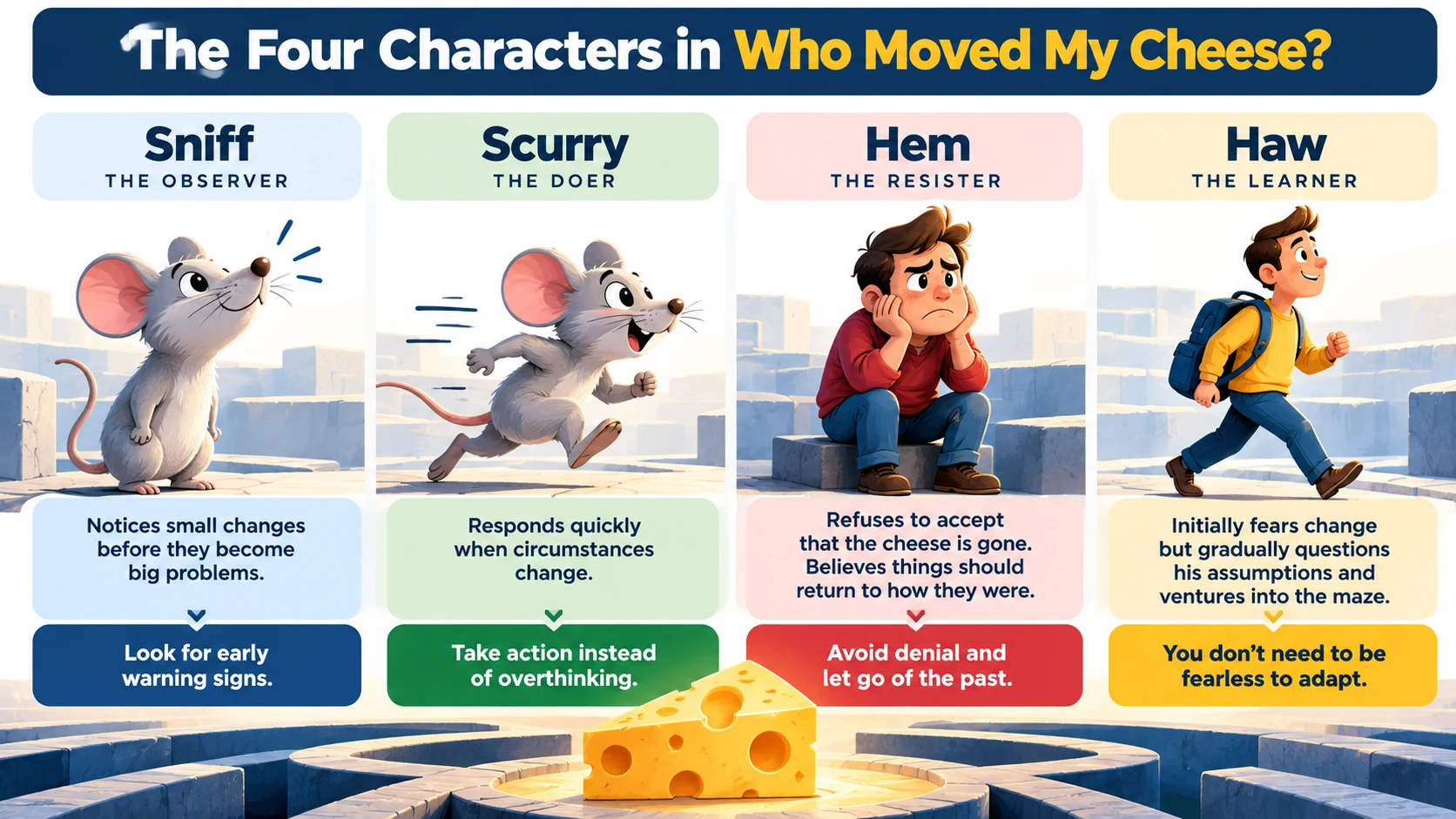
1. Sniff — The Observer
Sniff notices small changes before they become major problems.
He pays attention to his surroundings and recognizes when familiar conditions are beginning to shift.
What Sniff teaches us: Look for early warning signs instead of waiting until change becomes unavoidable.
Imagine a business owner noticing that customers are increasingly buying online rather than visiting physical stores.
Instead of ignoring the trend, the owner begins exploring digital sales channels.
That is Sniff-like behavior.
2. Scurry — The Doer
Scurry responds quickly when circumstances change.
He doesn’t waste much time debating why the cheese disappeared.
He begins searching for alternatives.
What Scurry teaches us: Sometimes taking action is more useful than endless analysis.
Imagine an employee whose organization introduces a new software platform.
Rather than complaining about the old system being replaced, the employee begins learning the new tool.
That is Scurry-like behavior.
However, speed should not replace good judgment. In real life, some decisions require careful evaluation.
3. Hem — The Resister
Hem refuses to accept that the cheese is gone.
He believes things should return to how they were.
He feels frustrated and unfairly treated.
Instead of searching for alternatives, he remains attached to the old situation.
What Hem teaches us: Denial can turn a difficult situation into a prolonged problem.
Imagine a professional insisting that their twenty years of experience should be enough, even though their industry now requires additional skills.
Their experience remains valuable, but refusing to evolve may limit future opportunities.
4. Haw — The Learner
Haw initially reacts much like Hem.
He is frightened, confused, and reluctant to leave the familiar cheese station.
But eventually, he begins questioning his assumptions.
He realizes that waiting is not solving anything.
Despite his fear, he ventures into the maze.
Over time, he becomes more confident and discovers new opportunities.
What Haw teaches us: You don’t need to be fearless to begin adapting.
You only need enough courage to take the next sensible step.
Which Character Are You?
Here is something important.
You are probably not just one of these characters.
You might behave like Sniff when managing your finances, Scurry when solving workplace problems, Hem when facing criticism, and Haw when considering a career change.
The purpose of the story isn’t to label yourself or other people.
It is to recognize which response is helping you and which one is keeping you stuck.
The Story: What Happens When the Cheese Disappears?
At the beginning, all four characters search for cheese inside a maze.
Eventually, they discover Cheese Station C, where they find plenty of cheese.
Sniff and Scurry continue paying attention to their surroundings.
Hem and Haw gradually become comfortable with their routine.
They begin treating the cheese as something permanent.
Then, one day, the cheese is gone.
Sniff and Scurry aren’t completely surprised. They have been noticing changes.
They quickly put on their running shoes and search for new cheese.
Hem and Haw react differently.
Hem becomes angry. He believes the situation is unfair and insists that the cheese should return.
Haw is also frightened.
He worries about entering the maze again.
What if he gets lost?
What if there is no more cheese?
What if he fails?
For a while, he remains with Hem.
But eventually, Haw recognizes that waiting is making things worse.
He decides to venture into the maze.
His journey isn’t immediately successful.
He encounters uncertainty, makes discoveries, and learns to become more comfortable with change.
Eventually, Haw finds new cheese at Cheese Station N, where Sniff and Scurry have already arrived.
Hem’s eventual fate remains unresolved.
The story contrasts two responses to disruption.
One character remains attached to what he has lost.
Another learns to move forward despite uncertainty.
The deeper lesson is that our assumptions about stability can become dangerous when we stop questioning them.
Who Moved My Cheese Summary: 7 Powerful Lessons About Change
The book contains several memorable ideas, but these seven lessons are especially useful in modern work and everyday life.
Lesson 1: Change Is Inevitable, Even When Everything Seems Perfect
One of the biggest mistakes we make is assuming that what works today will continue working tomorrow.
A successful business can lose customers.
A stable job can become uncertain.
A valuable skill can become less relevant.
A comfortable routine can stop producing results.
The problem isn’t that circumstances change.
It is that we often build our plans around the assumption that they won’t.
Why this matters
When we expect stability to last forever, change feels like a personal injustice rather than a situation we need to understand.
We spend our energy asking why things changed instead of deciding what to do next.
Real-life example
Imagine a software developer who has spent ten years mastering one technology.
Their organization begins adopting newer tools and AI-assisted development.
Instead of learning, the developer insists that their existing skills should be enough.
Their experience still matters.
But refusing to develop new capabilities may gradually reduce their opportunities.
How to apply this lesson
Every three months, ask yourself:
- What is changing in my industry, career, or personal life?
- Which of my current assumptions may no longer be true?
- What should I begin learning or doing differently?
The goal isn’t to worry constantly about the future.
It is to avoid becoming so comfortable that you stop paying attention.
Lesson 2: Pay Attention to Small Changes Before They Become Big Problems
Sniff and Scurry don’t wait until the situation becomes desperate.
They remain aware of their surroundings.
In everyday life, warning signs often appear before major disruptions.
A business may notice declining repeat purchases.
A manager may observe increasing employee dissatisfaction.
A professional may see that job descriptions increasingly require skills they don’t possess.
These signals don’t guarantee that something bad will happen.
But they deserve attention.
Why this matters
Early awareness gives you more time to explore options.
When you recognize change early, you may be able to respond gradually rather than under pressure.
Real-life example
A small retail business notices that more customers are researching products online before visiting its store.
The owner has two options.
Ignore the trend and continue operating exactly as before.
Or experiment with online ordering, digital marketing, and improved customer service.
The second approach creates additional opportunities before the business is forced to react.
How to apply this lesson
Create a monthly change radar.
Identify three important signals in your work or personal life.
For each signal, decide whether it requires immediate action, further investigation, or no response for now.
Awareness doesn’t mean reacting to every trend.
It means knowing when the environment around you is changing.
Lesson 3: Your Comfort Zone Can Become Your Biggest Limitation
Hem and Haw become comfortable at Cheese Station C.
Their routines become predictable.
Over time, their comfort begins to feel permanent.
This is a familiar human tendency.
Once we find a situation that feels safe, we naturally want to preserve it.
There is nothing wrong with enjoying stability.
The problem begins when comfort prevents us from seeing reality.
Why this matters
A routine that once helped you succeed can eventually become an obstacle.
The same habits, processes, or beliefs may no longer produce the results you need.
Real-life example
Imagine a manager who has always supervised employees through frequent status meetings and detailed instructions.
Initially, this approach works because the team is inexperienced.
Over time, the employees become more capable.
But the manager continues using the same approach.
Eventually, team members become frustrated because they want greater autonomy.
The manager’s familiar leadership style has become a limitation.
How to apply this lesson
Identify one routine you maintain primarily because it feels familiar.
Ask yourself:
- Does this approach still produce the results I need?
- Am I following it because it works or because it feels comfortable?
- What might improve if I tried something different?
Sometimes growth requires improving what you already do.
Other times it requires abandoning an approach that once served you well.
Lesson 4: Fear Often Makes Change Look Worse Than It Is
Haw initially hesitates to enter the maze.
He imagines danger, failure, and uncertainty.
His fear isn’t entirely unreasonable.
The maze contains genuine unknowns.
But remaining in the old location also has consequences.
Why this matters
Fear can help us recognize risks.
However, fear doesn’t always tell us which decision is best.
Sometimes it makes unfamiliar possibilities appear more dangerous than they really are.
Real-life example
A professional wants to move from a technical role into management.
But they worry about losing credibility, making mistakes, or failing to lead people effectively.
Instead of immediately resigning or making a major career decision, they could start with smaller experiments.
They might volunteer to lead a project, mentor a junior colleague, or coordinate a cross-functional initiative.
These experiences can reduce uncertainty and build confidence.
How to apply this lesson
Write down three things:
- What exactly am I afraid of?
- What evidence supports that fear?
- What small action could help me learn more?
You don’t need to eliminate fear before moving forward.
You need to understand it well enough to make a sensible decision.
Lesson 5: The Longer You Wait, the Harder Change Can Become
Hem spends much of his time questioning why the cheese disappeared.
His frustration is understandable.
But repeatedly demanding the return of something that is gone doesn’t improve his circumstances.
In real life, people sometimes delay necessary decisions because accepting change feels like admitting defeat.
Why this matters
The more time, money, or effort we invest in an old approach, the harder it can feel to move away.
We may continue defending a decision simply because we have already invested so much in it.
Real-life example
Imagine an entrepreneur who spends a year developing a product.
After launch, customers show little interest.
Instead of examining customer feedback, the founder continues investing because abandoning the original idea would feel like wasting a year of effort.
But the money and time already spent cannot be recovered by ignoring current evidence.
A better response might be to improve the product, change the target market, or explore another solution.
How to apply this lesson
Ask yourself:
If I were starting today, knowing everything I know now, would I make the same decision?
If the answer is no, examine what needs to change.
Changing direction doesn’t automatically mean your previous effort was wasted.
Sometimes it means you have learned something valuable.
Lesson 6: Imagine a Better Future, Then Take One Step Toward It
As Haw moves through the maze, he begins imagining the possibility of finding new cheese.
This shift matters.
Uncertainty often causes us to focus entirely on what we might lose.
A clearer picture of a desirable future can help us identify useful actions.
Why this matters
When you focus only on potential losses, it becomes difficult to see opportunities.
But when you imagine a realistic future worth pursuing, you have a reason to move forward.
Real-life example
An employee discovers that their department is being reorganized.
Initially, they focus on losing familiar responsibilities.
But after examining the situation, they identify possible opportunities.
They could lead a different team, learn an emerging technology, or move into a more strategic role.
These opportunities are not guaranteed.
But exploring them creates possibilities that passive resistance would never reveal.
How to apply this lesson
Describe what a successful transition would look like six months from now.
Then identify the smallest practical action that could move you toward that outcome.
A useful vision should lead to action.
Positive thinking alone isn’t enough.
Lesson 7: Keep Moving, but Keep Learning
Finding new cheese isn’t the end of Haw’s learning.
His experience teaches him that even a new source of comfort may not last forever.
This may be the most enduring lesson of the book.
Adaptability isn’t a single decision.
It is an ongoing capability.
Why this matters
The world continues changing after we solve one problem.
A successful response today may not remain effective forever.
But movement without reflection can become another mistake.
Scurry’s willingness to act is valuable.
Sniff’s ability to observe is equally important.
Haw adds reflection and learning.
Together, these qualities suggest a balanced approach.
Real-life example
An entrepreneur launches a new service after noticing changing customer needs.
Instead of assuming the service will succeed, they test it with a small customer group.
They gather feedback, improve the offering, and evaluate whether expansion makes sense.
They remain willing to adjust their strategy as they learn.
How to apply this lesson
After every significant change, ask:
- What did I expect to happen?
- What actually happened?
- What did I learn?
- What should I do differently next time?
Adaptability becomes more valuable when experience improves future decisions.
The Change Adaptation Cycle: A Practical Five-Step Framework
The seven lessons can be translated into a simple five-step process.
This is our original application framework inspired by the book, not an official model created by Spencer Johnson.
Notice → Accept → Act → Learn → Adapt
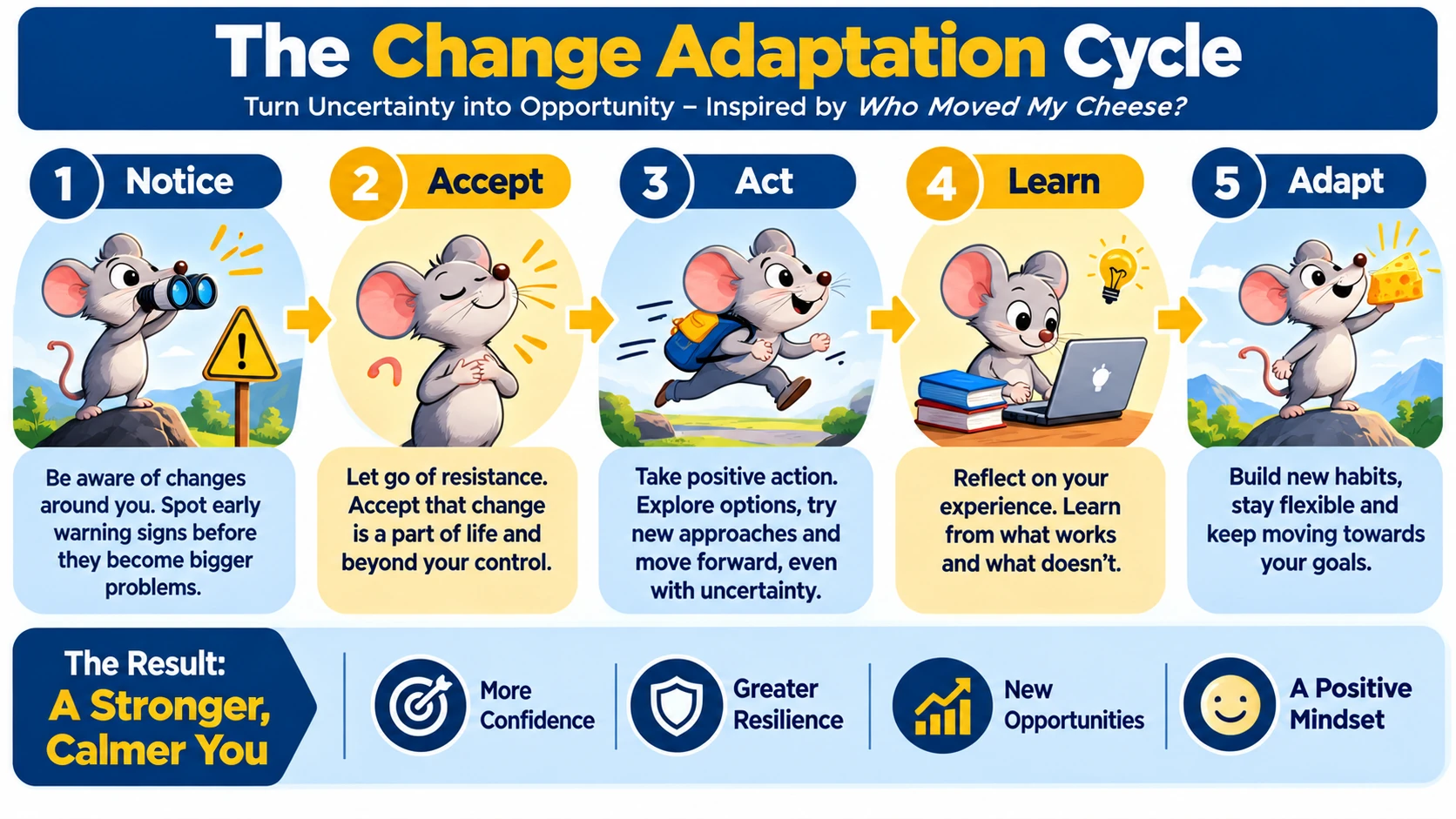
Step 1 — Notice: Pay attention to changing circumstances and early warning signs.
Step 2 — Accept: Acknowledge what has happened, even if you dislike it. Acceptance doesn’t mean approval.
Step 3 — Act: Identify a sensible next step. Start small when uncertainty is high.
Step 4 — Learn: Examine what worked, what failed, and what the experience revealed.
Step 5 — Adapt: Adjust your approach and continue developing your ability to respond to future changes.
The value of this framework is that it combines awareness with action.
You don’t need to predict every disruption.
You need a repeatable way to respond when circumstances change.
The Cheese Metaphor Explained
The central metaphor in Who Moved My Cheese? is simple but memorable.
Cheese represents the things we want.
The maze represents the environment in which we pursue them.
But the metaphor becomes more useful when we examine our own lives.
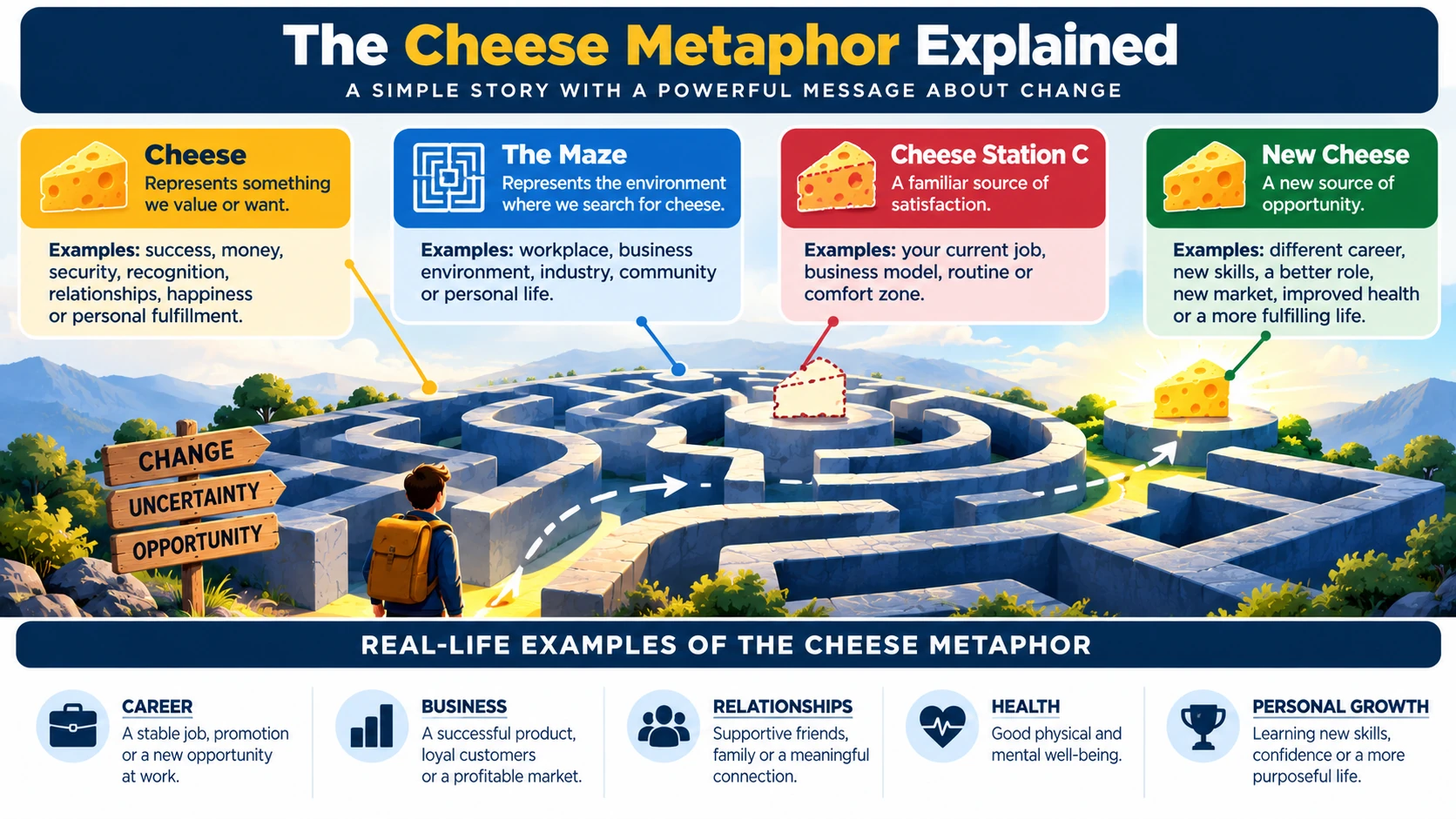
| Element | What It Represents | Everyday Example |
|---|---|---|
| Cheese | Something we value | Success, money, security, happiness |
| Maze | The environment around us | Workplace, business, relationships |
| Cheese Station C | A familiar source of satisfaction | Current job or business model |
| Missing cheese | An unexpected disruption | Layoff, changing technology, lost customer |
| Searching the maze | Exploring alternatives | Reskilling, experimenting, changing direction |
| New cheese | A new source of opportunity | Different career, healthier routine, new market |
Your Cheese May Change as You Grow
Here is an interesting way to look at the metaphor.
At 25, your cheese might be a well-paying job.
At 40, it might be meaningful work and more time with your family.
Later, it might be health, independence, or the freedom to pursue personal interests.
The things we value can evolve as our circumstances and priorities change.
Sometimes the challenge isn’t that someone moved your cheese.
Sometimes you have outgrown the cheese you once wanted.
That is why adapting isn’t always about finding a replacement for what you lost.
It can also mean reconsidering what success looks like.
How to Apply Who Moved My Cheese at Work and in Everyday Life
Understanding the story is useful.
Applying its lessons is where the real value begins.
1. Career Growth: Don’t Confuse Experience with Future Readiness
Experience is valuable.
But it doesn’t guarantee that your existing skills will remain sufficient forever.
A professional who has successfully managed projects for years may need to learn new collaboration methods, automation tools, or business capabilities.
The right question isn’t whether your past experience matters.
It is how to combine that experience with what the future requires.
Practical action: Identify one emerging skill relevant to your career and dedicate two focused learning sessions each week to developing it.
2. Leadership: Help People Navigate Change, Don’t Just Demand It
Managers often underestimate the emotional impact of organizational change.
A new process may look efficient on paper while creating uncertainty for employees.
People may worry about their responsibilities, competence, job security, or influence.
A leader who simply tells everyone to adapt may create more resistance.
A better approach is to explain why change is necessary, invite questions, provide training, and involve employees in shaping implementation.
The American Psychological Association’s workplace resources offer additional perspectives on employee well-being and organizational conditions.
Practical action: Before introducing a significant change, ask your team what concerns them most and what support would make the transition easier.
3. Entrepreneurship: Fall in Love with the Problem, Not Your First Solution
Entrepreneurs can become emotionally attached to a product or business model.
They may continue investing in an idea because they spent months building it.
But customers care about whether a product solves their problems, not how much effort went into creating it.
Real-life example
A startup builds a complex mobile application but discovers that customers prefer a simpler web-based solution.
Instead of defending the original plan, the founders can use customer feedback to adjust their product strategy.
Practical action: Regularly review customer behavior, not just customer compliments. Test important assumptions through small experiments.
4. Personal Life: Accept That Priorities Evolve
Change isn’t limited to jobs and businesses.
Friendships evolve.
Family responsibilities increase.
Personal goals shift.
A lifestyle that suited you five years ago may no longer match your circumstances.
That doesn’t necessarily mean something has gone wrong.
Practical action: Once every six months, review your priorities and ask whether your daily habits reflect what matters to you now.
Five Common Mistakes When Dealing with Change
Mistake 1: Believing Every Change Is Good
The book encourages adaptability, but change isn’t automatically beneficial.
A poorly designed company policy, unsafe working environment, or unfair decision may deserve to be challenged rather than accepted.
The useful lesson is to respond thoughtfully to reality, not agree with everything that happens.
Mistake 2: Confusing Speed with Progress
Scurry’s quick response is helpful in the story.
But real-world decisions can have serious consequences.
Changing careers, investing savings, or restructuring a business may require careful analysis.
Moving quickly in the wrong direction isn’t necessarily better than pausing to gather essential information.
Mistake 3: Assuming Fear Is Weakness
Fear can be a reasonable response to uncertainty.
The goal isn’t to shame people for feeling afraid.
It is to understand their concerns and identify actions that reduce unnecessary risk.
Mistake 4: Waiting Until You Feel Completely Ready
The opposite mistake is endless preparation.
You may never have complete certainty about a new career, business idea, or personal decision.
When risks are manageable, a small experiment can teach you more than another month of worrying.
Mistake 5: Treating People as Fixed Character Types
Calling a colleague “Hem” because they disagree with a new initiative oversimplifies human behavior.
Their resistance might reveal a genuine problem others have overlooked.
Use the characters for self-reflection, not to dismiss criticism.
A Practical 7-Day Change Challenge
Reading about change is easy.
Responding differently when change arrives takes practice.
This seven-day exercise is our original action plan inspired by the book’s ideas.
Choose one important change you are currently facing.
It might involve your career, business, relationships, habits, or personal goals.
Then follow these seven steps.

| Day | Your Action | Expected Outcome |
|---|---|---|
| Day 1 | Identify one important change you are avoiding | Awareness |
| Day 2 | Write down your fears and assumptions | Clarity |
| Day 3 | Identify what you can and cannot control | Focus |
| Day 4 | Explore three possible responses | Options |
| Day 5 | Take one small, low-risk action | Momentum |
| Day 6 | Review the results and gather feedback | Learning |
| Day 7 | Decide your next step and set a review date | Continued progress |
Example: Adapting to AI at Work
Imagine you are a project manager concerned that AI tools may change your responsibilities.
Day 1: Identify which tasks in your role are changing.
Day 2: Write down your concerns about job security, relevance, and learning difficulty.
Day 3: Separate what you can control, such as your skills and willingness to experiment, from broader company decisions.
Day 4: Explore possible responses, such as learning AI-assisted reporting, improving stakeholder communication, or developing AI governance knowledge.
Day 5: Test one tool on a non-sensitive task.
Day 6: Evaluate whether it actually improved your work.
Day 7: Create a realistic learning plan and schedule your next review.
You haven’t solved every uncertainty.
But you’ve moved from passive worry to informed action.
That is the purpose of the challenge.
Who Moved My Cheese Cheat Sheet
Here is a quick reference you can return to whenever circumstances change.
| Situation | Unhelpful Response | Better Response |
|---|---|---|
| Your industry is changing | Ignore emerging trends | Monitor developments |
| Your skills are becoming outdated | Depend only on experience | Learn and experiment |
| Your organization introduces change | Reject it immediately | Understand its purpose and consequences |
| You fear failure | Avoid every risk | Test a manageable first step |
| A strategy stops working | Defend past decisions | Reassess current evidence |
| You discover a new opportunity | Assume success is permanent | Continue observing and improving |
| Your plans are disrupted | Focus only on what you lost | Explore what remains possible |
The goal isn’t to become someone who enjoys every disruption.
It is to become someone who can respond constructively when familiar circumstances no longer work.
Who Should Read Who Moved My Cheese?
This book is particularly useful for people who want a quick, accessible introduction to the psychology of change.
You May Find It Valuable If You Are:
- A working professional navigating career transitions, changing responsibilities, or emerging technologies.
- A manager or leader helping employees adjust to organizational changes.
- An entrepreneur dealing with evolving customer expectations and market conditions.
- A student preparing for the transition from education to professional life.
- Someone facing personal change who wants a memorable perspective on fear and uncertainty.
Who Might Find It Less Useful?
Readers seeking detailed psychological research, comprehensive organizational change frameworks, or step-by-step guidance for complex decisions may find the book too simple.
It is a parable designed to encourage reflection, not a complete manual for handling every form of disruption.
Strengths and Limitations: Is Who Moved My Cheese Worth Reading?
What the Book Does Well
1. It makes a complicated emotion easy to understand.
The four characters provide a memorable way to recognize different reactions to uncertainty.
2. It encourages personal responsibility.
Rather than remaining focused entirely on what has happened, readers are encouraged to consider their next move.
3. It is accessible.
The story requires no business background or technical knowledge.
4. It starts useful conversations.
Teams can use the story to discuss why change feels difficult and what support people need.
5. It is short and memorable.
The publisher’s official book page identifies the hardcover edition as 96 pages, making it a relatively quick read.
Where the Book Falls Short
The book’s greatest strength—simplicity—is also its main limitation.
Not all changes are comparable to disappearing cheese.
Real-world disruptions may involve financial hardship, unequal power, discrimination, health problems, or responsibilities that make rapid adaptation difficult.
The story can also be interpreted as placing too much responsibility on individuals while paying insufficient attention to the people or institutions creating the change.
For example, an employee facing an unfair organizational decision may need to raise concerns, negotiate, or seek support rather than simply accept the situation.
This is why the book should not be used as an excuse to demand unquestioning compliance.
Harvard Business School professor Deepak Malhotra explores related questions in I Moved Your Cheese, a separate parable that challenges assumptions about the maze itself.
Our interpretation is that Johnson’s book is most valuable as a starting point for reflection, not a universal decision-making formula.
Adapt when circumstances genuinely require it. Challenge change when it is harmful or unjustified. And whenever possible, help shape the future instead of merely reacting to it.
Our Biggest Takeaway: Don’t Just Find New Cheese—Learn How to Navigate the Maze
Many readers finish the story thinking the lesson is simply to move faster when circumstances change.
That interpretation misses something important.
Sniff observes.
Scurry acts.
Haw reflects and learns.
Together, these responses suggest a more balanced approach.
Notice what is happening.
Question your assumptions.
Take sensible action.
Learn from the outcome.
And remember that the goal isn’t to chase every new opportunity.
It is to develop the judgment to recognize which changes matter, which risks are worth taking, and which values you want to preserve.
Adaptability works best when combined with purpose.
Sometimes you need to move.
Sometimes you need to wait and gather more information.
Sometimes you need to challenge the rules of the maze itself.
The real skill is learning to recognize the difference.
Final Thoughts: Your Cheese Will Move Again
The next time your plans are disrupted, you may feel frustrated, disappointed, or afraid.
Those reactions are natural.
What matters is what happens afterward.
Will you keep waiting for things to return to exactly how they were?
Will you rush into something new without thinking?
Or will you examine the situation, consider your options, and take a useful step forward?
The lasting message of this Who Moved My Cheese Summary is not that we should welcome every disruption.
It is that we should avoid allowing attachment to the past to prevent us from responding intelligently to the present.
You cannot control every change around you.
But you can improve how you recognize it, evaluate it, and decide what to do next.
And that ability may be more valuable than any particular piece of cheese.
The question isn’t whether your cheese will move again. It’s whether you’ll be ready to find a new path when it does.
Frequently Asked Questions About Who Moved My Cheese
1. What is the main message of Who Moved My Cheese?
The main message is that change is inevitable and that recognizing, accepting, and responding constructively to it can help people navigate uncertainty. The story illustrates how fear and attachment to familiar circumstances can delay action.
2. Who are the four characters in Who Moved My Cheese?
The characters are Sniff and Scurry, two mice, and Hem and Haw, two Littlepeople. They represent different responses to change, including noticing early signals, acting quickly, resisting change, and gradually learning to adapt.
3. What does cheese symbolize in the book?
Cheese symbolizes whatever people value or seek, such as career success, money, security, relationships, happiness, or personal fulfillment.
4. What does the maze represent?
The maze represents the environment in which people pursue their goals. It can symbolize a workplace, business environment, community, or personal circumstances.
5. Why does Hem refuse to change?
Hem is attached to the comfort and predictability of his previous situation. He struggles to accept that the cheese is gone and hopes the old circumstances will return.
6. What happens to Haw at the end?
Haw overcomes his initial hesitation, explores the maze, learns from his experiences, and eventually discovers new cheese at Cheese Station N.
7. What are the most important lessons from Who Moved My Cheese?
The key lessons include anticipating change, paying attention to early warning signs, questioning familiar routines, managing fear, avoiding unnecessary delays, exploring new opportunities, and continuing to learn.
8. Is Who Moved My Cheese a good book for leaders?
Yes, particularly as an introduction to how people respond emotionally to change. However, leaders should avoid using the story to dismiss legitimate employee concerns. Effective change management also requires communication, support, and fair decision-making.
9. Is Who Moved My Cheese worth reading in 2026?
Yes. Its core message remains relevant to technological disruption, career transitions, changing business models, and personal development. Readers should complement its simple lessons with more detailed guidance when dealing with complex or high-stakes changes.
10. How long does it take to read Who Moved My Cheese?
The book is relatively short, with the commonly available hardcover edition containing 96 pages. Many readers can finish it in approximately one to two hours, depending on reading speed and time spent reflecting on its lessons.