You’ve started the same habit four times this year.
Exercise. Reading. Writing. Waking up earlier.
It works for a week.
Maybe two.
Then life happens.
And you’re back to square one, wondering what’s wrong with you.
Nothing is wrong with you.
The system is wrong.
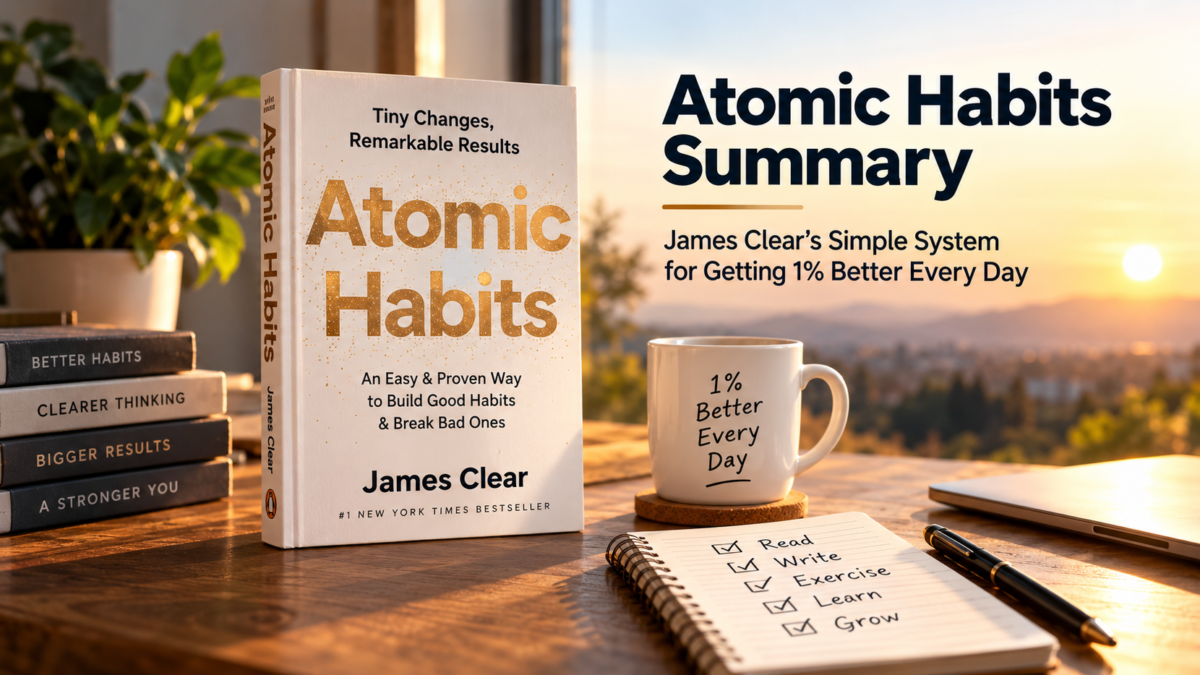
That is the central idea behind Atomic Habits by James Clear.
The book is not really about becoming more disciplined.
It is about making good habits easier to repeat and bad habits harder to continue.
And that difference matters.
Because most of us try to change our lives by setting bigger goals.
Clear suggests another approach:
Make the behaviour smaller. Improve the system. Repeat it long enough for the results to compound.
This Atomic Habits summary breaks down the most useful ideas from the book, how to apply them in real life, where people commonly go wrong, and what I personally took away from it.
Atomic Habits in 60 Seconds
If you remember only five ideas from this book, remember these:
- Small improvements compound.
- Systems matter more than goals.
- Build habits around identity, not just outcomes.
- Make good habits obvious, attractive, easy and satisfying.
- Design your environment so the right behaviour becomes easier.
That is Atomic Habits in its simplest form.
But the real value comes from understanding how these ideas work together.
What Is Atomic Habits About?
Atomic Habits is about making small changes that are easy enough to repeat.
The word atomic has two useful meanings here.
Something atomic is extremely small.
But atoms are also the building blocks of something much larger.
That is exactly how habits work.
Reading ten pages doesn’t transform your life.
Walking for twenty minutes doesn’t transform your health.
Saving a small amount of money doesn’t make you wealthy.
Writing for fifteen minutes doesn’t make you an author.
Not today.
But repeat those behaviours for months or years and the story changes.
The power of a habit is not what it does once.
The power is what happens when it is repeated.
The 1% Rule
One of the most famous ideas from Atomic Habits is simple:
Get 1% better every day.
A 1% improvement sounds insignificant.
That is exactly why people underestimate it.
We naturally look for dramatic transformation:
Lose 10 kilograms.
Read 50 books.
Build a successful business.
Become highly productive.
Wake up at 5 AM.
But meaningful improvement rarely happens in one dramatic moment.
It usually looks boring while it is happening.
One workout.
One page.
One sales call.
One healthy meal.
One focused hour.
One better decision.
Then another.
And another.
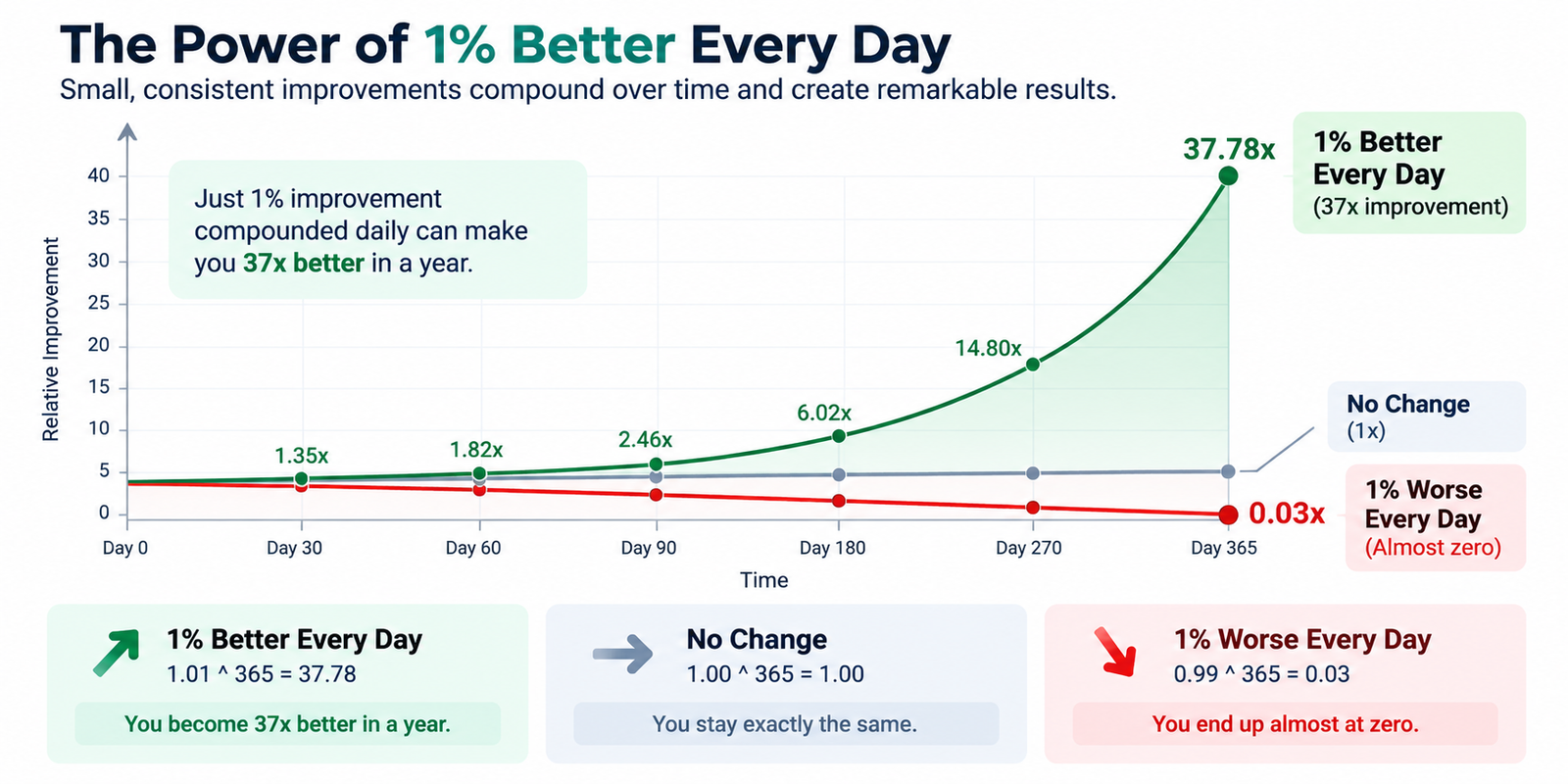
Small improvements begin to compound.
Why Compounding Matters
Imagine two people starting at roughly the same level.
One improves slightly and consistently.
The other stays exactly where they are.
For the first few days, the difference is almost invisible.
After a few weeks, you might notice something.
After several months, the gap becomes much larger.
Over years, their results can look completely different.
That is the mathematics and psychology behind small habits.
This is why habits can be frustrating.
Bad habits often feel harmless today but expensive later.
Good habits often feel difficult today but valuable later.
You rarely see the consequence immediately.
That delay is what makes consistency difficult.
Goals Tell You Where to Go. Systems Get You There.
Most people begin change with a goal.
“I want to lose 10 kilograms.”
“I want to write a book.”
“I want to grow my business.”
“I want to read 30 books this year.”
There is nothing wrong with goals.
Goals give you direction.
The problem begins when we expect the goal itself to create the behaviour required to achieve it.
Imagine two teams playing a championship final.
Both teams have the same goal:
Win the championship.
The goal doesn’t explain why one team wins.
The difference is preparation.
Training.
Strategy.
Coaching.
Recovery.
Daily practice.
In other words:
The system.
A writer’s goal might be:
Write a book.
The system might be:
Write for 30 minutes every morning before checking email.
A manager’s goal might be:
Become a better leader.
The system might be:
Hold one meaningful coaching conversation with a team member every week.
A student’s goal might be:
Get better grades.
The system might be:
Study for 45 focused minutes every evening.
Goals tell you what you want.
Systems determine what you repeatedly do.
And repeated behaviour is what eventually creates the result.
Why Identity Matters More Than You Think
This was one of the strongest ideas in the book for me.
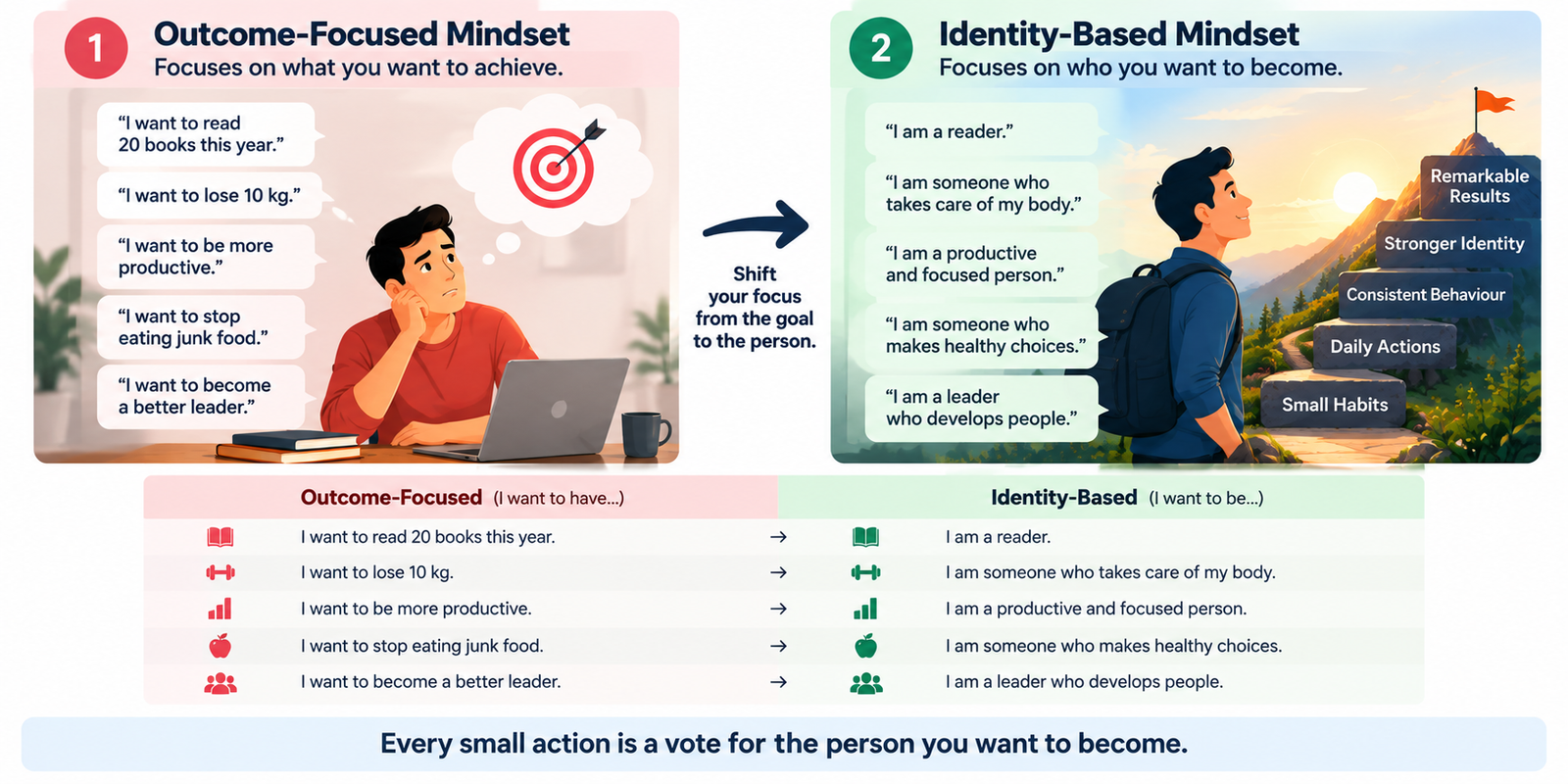
Most people try to change their behaviour by starting with an outcome.
I want to read more.
I want to lose weight.
I want to exercise regularly.
I want to become more productive.
Clear suggests going one level deeper.
Instead of asking:
“What do I want to achieve?”
Ask:
“Who do I want to become?”
That changes the conversation.
Instead of:
I want to read 20 books.
Try:
I am a reader.
Instead of:
I want to exercise four times a week.
Try:
I am someone who takes care of my body.
Instead of:
I want to write more.
Try:
I am a writer.
Instead of:
I want to manage my team better.
Try:
I am a leader who develops people.
The behaviour becomes evidence for the identity.
Every time you read, you cast a vote for becoming a reader.
Every time you exercise, you cast a vote for becoming someone who takes care of their health.
Every time you sit down and write, you cast a vote for becoming a writer.
No single action completely changes your identity.
But repeated actions begin to reinforce a story about who you are.
This is much more powerful than chasing an outcome alone.
Because outcomes finish.
Identity continues.
Every Habit Runs on a Four-Step Loop
Before trying to change a habit, it helps to understand how a habit works.
According to the framework in Atomic Habits, habits move through four stages:
Cue → Craving → Response → Reward
Let’s make that simple.
1. Cue
Something triggers the behaviour.
Your phone vibrates.
You see chocolate on the kitchen counter.
Your running shoes are beside the door.
You finish your morning coffee.
The cue tells your brain:
Something is about to happen.
2. Craving
The cue creates a desire.
You don’t necessarily crave the behaviour itself.
You crave the feeling or outcome connected to it.
You don’t crave checking Instagram.
You may crave stimulation, entertainment or connection.
You don’t crave brushing your teeth.
You want the feeling of a clean mouth.
3. Response
This is the actual behaviour.
You check the phone.
You eat the chocolate.
You go for the run.
You read the book.
4. Reward
Finally, your brain receives something it values.
Pleasure.
Relief.
Progress.
Satisfaction.
Achievement.
That reward teaches the brain:
Remember this behaviour. It was useful.
Repeat the loop enough times and the behaviour begins to become automatic.
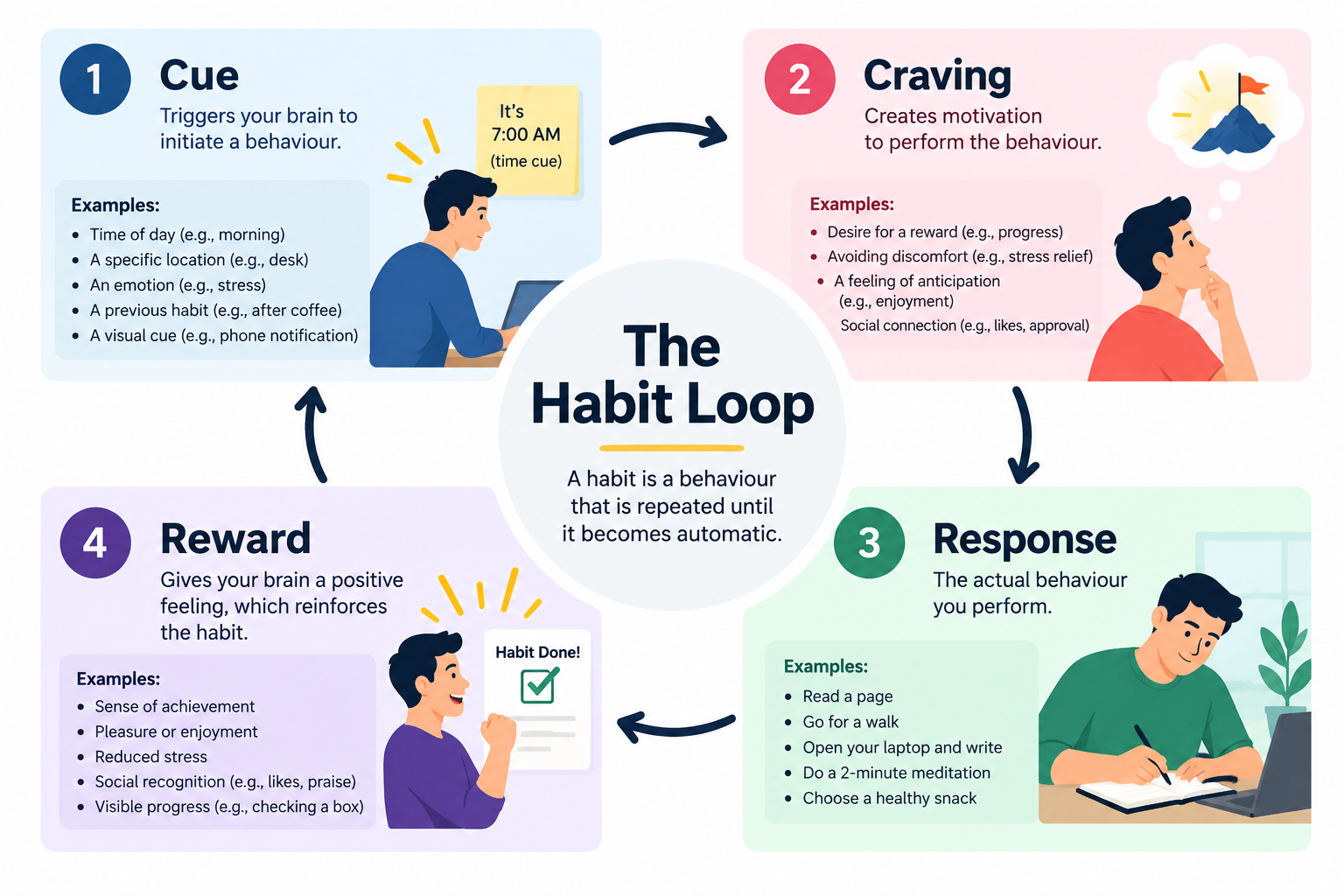
Once you understand this loop, the Four Laws of Behaviour Change become much easier to understand.
The Four Laws of Behaviour Change
James Clear turns the habit loop into a practical framework for changing behaviour.
To build a good habit:
1. Make it obvious.
2. Make it attractive.
3. Make it easy.
4. Make it satisfying.
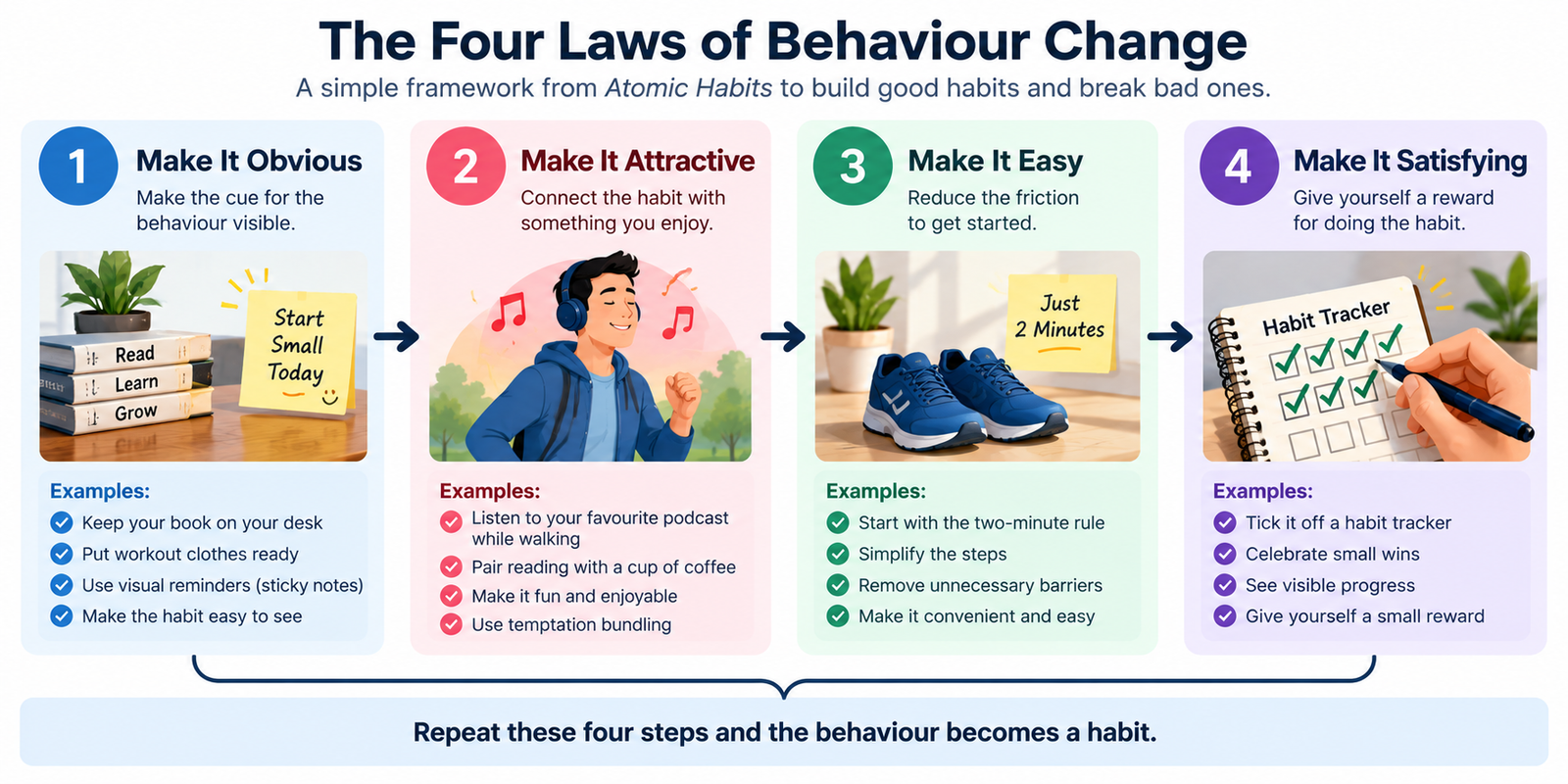
Let’s look at each one.
Law 1: Make It Obvious
Every habit begins with a cue.
So if you want a behaviour to happen more often, make the cue easier to see.
Want to read every evening?
Put the book on your pillow.
Want to drink more water?
Keep the bottle on your desk.
Want to exercise in the morning?
Put your shoes and workout clothes beside your bed.
Want to write tomorrow morning?
Leave the document open on your laptop.
This sounds almost too simple.
That is the point.
Your environment should remind you what to do without requiring you to remember.
Use Habit Stacking
Another useful technique is habit stacking.
The formula is:
After I [CURRENT HABIT], I will [NEW HABIT].
For example:
After I make my morning coffee, I will read two pages.
After I brush my teeth, I will meditate for two minutes.
After I sit at my desk, I will write my three priorities.
Instead of trying to create a completely new routine, attach the new behaviour to something already established.
Law 2: Make It Attractive
We naturally repeat behaviours we look forward to.
So make the habit more appealing.
Suppose you enjoy podcasts but struggle to exercise.
Create a rule:
I listen to my favourite podcast only while walking.
Now something you should do becomes connected to something you want to do.
Clear calls this idea temptation bundling.
The principle is simple:
Pair something beneficial with something enjoyable.
Law 3: Make It Easy
This may be the most practical law in the entire book.
When people want to build a habit, they often make the starting point too difficult.
They decide:
I will exercise for one hour every day.
I will read 50 pages every night.
I will meditate for 30 minutes.
I will write 2,000 words every morning.
Motivation is high, so the plan feels reasonable.
Then motivation disappears.
And the habit disappears with it.
A better approach is to reduce the friction required to start.
The Two-Minute Rule
When starting a new habit, scale it down until it can be done in approximately two minutes.
“Read every night” becomes:
Read one page.
“Exercise every morning” becomes:
Put on your workout clothes.
“Meditate every day” becomes:
Meditate for two minutes.
“Write a book” becomes:
Write one paragraph.
At first this can feel ridiculous.
But the goal is not to complete the entire activity.
The goal is to master showing up.
Think about exercise.
Putting on your running shoes is not the workout.
But the shoes are the door.
Once the shoes are on, starting becomes easier.
And once you start, continuing becomes easier.
Law 4: Make It Satisfying
We repeat behaviours that feel rewarding.
The problem with many good habits is that the reward is delayed.
Exercise today.
Maybe see results months later.
Save money today.
Benefit years later.
Study today.
See the grade later.
Bad habits often work in the opposite direction.
The reward is immediate.
The cost arrives later.
So one strategy is to give good habits an immediate sense of progress.
A habit tracker is a simple example.
Each time you complete the behaviour:
✓ mark the calendar
✓ tick the checkbox
✓ update the tracker
That tiny action creates satisfaction.
It also gives you visual evidence:
I am becoming consistent.
How to Break a Bad Habit
The same Four Laws can be reversed.
To break a bad habit:
Make it invisible.
Make it unattractive.
Make it difficult.
Make it unsatisfying.
Suppose you keep checking your phone while working.
Instead of telling yourself:
I need more discipline.
Change the environment.
Put the phone in another room.
Turn off unnecessary notifications.
Log out of distracting apps.
Use website blockers.
Increase the number of steps required to access the distraction.
You are no longer fighting temptation every five minutes.
You are redesigning the system.
Environment Often Beats Motivation
One of the most useful lessons from Atomic Habits is that behaviour is heavily influenced by what surrounds us.
We like to believe our decisions come from discipline.
Often they come from cues.
Imagine two rivers.
One naturally flows downhill.
The other needs to be pushed uphill.
Which one requires more energy?
Obviously the second.
Many people build habits like the second river.
They constantly fight their environment.
Chocolate is on the table.
The phone is beside the laptop.
Netflix opens automatically.
Notifications arrive all day.
Then they blame themselves for lacking discipline.
A better strategy is:
Design the environment so the desired behaviour flows downhill.
Want to eat healthier?
Put healthier food where you can see it.
Want to read more?
Keep books within reach.
Want fewer distractions?
Move your phone away from your workspace.
Want to practice guitar?
Keep the guitar visible instead of inside a cupboard.
Don’t only ask:
How can I become more disciplined?
Ask:
How can I make the right behaviour easier?
That question is often much more useful.
How to Actually Use Atomic Habits in Real Life
Ideas become useful only when they survive contact with real life.
Here are a few examples.
If You’re a Founder or Entrepreneur
Don’t say:
I need to become more productive.
Build systems.
For example:
After opening my laptop → write the three most important outcomes for today.
Before checking email → complete 30 minutes of deep work.
Every Friday → review the week’s wins, problems and priorities.
Small systems reduce the number of decisions you have to make repeatedly.
If You’re a Creator or Writer
Don’t begin with:
I need to publish more content.
Start with the smallest repeatable behaviour.
After my morning coffee → write for 15 minutes.
Keep the writing document open.
Put your phone away.
Track the days you write.
Your first objective isn’t producing a masterpiece.
It is becoming:
Someone who writes consistently.
If You’re a Student or Early-Career Professional
Instead of:
I need to learn more.
Create a trigger.
After dinner → study for 20 minutes.
Choose the topic before you begin.
Keep your learning material ready.
Remove the phone.
Track completion.
Twenty focused minutes sounds small.
That is exactly why you may actually repeat it.
Where People Go Wrong With Atomic Habits
The ideas in the book are simple.
Applying them consistently is harder.
Here are some common mistakes.
1. Treating Small Habits as Too Small
People think:
Reading one page won’t change anything.
Correct.
One page probably won’t.
But that is not the purpose.
The small behaviour establishes the pattern.
Once the pattern exists, you can expand it.
Consistency before intensity.
2. Changing Too Many Habits at Once
Monday arrives and suddenly you decide to:
Wake up at 5 AM.
Exercise.
Meditate.
Read.
Journal.
Stop sugar.
Drink three litres of water.
Study for an hour.
By Thursday, the entire system collapses.
Choose one or two behaviours.
Stabilise them.
Then add another.
3. Focusing Only on the Outcome
If your only motivation is losing 10 kilograms, what happens after you lose it?
If your identity becomes:
I am someone who takes care of my health.
The behaviour has a reason to continue.
4. Ignoring Your Environment
You can have the perfect habit plan.
But if your environment constantly pushes you toward the opposite behaviour, everything becomes harder.
Sometimes the best habit intervention isn’t motivation.
It is moving something.
Deleting something.
Preparing something.
Blocking something.
Or putting something directly in your path.
Never Miss Twice
You will miss a habit.
Eventually.
You will get sick.
Travel.
Have an emergency.
Get overloaded at work.
Sleep badly.
Life will interfere.
Missing once isn’t the real danger.
The danger is allowing one miss to become the beginning of a new pattern.
So use a simple rule:
Never miss twice.
Miss Monday’s workout?
Fine.
Show up Tuesday.
Miss today’s writing session?
Fine.
Write tomorrow.
One bad day is an event.
Two, three and four can begin becoming a pattern.
Don’t chase perfection.
Protect the pattern.
Atomic Habits Cheat Sheet
| Principle | What It Means | Example |
|---|---|---|
| 1% Better | Improve slightly and consistently | Read 5 pages daily |
| Systems > Goals | Focus on repeatable processes | Write for 20 minutes each morning |
| Identity-Based Habits | Become the type of person who does the behaviour | “I am a reader.” |
| Make It Obvious | Make the cue visible | Leave the book on your desk |
| Make It Attractive | Pair the habit with something enjoyable | Podcast while walking |
| Make It Easy | Reduce friction | Prepare workout clothes beforehand |
| Make It Satisfying | Create an immediate reward | Tick a habit tracker |
| Two-Minute Rule | Shrink the starting behaviour | Read one page |
| Habit Stacking | Attach a new habit to an existing one | Read after morning coffee |
| Never Miss Twice | Recover quickly after a miss | Resume the next day |
A Simple Atomic Habits Plan You Can Start Today
If you want to apply the book instead of simply understanding it, start here.
Step 1: Pick One Identity
Complete this sentence:
I want to become someone who __________.
For example:
I want to become someone who reads.
I want to become someone who exercises.
I want to become someone who writes.
I want to become someone who learns continuously.
Step 2: Choose One Tiny Behaviour
Make it almost impossible to refuse.
Read one page.
Walk for five minutes.
Write one paragraph.
Study for ten minutes.
Step 3: Choose a Cue
Decide exactly when the behaviour will happen.
After my morning coffee, I will read one page.
Step 4: Prepare the Environment
Put everything you need in place before the habit begins.
Book on desk.
Shoes by door.
Notebook open.
Phone outside the room.
Step 5: Track It
Use a calendar, notebook or habit tracker.
Give yourself visible evidence that you’re showing up.
Step 6: Protect the Pattern
You will eventually miss.
When that happens:
Never miss twice.
That is enough to begin.
Who Should Read Atomic Habits?
I would recommend Atomic Habits if you:
- struggle to stay consistent
- repeatedly start and stop habits
- depend heavily on motivation
- want better routines
- want to become more productive
- want to understand why certain behaviours feel automatic
- are trying to break an unwanted habit
- lead people and want to understand behaviour change
It is particularly useful if you’ve spent years believing:
“I just need more discipline.”
You may discover that discipline was never the whole problem.
The system around the behaviour matters just as much.
What I Personally Took From Atomic Habits
I expected a book about discipline.
What I found was a book about architecture.
Architecture of behaviour.
Architecture of environment.
Architecture of identity.
Architecture of repeated decisions.
That distinction stayed with me.
But I also think there is an important limitation worth mentioning.
The ideas in Atomic Habits work beautifully when you have control over your environment.
Personal fitness.
Reading.
Writing.
Learning.
Diet.
Personal routines.
Professional life can be messier.
Sometimes your calendar is not fully yours.
Your manager changes priorities.
Clients create emergencies.
Meetings appear.
Teams depend on you.
Organisational culture creates cues you cannot simply remove.
In those environments, you can’t always redesign everything around yourself.
So I don’t think the lesson is:
Build the perfect environment.
I think the more realistic lesson is:
Redesign the parts of the environment you actually control.
Your first hour.
Your notifications.
Your meeting habits.
Your preparation.
Your boundaries.
Your default responses.
Your workspace.
Your routines before and after work.
Small areas of control can still create significant change.
And if there is one idea from Atomic Habits that I keep coming back to, it is the identity shift.
Instead of constantly asking:
What result am I trying to achieve?
Ask:
What kind of person would naturally produce that result?
Then build small evidence for that identity.
Day after day.
One Question to Take Away
Here’s the question I’d leave you with:
If your daily habits were the only evidence anyone had about who you are, what would they conclude?
And more importantly:
Is that the person you’re trying to become?
That question is uncomfortable.
But useful.
Because ultimately your habits are not just producing results.
They are producing you.
Final Takeaway
You do not need to rebuild your entire life tomorrow.
You don’t need a perfect morning routine.
You don’t need unlimited motivation.
And you don’t need to change ten habits at once.
Start smaller.
Choose one behaviour.
Make the cue obvious.
Make the behaviour easy.
Repeat it.
Then repeat it again.
Let consistency do the heavy lifting.
Because meaningful change rarely begins with one huge decision.
It begins with something small enough to do today.
Then tomorrow.
Then the day after that.
Not a perfect you.
A better you.
One small step at a time.
Frequently Asked Questions About Atomic Habits
What is the main idea of Atomic Habits?
The main idea is that small behaviours repeated consistently can create significant long-term results. Instead of relying only on goals or motivation, build systems that make good behaviours easier to repeat.
What is the 1% rule in Atomic Habits?
The 1% rule is the idea of making small, continuous improvements rather than expecting dramatic overnight transformation. Tiny gains can become meaningful when they compound over time.
What are the Four Laws of Behaviour Change?
The Four Laws are:
Make it obvious.
Make it attractive.
Make it easy.
Make it satisfying.
They provide a framework for building good habits.
What are the four stages of a habit?
The four stages are:
Cue → Craving → Response → Reward
Together they form the habit loop.
What is an identity-based habit?
An identity-based habit focuses on the person you want to become rather than only the result you want to achieve.
Instead of:
“I want to read more.”
Think:
“I am a reader.”
What is the Two-Minute Rule?
The Two-Minute Rule means reducing a new habit to a version that takes approximately two minutes to start.
For example:
“Read every night” becomes “read one page.”
The goal is to make starting easy.
Is Atomic Habits worth reading?
Yes, especially for people who struggle with consistency, routines or relying too heavily on motivation. Its biggest strength is turning behaviour change into practical systems you can use immediately.
The biggest lesson from Atomic Habits isn’t that tiny actions are magical.
It is that tiny actions become powerful when they become consistent.