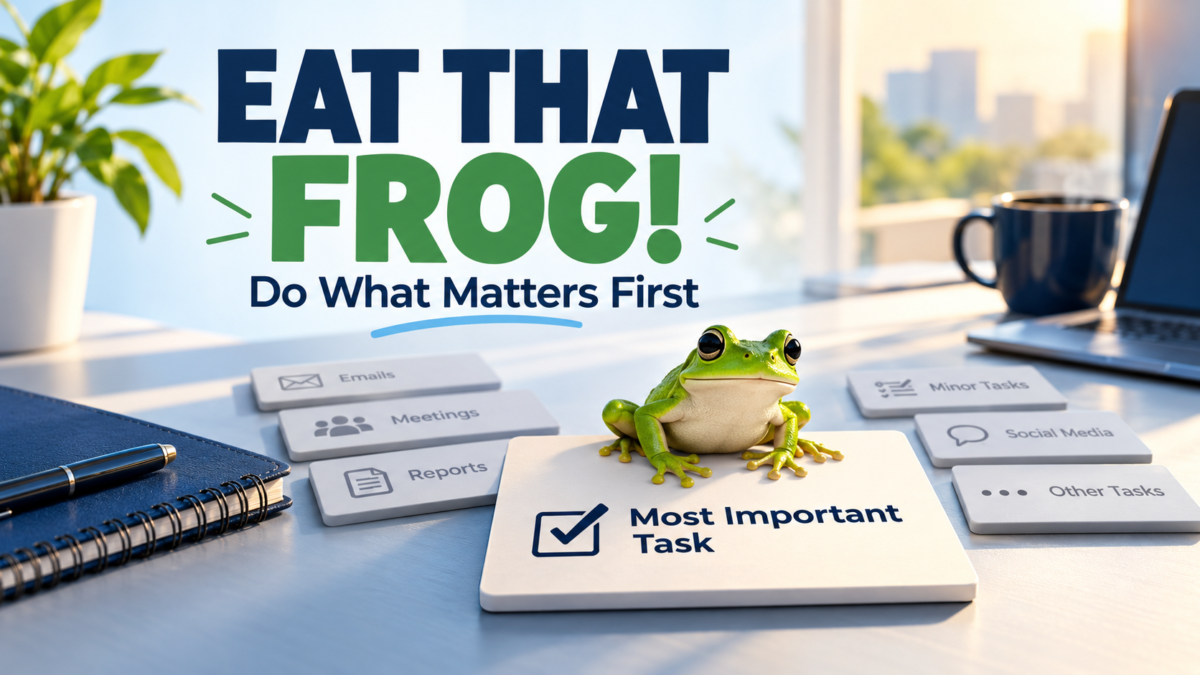
You sit down at your desk at 9 AM, determined to have a productive day.
There’s an important presentation to prepare, a difficult conversation you’ve been avoiding, and a project that needs your attention.
You know exactly which task matters most.
But first, you check your email.
One message needs a reply. Another leads to a quick call. Then comes a meeting, a few notifications, and an urgent request from a colleague.
By lunchtime, you’ve been working for three hours.
You’ve answered 20 emails, attended two meetings, and crossed five things off your to-do list.
Yet the most important task remains untouched.
And the frustrating part?
You knew it was important when you started.
That’s the difference between being busy and being productive.
It’s also the central problem Brian Tracy addresses in Eat That Frog!.
The book introduces a simple but powerful idea: instead of spending your day completing whatever feels easiest or most urgent, identify the task that will make the biggest difference and tackle it first.
Tracy calls that task your frog.
In this detailed Eat That Frog summary, we’ll explore all 21 techniques from the 2017 third edition, understand the book’s most useful frameworks, apply them to everyday situations, and examine where the advice needs a little more nuance.
Because the goal isn’t to squeeze more work into an already crowded day.
It’s to make sure your best time and energy go toward work that actually matters.
Eat That Frog! in 60 Seconds
| Book | Eat That Frog!: 21 Great Ways to Stop Procrastinating and Get More Done in Less Time |
| Author | Brian Tracy |
| Edition covered | Third edition, 2017 |
| Main idea | Complete your highest-value tasks before lower-priority activities consume your time |
| Key frameworks | 80/20 Rule, ABCDE Method, Law of Three |
| Best for | Professionals, managers, entrepreneurs, students, and anyone struggling with procrastination |
Seven lessons worth remembering
- Your frog is the important task you’re most likely to postpone.
- Being busy doesn’t automatically mean you’re making progress.
- Planning ahead reduces confusion and makes it easier to start.
- A small number of activities often produces a disproportionate share of results.
- You must deliberately say no to less important work.
- Large, intimidating tasks become manageable when broken into smaller actions.
- Consistent focus matters more than occasional bursts of motivation.
The book’s central message: You will never have enough time to do everything, but you can make time for the things that matter most.
What Is Eat That Frog! About?
Imagine being told that you must eat a live frog today.
It sounds unpleasant.
You might avoid thinking about it, find excuses to delay it, or suddenly discover several other things that need your attention.
But if eating the frog were unavoidable, getting it over with would spare you hours of worrying about it.
That’s the metaphor behind Brian Tracy’s book.
Your frog represents the task that is both important and tempting to postpone.
It might be difficult, uncomfortable, complicated, or simply require more concentration than your usual activities.
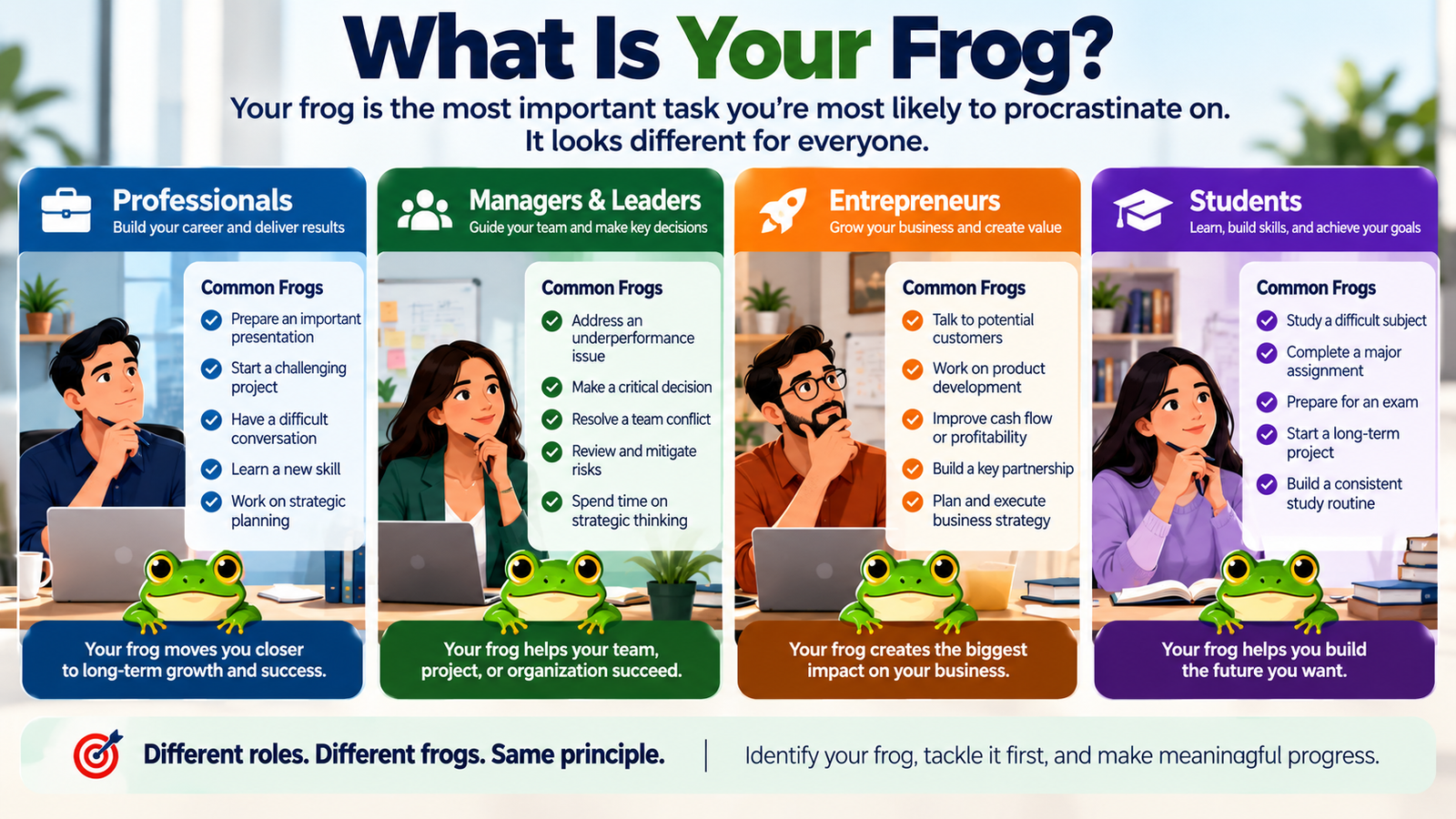
For a salesperson, the frog could be calling an important prospective customer.
For a student, it could be studying the subject they find most difficult.
For a business owner, it could be addressing a problem affecting profitability.
For a manager, it might be having an uncomfortable conversation with an underperforming employee.
These tasks don’t always offer immediate satisfaction.
But completing them can create significant progress.
Tracy’s argument is that successful time management depends on choosing the right tasks and developing the discipline to complete them.
He emphasizes three qualities: decision, discipline, and determination.
You decide what matters, discipline yourself to begin, and remain determined enough to follow through.
Who is Brian Tracy?
Brian Tracy is an author, speaker, and business trainer known for his work on productivity, goal setting, leadership, sales, and personal development.
His books include Goals!, No Excuses!, and Eat That Frog!.
The third edition of Eat That Frog! was published by Berrett-Koehler in April 2017 and expanded the book’s discussion of technology and attention management.
The book is practical rather than academic. It focuses on techniques readers can apply immediately, rather than providing a comprehensive scientific explanation of procrastination.
The 21 Lessons from Eat That Frog!
The following lessons follow the chapter sequence of the 2017 third edition.
Rather than treating them as isolated productivity tricks, think of them as parts of one system: decide what matters, prepare yourself, remove obstacles, and execute.
Part 1: Choose the Right Work
1. Set the Table: Clarity Comes Before Productivity
Imagine asking someone to drive as fast as possible without telling them where to go.
They might cover a lot of distance, but there’s no guarantee they’ll reach the right destination.
Work is no different.
When your goals are unclear, almost any activity can feel productive.
You answer messages, attend meetings, complete small tasks, and remain busy without knowing whether you’re moving toward anything meaningful.
Tracy begins with clarity because you cannot identify your most important task until you know what you’re trying to achieve.
Example: Suppose you want to improve your career.
That’s a reasonable ambition, but it’s too vague to guide daily action.
Now make it specific: “Earn a professional certification within the next 90 days.”
Suddenly, you can identify what needs to happen. You must select the certification, prepare a study plan, complete the learning material, and schedule the examination.
The goal now provides direction.
How to apply it: Write down one important goal, define a realistic deadline, and identify the next concrete action.
Don’t confuse having a goal with having a plan.
A goal tells you where you’re going. A plan helps you get there.
2. Plan Every Day in Advance: Don’t Let the Day Decide for You
Most people don’t deliberately choose to waste their day.
They simply begin without a clear plan.
They open their laptop, check notifications, and respond to whatever demands attention first.
The problem is that the first thing demanding attention isn’t necessarily the most important.
Tracy recommends planning your day in advance, preferably before the next workday begins.
This gives you an opportunity to think about priorities before interruptions arrive.
Example: Consider two managers preparing for the same busy Monday.
The first arrives without a plan and immediately starts answering emails.
The second spent ten minutes on Friday identifying Monday’s priorities, including a critical project decision.
When Monday begins, the second manager already knows what deserves attention.
That doesn’t guarantee a perfect day, but it makes deliberate progress more likely.
How to apply it: At the end of each workday, write tomorrow’s task list and identify your top priority.
Keep the plan realistic. An impossible to-do list can become another source of stress.
3. Apply the 80/20 Rule to Everything: Not All Tasks Create Equal Results
One of the book’s most important ideas comes from the Pareto Principle.
The principle is commonly expressed as the 80/20 Rule: roughly 80% of results may come from 20% of activities.
The exact ratio isn’t a universal law. What matters is the underlying observation that effort and results are often distributed unevenly.
Some activities create far more value than others.
Imagine a salesperson managing 50 customer accounts.
They may discover that a relatively small group of customers generates most of their revenue.
If they spend equal time on every account, they may neglect the relationships that matter most.
Or imagine a student preparing for an examination.
A handful of fundamental concepts may unlock an entire collection of problems.
Mastering those concepts could be more valuable than memorizing dozens of isolated facts.
The important question is not simply how much work you have.
It’s which activities produce the greatest results.
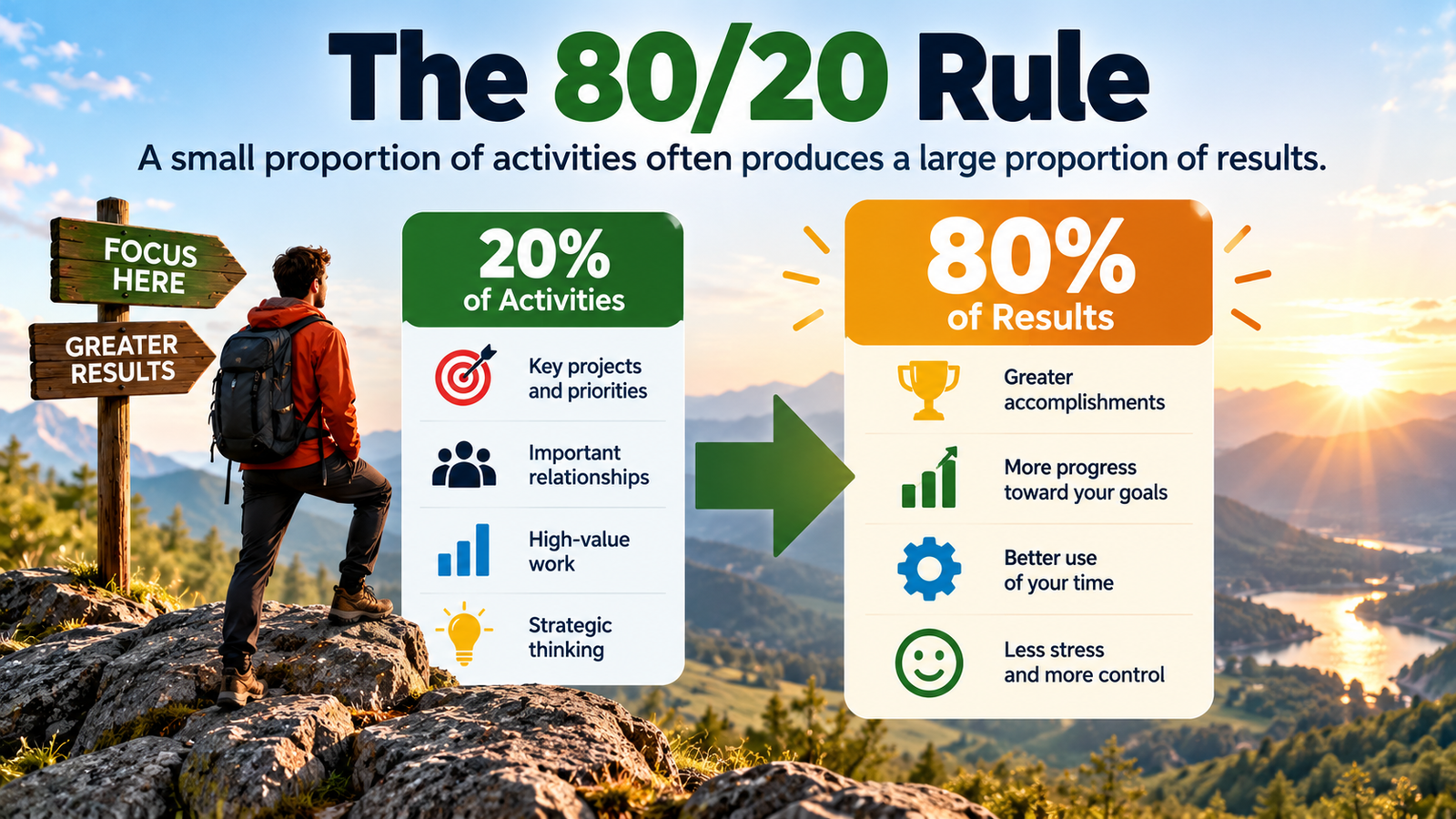
A small proportion of activities may create a disproportionately large share of results. The 80/20 ratio is a prioritization heuristic, not a guaranteed outcome.
How to apply it: Review your current responsibilities and identify the few activities that contribute most directly to your goals.
Then compare their importance with the amount of time you actually spend on them.
You may discover that your calendar doesn’t reflect your priorities.
4. Consider the Consequences: Think Beyond Today’s To-Do List
Here’s a useful way to evaluate any task:
What happens if you complete it?
And what happens if you don’t?
Tracy encourages considering the potential consequences of your activities, especially their long-term effects.
For example, spending an hour preparing for an important customer meeting may influence a valuable business relationship.
Spending the same hour reorganizing old files might make your workspace tidier but have little long-term impact.
Both activities require effort.
Their consequences are very different.
This is why important tasks are not always urgent.
Learning a new skill, improving your health, building professional relationships, or planning for the future may not have an immediate deadline.
But neglecting them repeatedly can have significant consequences.
How to apply it: Before prioritizing a task, ask yourself whether its outcome will matter in a week, a month, or a year.
Give greater attention to activities with meaningful long-term consequences.
5. Practice Creative Procrastination: Deliberately Delay the Unimportant
This might be the most surprising lesson in the book.
Tracy doesn’t suggest that you must stop postponing everything.
Instead, he argues that since you cannot do everything, you must deliberately postpone less valuable activities.
Think about that for a moment.
You will never finish every email, attend every event, read every article, or pursue every interesting opportunity.
Trying to do everything guarantees that some things will remain unfinished.
The question is whether you postpone important work or unimportant work.
Example: A business owner has three hours available.
They could spend those hours adjusting the design of their website, reviewing routine reports, or speaking with potential customers.
If customer acquisition is the company’s biggest challenge, sales conversations probably deserve priority.
Website improvements can wait unless they are blocking those conversations.
How to apply it: Identify one recurring activity that adds little value.
Can you eliminate it, reduce it, delegate it, or postpone it?
Creative procrastination isn’t neglecting responsibilities. It’s making intentional choices about limited time.
6. Use the ABCDE Method Continually: Give Every Task a Priority
A to-do list tells you what needs doing.
It doesn’t necessarily tell you what deserves your attention first.
Tracy’s ABCDE Method solves that problem by classifying tasks according to importance and consequences.
| Category | Meaning | Example |
|---|---|---|
| A | Must do; serious consequences if neglected | Resolve a critical delivery issue |
| B | Should do; relatively minor consequences | Prepare a routine team update |
| C | Nice to do; no significant consequences | Read an interesting industry article |
| D | Delegate to someone else | Assign a routine data compilation task |
| E | Eliminate because it isn’t necessary | Attend an irrelevant optional meeting |
If you have several A tasks, rank them A1, A2, A3, and so on.
Your A1 task becomes your primary frog.
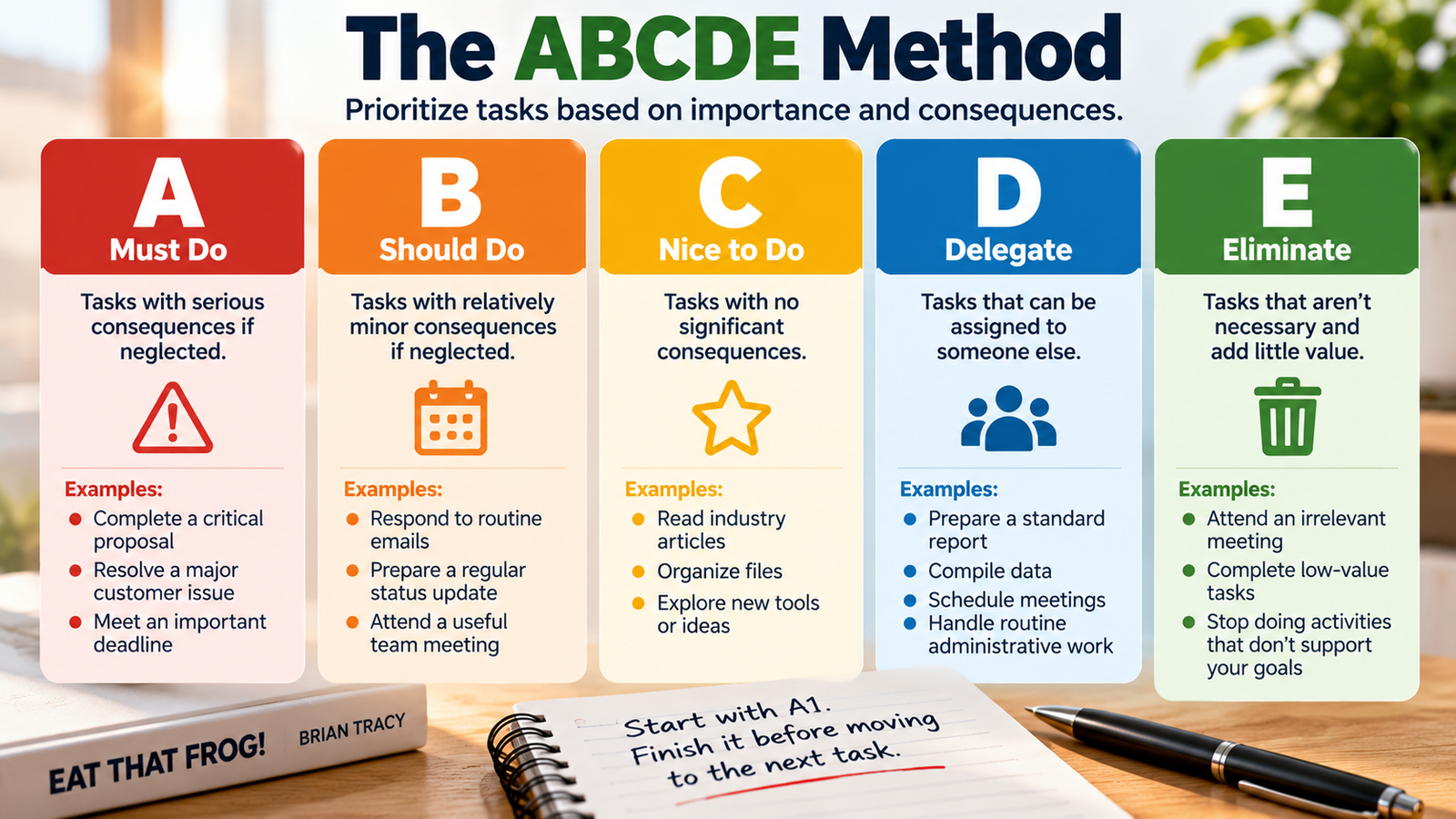
The ABCDE Method helps you prioritize tasks based on importance and consequences. Begin with A1 before moving to lower-priority work.
Example: A project manager has six tasks:
| Task | Priority |
|---|---|
| Resolve a critical security issue | A1 |
| Finalize tomorrow’s client proposal | A2 |
| Review a routine progress update | B |
| Read a new technology article | C |
| Ask an analyst to compile project metrics | D |
| Attend an optional meeting with no relevant agenda | E |
Instead of treating all six tasks equally, the manager now has a clear order of attention.
How to apply it: Write your task list and assign each activity an ABCDE category.
Start with A1 whenever circumstances allow.
A useful addition is to reassess priorities when genuinely new information arrives. A rigid list should not prevent you from responding to real emergencies.
7. Focus on Key Result Areas: Know What You’re Actually Paid to Achieve
Every job contains many activities.
But only some directly determine whether you’re successful.
Tracy calls these your key result areas.
For a project manager, these might include delivery planning, managing risks, coordinating stakeholders, and ensuring quality.
For a salesperson, they might include prospecting, understanding customer needs, developing proposals, and closing deals.
For a teacher, they might include lesson preparation, teaching, assessing understanding, and supporting student progress.
Being excellent at peripheral activities cannot fully compensate for poor performance in your core responsibilities.
Imagine a manager who prepares beautiful presentations, responds quickly to emails, and attends every meeting.
But their team regularly misses deadlines because risks are not identified early.
Despite being busy and organized, the manager is struggling in a key result area.
How to apply it: Identify five to seven outcomes that define success in your role.
Assess your performance in each area and identify the one weakness that most limits your effectiveness.
Improving that area may produce greater results than becoming even better at something you already do well.
8. Apply the Law of Three: Find Your Three Most Valuable Contributions
The Law of Three builds on the previous lesson.
Tracy argues that three core activities often account for a large proportion of the value you contribute at work.
Consider a business owner who spends their day answering messages, approving small purchases, reviewing invoices, and managing administrative details.
All those tasks may be necessary.
But perhaps the company’s success depends primarily on three activities:
- Acquiring profitable customers.
- Delivering an excellent product or service.
- Retaining existing customers.
If the owner neglects those three areas, administrative efficiency alone won’t save the business.
The Law of Three encourages you to identify the activities that matter most and protect time for them.
How to apply it: Ask yourself:
If I could perform only three activities exceptionally well in my current role, which three would create the greatest value?
Write them down.
Then review last week’s calendar.
Are those activities receiving the attention they deserve?
Part 2: Make Important Work Easier to Start
9. Prepare Thoroughly Before You Begin: Remove the Friction
Have you ever sat down to work on something important, only to discover that you were missing a document, a password, a report, or a piece of information?
You spend the next twenty minutes searching for it.
Then a notification appears.
Before long, the task you intended to start has disappeared from your attention.
Preparation matters because small obstacles can become convenient excuses for procrastination.
Tracy recommends getting everything ready before beginning.
Example: Suppose you need to prepare a financial presentation.
Before your focused work session, gather the relevant financial statements, templates, assumptions, and previous reports.
Now you can concentrate on analysis rather than hunting for information.
How to apply it: Before starting your frog, prepare the tools and information you need.
Then remove unrelated materials from your immediate workspace.
The important distinction is that preparation should support action, not replace it.
10. Take It One Oil Barrel at a Time: Stop Staring at the Entire Mountain
Large projects can feel overwhelming.
You look at the amount of work remaining and wonder how you’ll ever finish.
Tracy uses the image of progressing through a difficult journey one manageable section at a time.
The idea is simple: you don’t need to complete the entire journey in one movement.
You need to complete the next section.
Example: Imagine being responsible for implementing a new enterprise system.
The project includes requirements, architecture, development, testing, migration, training, and deployment.
Thinking about everything simultaneously can create unnecessary anxiety.
But identifying the next milestone makes progress more manageable.
Perhaps today’s priority is finalizing the requirements for one critical module.
That is something you can act on.
How to apply it: Divide large goals into meaningful milestones.
For each milestone, identify the next action you can complete.
When the overall project feels overwhelming, return your attention to the next visible step.
11. Upgrade Your Key Skills: Sometimes the Problem Isn’t Motivation
We often assume procrastination is a discipline problem.
But sometimes we avoid tasks because we don’t feel capable of completing them.
Imagine someone who must create a financial forecast but lacks confidence in spreadsheet modeling.
They might delay the task, not because they’re unwilling to work, but because they don’t know where to begin.
As their skills improve, the task becomes less intimidating.
Tracy encourages continuous learning because stronger capabilities can improve both performance and confidence.
How to apply it: Identify one skill gap that repeatedly slows you down.
Find a practical learning resource and create a regular practice schedule.
Don’t wait until you’re an expert to begin the task. Learn enough to take the next step, then continue improving.
12. Identify Your Key Constraints: Find the Real Bottleneck
Sometimes working harder doesn’t produce better results.
Why?
Because the real problem lies somewhere else.
Imagine a software development team working overtime to complete features.
Despite the additional effort, the release date keeps slipping.
After investigating, the manager discovers that testing environments are frequently unavailable.
More development hours won’t solve that problem.
The testing environment is the constraint.
Tracy encourages identifying the factor that most limits progress toward a goal.
This could be a missing skill, insufficient information, a slow approval process, or an external dependency.
How to apply it: Ask:
What is the single biggest factor preventing this goal from moving forward?
Investigate before answering.
Then focus on removing or reducing that constraint.
The key is to solve the problem that limits the whole system, not merely the problem that is easiest to see.
13. Put the Pressure on Yourself: Create Accountability Before Deadlines Force It
Think about how people behave when a deadline is approaching.
Tasks that seemed impossible to begin suddenly become urgent.
Distractions become less interesting.
Decisions happen faster.
Tracy encourages creating some of that momentum without waiting for an external deadline.
Set personal targets and hold yourself accountable.
Example: You have a report due Friday.
Instead of planning to finish it at the last moment, set a personal deadline to complete the first draft by Wednesday.
This creates time for feedback and unexpected problems.
How to apply it: Set realistic internal deadlines for important tasks.
For complex work, create intermediate checkpoints rather than relying on one final deadline.
Avoid turning self-imposed pressure into constant stress. The goal is commitment and momentum, not exhaustion.
14. Motivate Yourself into Action: Focus on What You Can Control
Not every workday goes according to plan.
Projects get delayed. Customers reject proposals. Difficult problems take longer than expected.
When things go wrong, it’s easy to focus on frustration.
Tracy encourages developing a constructive, optimistic attitude and directing attention toward possible solutions.
This doesn’t mean pretending problems are smaller than they are.
It means asking a more useful question.
Instead of thinking, “Everything is going wrong,” ask, “What can I do next that will improve the situation?”
Example: A client rejects your proposal.
You could spend the afternoon complaining about the decision.
Or you could review the feedback, identify weaknesses, and improve the next proposal.
The disappointment may remain, but your response becomes productive.
How to apply it: When you feel stuck, write down the problem and identify one action within your control.
Then take that action.
Motivation often becomes easier once progress begins.
Part 3: Take Control of Technology and Attention
The third edition places particular emphasis on technology and maintaining focus.
15. Technology Is a Terrible Master: Don’t Let Your Devices Set Your Priorities
Imagine you’re working on an important document.
Your phone vibrates.
You check the message.
While you’re there, you notice another notification.
Then you open an app, read a headline, and respond to a comment.
Ten minutes later, you return to the document.
But now you need to remember where you left off.
The interruption cost more than the time spent looking at your phone.
It also disrupted your concentration.
Tracy warns against allowing technology to control how we spend our time.
The issue isn’t that smartphones, email, or digital tools are inherently harmful.
It’s that they can turn us into reactive workers.
Instead of choosing our priorities, we repeatedly respond to whatever appears on a screen.
How to apply it: During demanding work, disable nonessential notifications and keep distracting apps out of reach.
Where your responsibilities permit, establish specific times for checking messages.
Your attention should be guided by your priorities, not by the next notification.
16. Technology Is a Wonderful Servant: Use Tools to Support Your Goals
After warning about technology, Tracy makes an equally important point.
Technology can be enormously useful when you control how it’s used.
The same smartphone that distracts you can help you manage your calendar, learn a new skill, communicate with colleagues, or capture important ideas.
The difference lies in whether technology serves your priorities.
Example: A project manager could spend an hour manually collecting routine status updates.
Alternatively, an appropriately configured project-management system might automatically consolidate the information.
That could free time for risk analysis, stakeholder decisions, or team support.
Technology creates value when it reduces unnecessary effort or improves outcomes.
How to apply it: Review the digital tools you use regularly.
Ask whether each tool helps you complete meaningful work or merely keeps you occupied.
Use automation, templates, reminders, and task-management tools where they genuinely simplify your responsibilities.
Don’t adopt new software simply because it promises greater productivity.
17. Focus Your Attention: Protect Your Ability to Concentrate
There is a difference between spending an hour at your desk and spending an hour fully engaged in meaningful work.
You might sit in front of a document for sixty minutes while repeatedly switching between messages, browser tabs, and unrelated tasks.
The clock says you’ve worked for an hour.
Your progress may tell a different story.
Tracy emphasizes the importance of controlling attention and reducing distractions.
Example: A professional preparing a strategy presentation reserves ninety minutes for focused work.
They close unrelated applications, silence nonessential notifications, and define a clear outcome: complete the presentation’s core argument.
At the end of the session, they have something meaningful to review.
Compare that with spending ninety minutes alternating between presentation slides, email, and instant messages.
The difference isn’t necessarily effort.
It’s the quality of attention.
How to apply it: Before starting a focused session, define one specific outcome.
Remove avoidable distractions and give that task your attention.
If interruptions are unavoidable in your role, create shorter protected sessions rather than abandoning the idea of focused work altogether.
Part 4: Turn Priorities into Consistent Action
18. Slice and Dice the Task: Make Starting Almost Effortless
Some tasks feel difficult because they are too large to approach comfortably.
Writing a book, preparing a business plan, studying for an examination, or launching a product can feel overwhelming when viewed as one enormous responsibility.
Tracy introduces two approaches to breaking down such work.
The salami slice method means dividing a large task into small pieces and completing them one at a time.
The Swiss cheese method means making small openings in the task by completing manageable portions whenever you can.
Both approaches reduce the resistance associated with getting started.
Example: Suppose you need to write a 30-page proposal.
Instead of demanding that you complete the entire document today, begin with the outline.
Then write the problem statement.
Next, develop the proposed solution.
Each completed section creates visible progress.
How to apply it: When you’re avoiding a large task, identify a portion you can complete in ten or fifteen minutes.
Start there.
You don’t need to feel ready to finish the entire task before beginning a small part of it.
19. Create Large Chunks of Time: Give Important Work Enough Space
Some tasks cannot be completed effectively in scattered five-minute intervals.
Strategic planning, analysis, writing, complex problem-solving, and learning difficult concepts often require sustained attention.
Tracy recommends reserving substantial blocks of time for important work.
Example: A business analyst needs to review complex requirements.
They could attempt the work between meetings, responding to messages every few minutes.
Or they could reserve a focused period specifically for reviewing the requirements and identifying gaps.
The second approach gives them a better opportunity to understand the material deeply.
How to apply it: Reserve a meaningful block of time for your frog.
For many knowledge-work tasks, 60–90 minutes can be a useful starting point, but adjust the duration to your concentration, schedule, and responsibilities.
Protect the session as you would an important appointment.
20. Develop a Sense of Urgency: Act Before Conditions Are Perfect
Have you ever delayed a task because you were waiting for the perfect moment?
You wanted more information, a quieter day, better motivation, or more confidence.
Sometimes additional preparation is necessary.
But sometimes waiting becomes a habit.
Tracy encourages a bias toward action.
Once you know what matters and have enough information to begin responsibly, move forward.
Example: An entrepreneur wants to validate a new business idea.
They could spend months perfecting presentations and studying competitors.
Or they could prepare a basic concept and speak with potential customers to understand whether the problem is worth solving.
The second approach may provide valuable information much sooner.
How to apply it: Identify one task you’ve been postponing because conditions don’t feel ideal.
Ask what information is genuinely necessary to begin.
If you already have enough, take the first meaningful step today.
Urgency should accelerate responsible action, not replace judgment.
21. Single Handle Every Task: Finish What Matters
The final technique brings the book’s main argument together.
Once you’ve selected your most important task, stay focused on it until it’s completed.
Tracy calls this single handling.
The idea is to resist the temptation to constantly switch between unfinished activities.
Imagine writing an important proposal.
You work for ten minutes, check email, return to the proposal, respond to a message, and then attend to something unrelated.
Each switch creates another opportunity to lose momentum.
Single handling encourages sustained attention.
Example: A manager must prepare a difficult but important performance review.
They gather the necessary information, reserve time, prepare the discussion points, and finish the preparation before moving to less important work.
They don’t repeatedly abandon the task whenever something easier appears.
How to apply it: Define what completion looks like before beginning.
Work toward that outcome and avoid unnecessary switching.
For tasks that require multiple days or input from others, complete the next meaningful stage rather than expecting the entire project to finish in one sitting.
The Four Frameworks That Make Eat That Frog! Practical
The 21 techniques become easier to remember when organized into four complementary frameworks.
Framework 1: The 80/20 Rule — Find the Work That Creates Value
Use the 80/20 Rule to identify activities that contribute disproportionately to your goals.
Don’t assume that every task deserves equal time.
Ask which activities produce meaningful results.
Framework 2: The ABCDE Method — Decide What Comes First
Once you’ve identified your responsibilities, use the ABCDE Method to rank them.
This prevents low-value activities from taking priority simply because they are easier or more visible.
Framework 3: The Law of Three — Protect Your Core Responsibilities
Identify the three activities that contribute most to your success.
Use them as a guide when planning your week and deciding which commitments to accept.
Framework 4: Single Handling — Turn Decisions into Results
After choosing your most important task, protect your attention and work toward a clear outcome.
Prioritization without execution changes very little.
Together, these frameworks create a practical sequence:
Identify value → Prioritize → Prepare → Execute → Review
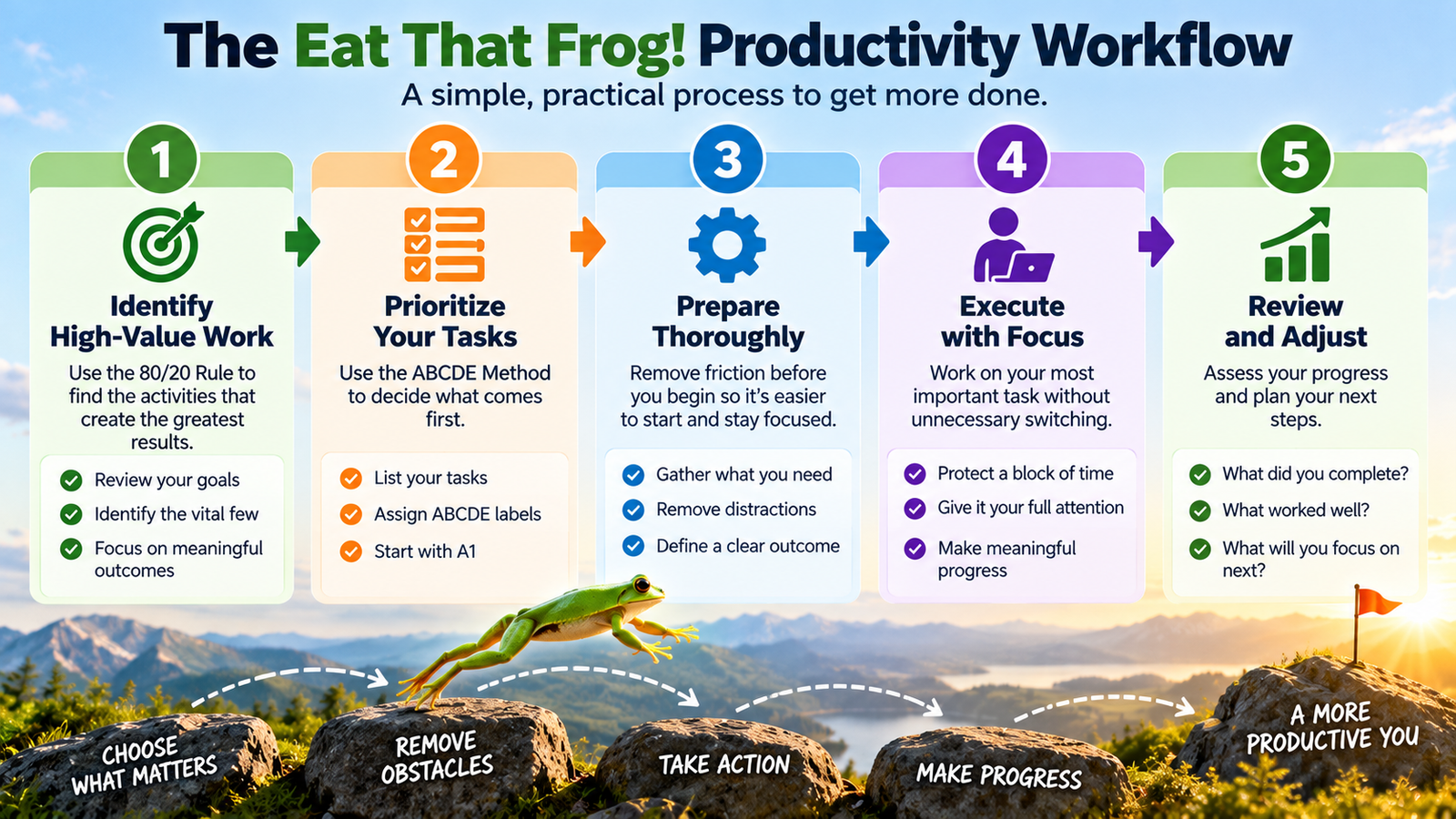
A five-step productivity system inspired by Brian Tracy’s principles: identify what matters, prioritize, prepare, execute with focus, and review progress.
A Practical Example: Eating the Frog as a Project Manager
Let’s bring these ideas together.
Imagine you’re managing an enterprise software implementation scheduled for release in six weeks.
Your Monday task list looks like this:
| Task | Estimated time |
|---|---|
| Review 30 emails | 45 minutes |
| Attend a routine status meeting | 30 minutes |
| Resolve a critical integration dependency | 90 minutes |
| Update the project dashboard | 30 minutes |
| Prepare a steering committee presentation | 60 minutes |
| Review team timesheets | 20 minutes |
You have several hours of work ahead of you.
Without prioritization, you might start with emails because they are familiar and easy to handle.
Then you attend the status meeting.
Next, you update the dashboard.
By lunchtime, you’ve completed several tasks.
But the critical integration dependency remains unresolved.
If that issue delays testing, it could threaten the release schedule.
Using the ABCDE Method, you identify the integration dependency as A1.
You reserve time to investigate it, coordinate with the responsible teams, and agree on a resolution plan.
Perhaps you cannot solve the entire problem immediately.
But you can remove uncertainty, assign responsibilities, and establish a realistic next step.
That progress may be more valuable than completing several administrative tasks.
The lesson: Your frog isn’t always a task you can finish alone. Sometimes it’s the important decision, conversation, or obstacle that unlocks progress for everyone else.
Why Do We Procrastinate Even When We Know What Matters?
One limitation of many productivity systems is that they assume procrastination is mainly a planning problem.
Sometimes it is.
But not always.
Consider someone who needs to prepare an important presentation.
They know it’s important.
They have enough time.
They even have a clear task list.
Yet they continue postponing it.
Why?
Perhaps they are worried the presentation won’t be good enough.
Perhaps they don’t understand the subject.
Perhaps the task feels too large.
Or perhaps they’re mentally exhausted.
In these situations, the problem may involve emotions, skills, energy, or uncertainty—not simply poor time management.
This distinction matters because different causes require different responses.
| Why you’re procrastinating | What may help |
|---|---|
| The task feels overwhelming | Break it into smaller steps |
| You don’t know where to begin | Define the next concrete action |
| You’re afraid of making mistakes | Create an imperfect first draft |
| You lack the required skills | Learn or request support |
| You’re constantly interrupted | Protect focused work time |
| You’re exhausted | Rest and adjust your workload |
| The task doesn’t feel meaningful | Clarify its consequences and purpose |
Tracy’s methods address several of these problems effectively, especially task clarity, prioritization, and starting friction.
However, persistent procrastination related to anxiety, burnout, or other difficulties may require support beyond productivity techniques.
Five Mistakes People Make When Applying Eat That Frog!
Mistake 1: Choosing the Most Difficult Task Instead of the Most Valuable
The hardest task isn’t always the most important.
You might spend hours solving a complicated but insignificant problem while ignoring a simpler decision that could create much greater value.
Choose your frog based on meaningful consequences.
Mistake 2: Treating Every Urgent Request as a Priority
Urgency and importance are not the same thing.
Some urgent tasks genuinely require immediate attention.
Others merely reflect someone else’s poor planning or preference.
Before changing your priorities, consider the consequences of the interruption.
Mistake 3: Spending Too Much Time Planning
Planning should make action easier.
If you spend an hour organizing a task-management system for something that takes twenty minutes, planning may have become procrastination.
Create enough structure to begin, then start.
Mistake 4: Ignoring Dependencies
Some tasks require information, approval, or contributions from other people.
Trying to complete them independently may be unrealistic.
In these situations, your frog might be resolving the dependency rather than doing the entire task yourself.
Mistake 5: Confusing Productivity with Working Longer
The purpose of prioritization isn’t to fill every available minute with more work.
It’s to direct your limited attention toward meaningful results.
Rest, recovery, and sustainable working habits remain important.
The Seven-Day Eat That Frog Challenge
Reading productivity advice can be motivating.
But unless you change how you work, the motivation eventually fades.
Here’s a seven-day challenge designed to turn the book’s main principles into a practical routine.
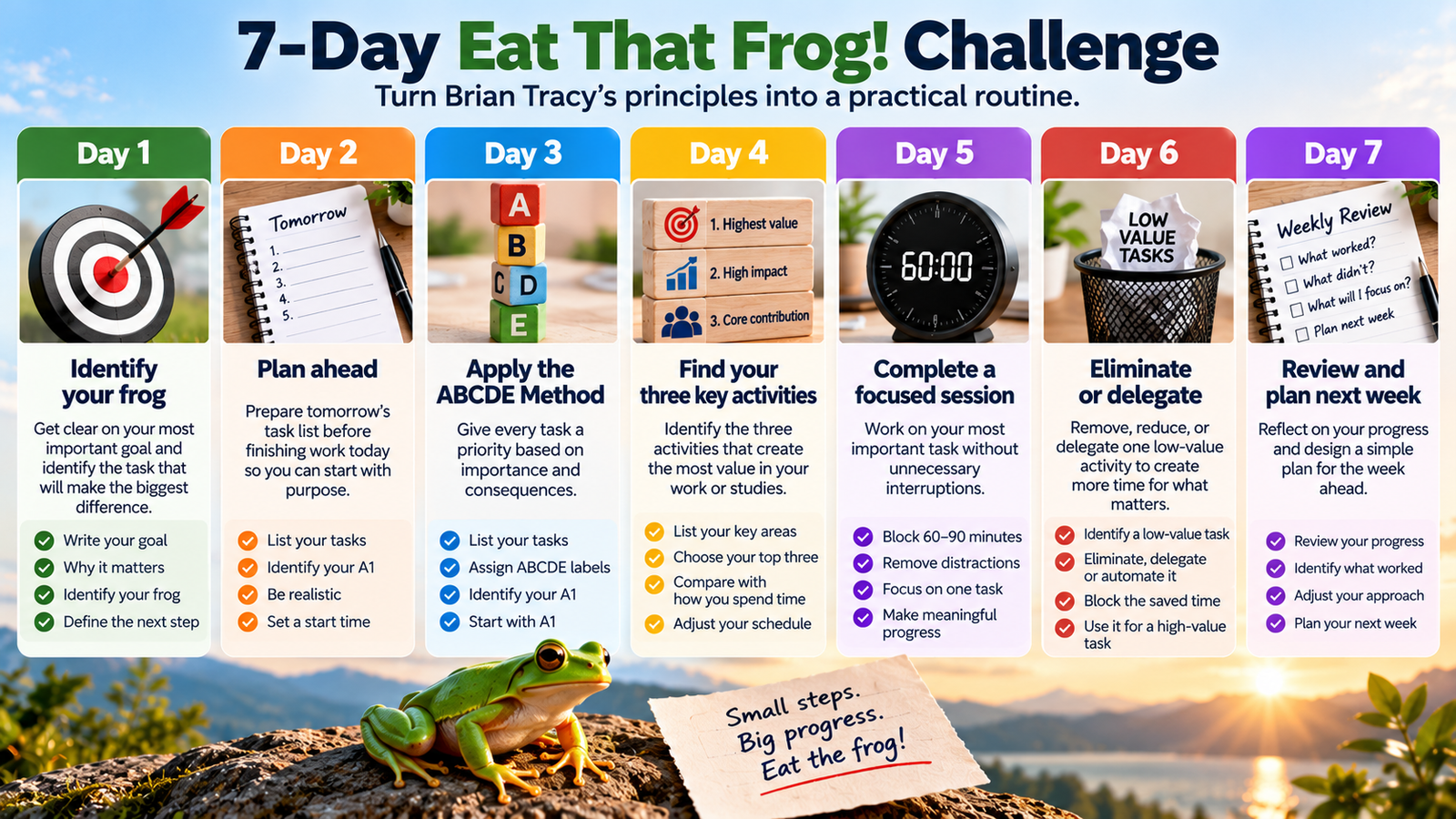
Turn Brian Tracy’s productivity principles into action with seven daily exercises to build focus, improve prioritization, and overcome procrastination.
| Day | Challenge | Expected outcome |
|---|---|---|
| Day 1 | Identify your most important goal and current frog | Clarity |
| Day 2 | Plan tomorrow before finishing today | Better preparation |
| Day 3 | Apply the ABCDE Method | Clearer priorities |
| Day 4 | Identify your three highest-value activities | Better focus |
| Day 5 | Complete one uninterrupted work session | Meaningful progress |
| Day 6 | Eliminate, reduce, or delegate one low-value task | More available time |
| Day 7 | Review what worked and plan the following week | Consistency |
A Simple Daily Routine
Each morning, answer four questions:
- What is my most important task today?
- Why does it matter?
- What’s the first concrete action?
- When will I give it my undivided attention?
At the end of the day, ask one more question:
Did I make meaningful progress on my most important task?
The goal isn’t to achieve seven perfect days.
It’s to learn how to make better decisions about your attention and repeat those decisions consistently.
Eat That Frog! Cheat Sheet: All 21 Lessons at a Glance
| # | Principle | One action to remember |
|---|---|---|
| 1 | Set the Table | Define your goals clearly |
| 2 | Plan Every Day in Advance | Prepare tomorrow’s priorities |
| 3 | Apply the 80/20 Rule | Find your highest-value activities |
| 4 | Consider the Consequences | Think about long-term impact |
| 5 | Practice Creative Procrastination | Postpone low-value work |
| 6 | Use the ABCDE Method | Start with your A1 task |
| 7 | Focus on Key Result Areas | Know your core responsibilities |
| 8 | Apply the Law of Three | Identify your three most valuable contributions |
| 9 | Prepare Thoroughly | Remove obstacles before starting |
| 10 | Take It One Oil Barrel at a Time | Focus on the next milestone |
| 11 | Upgrade Your Key Skills | Improve skills that limit progress |
| 12 | Identify Your Key Constraints | Find and address the bottleneck |
| 13 | Put the Pressure on Yourself | Create personal accountability |
| 14 | Motivate Yourself into Action | Focus on controllable actions |
| 15 | Technology Is a Terrible Master | Control digital interruptions |
| 16 | Technology Is a Wonderful Servant | Use tools to support priorities |
| 17 | Focus Your Attention | Protect concentration |
| 18 | Slice and Dice the Task | Break big tasks into small pieces |
| 19 | Create Large Chunks of Time | Schedule focused work |
| 20 | Develop a Sense of Urgency | Act without unnecessary delay |
| 21 | Single Handle Every Task | Work toward completion |
Who Should Read Eat That Frog!?
This book is especially useful for people who feel busy but struggle to make progress on important goals.
Working professionals can use it to distinguish meaningful contributions from routine activity.
Managers and team leaders can apply its principles to prioritization, delegation, and resolving important problems.
Entrepreneurs may benefit from identifying the activities that most directly influence customers, revenue, and business growth.
Students can use its techniques to organize studying, tackle difficult subjects, and avoid last-minute preparation.
People who feel overwhelmed may appreciate the book’s simple, structured approach to managing competing responsibilities.
However, readers seeking an in-depth scientific explanation of procrastination or a comprehensive system for managing collaborative projects may need additional resources.
My Takeaways: What Eat That Frog! Gets Right and Where It Falls Short
1. Productivity Is a Decision-Making Skill Before It’s a Time-Management Skill
One of the book’s strongest insights is that better time management begins with better choices.
You can work efficiently on the wrong things.
You can finish your tasks quickly and still fail to make meaningful progress.
That’s why prioritization deserves more attention than simply working faster.
Before asking how to complete something, ask whether it deserves your attention.
2. Your Frog Changes as Your Responsibilities Change
The task that matters most today may not be the task that matters most next month.
A new employee might need to focus on learning essential skills.
A team leader might need to resolve a conflict affecting performance.
A business owner might need to improve profitability.
As your responsibilities change, your priorities must change with them.
Eating your frog isn’t about following one permanent routine.
It’s about repeatedly identifying what matters most.
3. The Book Is Strong on Action but Less Complete on the Emotional Side of Procrastination
Tracy provides useful tools for planning, prioritizing, and getting started.
But procrastination isn’t always a simple failure of discipline.
People sometimes avoid tasks because of anxiety, perfectionism, uncertainty, exhaustion, or fear of failure.
In those cases, additional strategies may be necessary.
This doesn’t make the book’s advice ineffective.
It means its techniques are most useful when matched to the real cause of procrastination.
4. Doing the Hardest Thing First Isn’t Always the Best Interpretation
The phrase “eat that frog” is often reduced to doing the most difficult task first thing in the morning.
That’s too simplistic.
Your frog should be chosen primarily for its importance and consequences.
And the best time to work on it depends on your schedule, energy, and responsibilities.
For some people, morning is ideal.
For others, a protected afternoon session may work better.
The deeper principle is to give your highest-value work access to your best available attention.
5. The Book Works Best When Prioritization Becomes a Habit
Completing one important task can make a day feel productive.
But the greater benefit comes from repeating the process.
When you regularly identify important work, prepare in advance, and protect time for execution, you begin making different decisions automatically.
Over time, the question changes from “What can I finish quickly?” to “What deserves my attention most?”
That is a more meaningful definition of productivity.
Is Eat That Frog! Worth Reading?
Yes, especially if you struggle with procrastination, prioritization, or finishing important tasks.
The book’s biggest strength is its practicality.
You don’t need complicated software or an elaborate productivity system.
Most techniques can be applied using a notebook, a calendar, and a willingness to make deliberate choices.
The advice is accessible, and many principles can be implemented immediately.
However, the book also has limitations.
Some techniques overlap, and readers familiar with productivity literature may recognize several concepts.
The book places substantial emphasis on personal discipline, which may not fully address problems caused by organizational dysfunction, excessive workload, emotional difficulties, or unclear responsibilities.
Even so, it provides a useful foundation for deciding what deserves your time and following through.
If you’re constantly busy but rarely satisfied with your progress, it’s a book worth considering.
Frequently Asked Questions
What is the main message of Eat That Frog!?
The main message is to identify your most important task and complete it before less valuable activities consume your time and attention.
What does “eat the frog” mean?
Eating the frog means tackling your most important and potentially challenging task instead of repeatedly postponing it.
What is the ABCDE Method?
The ABCDE Method is a task-prioritization framework. A tasks are essential, B tasks should be done, C tasks are optional, D tasks can be delegated, and E tasks can be eliminated.
What is the 80/20 Rule in Eat That Frog!?
The 80/20 Rule encourages you to identify the relatively small number of activities responsible for a large proportion of your results and give those activities priority.
Should I eat my frog first thing in the morning?
Morning can be a useful time for focused work, but it’s not mandatory. The important principle is to tackle high-value work before avoidable distractions consume your attention.
How can students apply Eat That Frog!?
Students can identify their most important academic task, break it into manageable study sessions, reduce distractions, and begin with challenging or high-impact material.
What is the difference between Eat That Frog! and Atomic Habits?
Eat That Frog! focuses primarily on prioritization, procrastination, and completing important tasks.
Atomic Habits by James Clear focuses on how small behavioral changes, environmental design, and repeated actions contribute to habit formation.
The books complement each other: one helps you decide what to do, while the other helps you make useful behaviors more consistent.
What is the difference between Eat That Frog! and Deep Work?
Eat That Frog! helps you choose and complete high-priority tasks.
Deep Work by Cal Newport focuses more specifically on the ability to concentrate without distraction on cognitively demanding activities.
Used together, they can help you identify important work and create the conditions needed to complete it.
Final Takeaway: Don’t Confuse a Full Day with a Meaningful Day
At the end of a busy day, it’s tempting to measure productivity by how much you’ve done.
How many emails did you answer?
How many meetings did you attend?
How many tasks did you cross off your list?
But imagine two people.
The first completes fifteen small tasks and leaves one important problem unresolved.
The second completes only four tasks, but one of them removes a major obstacle, advances an important goal, or creates significant value.
Who had the more productive day?
The answer isn’t always the person with the longer completed checklist.
That’s the lesson at the heart of Brian Tracy’s Eat That Frog!.
You don’t need to finish everything.
You need to become better at recognizing what matters and giving it the attention it deserves.
So before you begin tomorrow, ask yourself:
If I could complete only one important task today, which one would make the biggest difference?
Write it down.
Make a plan.
And start there.
That’s your frog.
Eat it first.