Have you ever achieved something you worked hard for—a promotion, a salary increase, a new house, or a major personal goal—only to discover that the happiness didn’t last as long as you expected?
You reach one milestone, celebrate briefly, and almost immediately start chasing the next.
Life becomes a never-ending list of things to accomplish.
But what if happiness isn’t something waiting for you at the finish line?
What if it’s something you can experience while living your ordinary, everyday life?
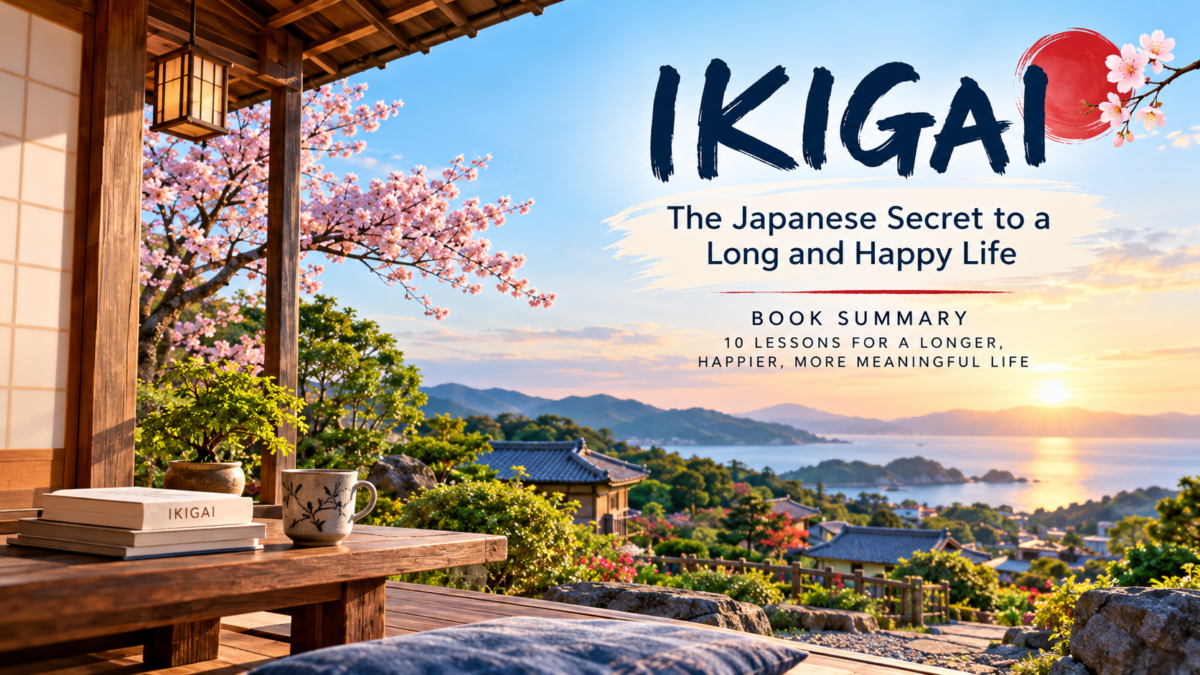
That is the central idea explored in Ikigai: The Japanese Secret to a Long and Happy Life by Héctor García and Francesc Miralles.
The authors travel to Okinawa, Japan, to explore why some people remain active, socially connected, and engaged with life well into old age.
What they discover is not a magic formula for happiness or longevity. Instead, they describe a way of living built around purpose, meaningful relationships, simple pleasures, gentle movement, and staying mentally engaged.
The most important lesson from Ikigai is this: You don’t need an extraordinary life to find extraordinary meaning in it.
You need a reason to get up in the morning—and a way of living that makes the journey worthwhile.
Ikigai Book Summary in 60 Seconds
Book: Ikigai: The Japanese Secret to a Long and Happy Life
Authors: Héctor García and Francesc Miralles
Main message: A fulfilling life comes from having reasons to live, staying active, nurturing relationships, and appreciating the present.
Best for: Professionals, entrepreneurs, students, retirees, and anyone searching for more meaning and balance.
Biggest takeaway: Purpose doesn’t have to be your job, a grand mission, or a single passion. It can come from everyday activities and relationships that make life worth living.
This Ikigai book summary explores the practical ideas behind the authors’ philosophy of meaningful living. Each lesson includes simple examples and actionable steps you can apply to your everyday life.
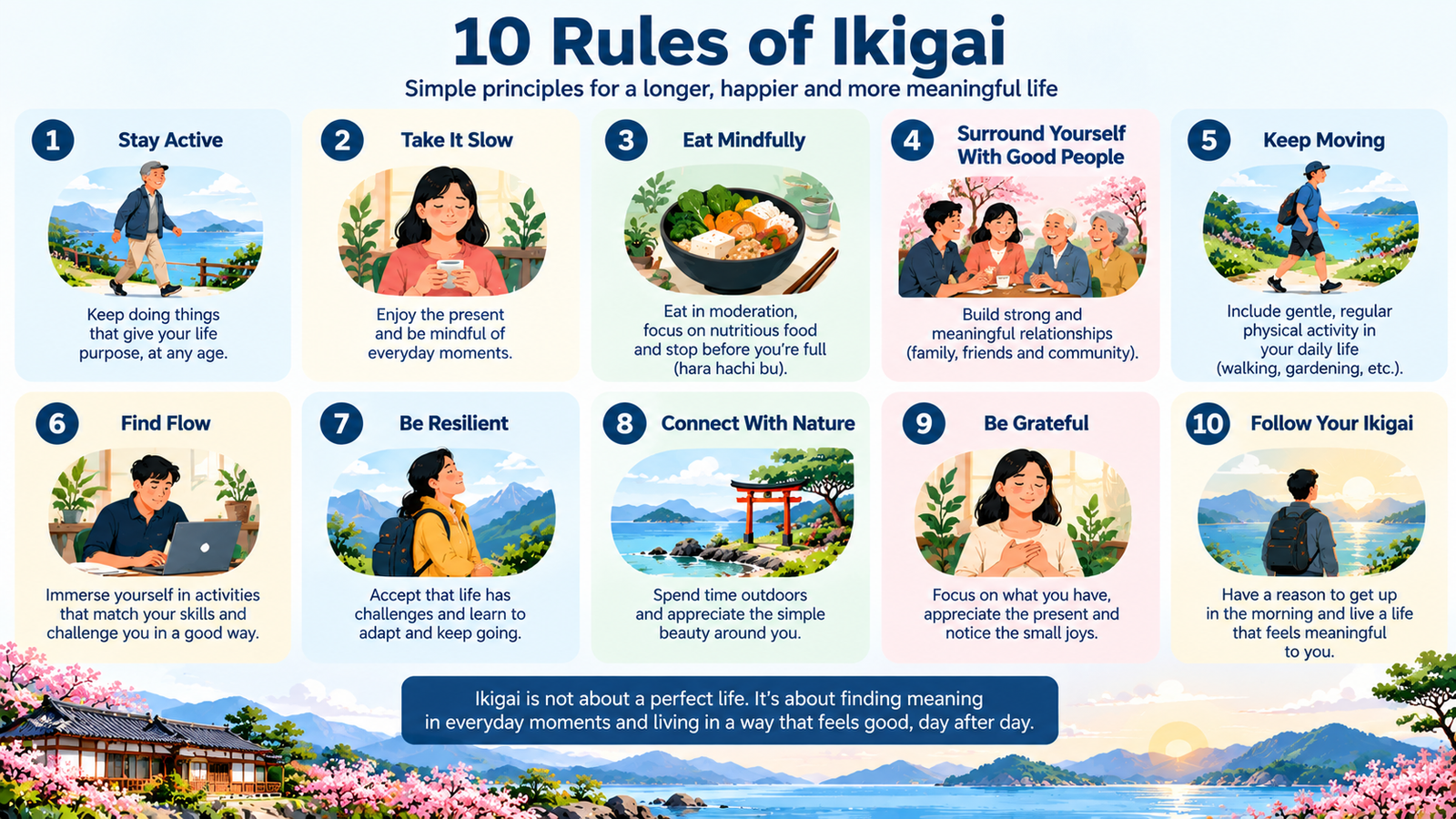
10 key lessons from Ikigai
- Find reasons to get up in the morning.
- Stay active and engaged throughout life.
- Slow down and enjoy the present.
- Develop a healthier relationship with food.
- Build meaningful friendships and communities.
- Keep your body moving.
- Practice mindfulness and experience flow.
- Develop resilience when life becomes difficult.
- Reconnect with nature and simple pleasures.
- Practice gratitude and appreciate the life you have.
These lessons synthesize the book’s major themes and concluding principles; they are not presented as the authors’ exact chapter titles.
What Is Ikigai?
Ikigai is a Japanese concept commonly explained as a reason for living, or something that makes life feel worthwhile.
In their book Ikigai: The Japanese Secret to a Long and Happy Life, Héctor García and Francesc Miralles explore how purpose, meaningful relationships, and everyday habits contribute to a fulfilling life. You can learn more about the book through its official publisher page.
The word combines iki, relating to life, and gai, relating to worth or value.
Imagine two people waking up on a Monday morning.
The first person immediately thinks about unfinished work, pending emails, and everything they must accomplish before Friday.
The second person also has responsibilities, but looks forward to something meaningful: helping a colleague, working on a craft, spending time with family, or tending a garden.
Both people may face similar pressures.
The difference is that the second person has something they genuinely value in everyday life.
That sense of meaning is close to the heart of ikigai.
Is ikigai the intersection of four circles?
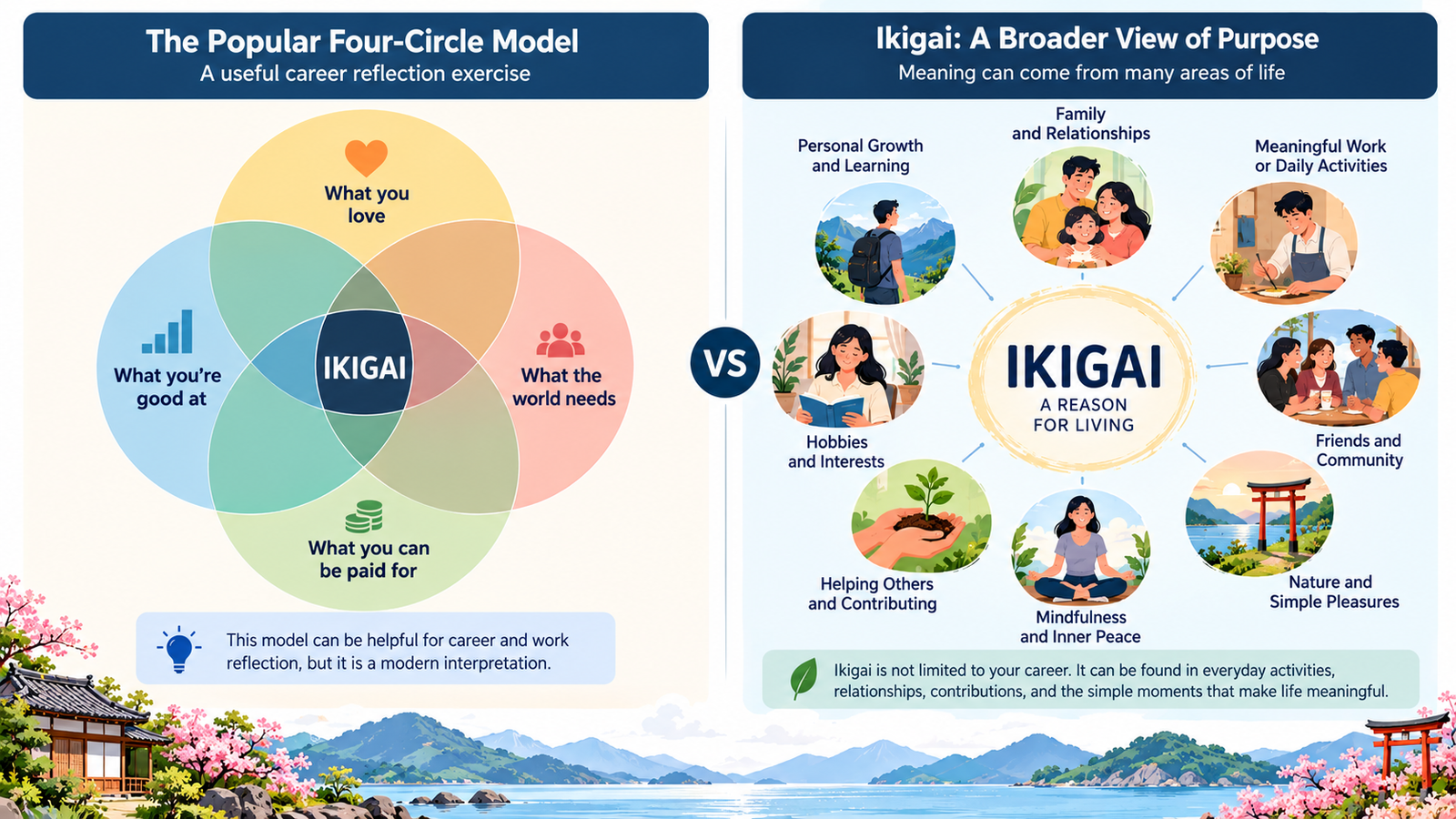
You may have seen the popular ikigai diagram showing four overlapping circles:
- What you love
- What you’re good at
- What the world needs
- What you can be paid for
This can be a useful career-reflection exercise, but it is not the traditional definition of ikigai.
Ikigai does not require you to earn money from your passion or turn everything meaningful into a career.
A grandparent caring for grandchildren, a retired teacher mentoring students, or someone enjoying their garden can experience ikigai without receiving payment.
This distinction matters because purpose should enrich your life, not become another performance target.
Lesson 1: Find Your Reason to Get Up in the Morning
One of the most important questions in the book is deceptively simple:
What makes you want to wake up tomorrow?
Your answer doesn’t have to be impressive.
It might be raising your children, creating something useful, helping others, improving a skill, or spending time with someone you love.
Consider a professional who has spent 15 years climbing the corporate ladder.
They have a good salary, a respected position, and a comfortable lifestyle.
Yet every Monday feels exhausting.
Why?
Perhaps they have become so focused on achieving success that they have lost touch with what makes that success meaningful.
Their job answers the question, “What do I do?”
But it may not answer, “Why does it matter to me?”
How to apply this lesson
Ask yourself three questions:
- What activities make me feel genuinely alive?
- When do I feel useful or connected to something meaningful?
- What would I continue doing even without recognition?
Look for recurring themes rather than forcing yourself to identify one perfect life purpose.
Remember: Your ikigai can change as you move through different stages of life.
Lesson 2: Stay Active—Don’t Retire From Life
The book emphasizes remaining engaged with meaningful activities as we grow older.
In the Okinawan communities described by the authors, older adults often continue gardening, socializing, helping family members, and participating in community life.
The deeper message isn’t that everyone should continue working forever.
It’s that retiring from a job doesn’t mean retiring from having a purpose.
Imagine someone who has spent 35 years building a successful career.
After retirement, their schedule suddenly becomes empty.
No meetings. No deadlines. No team depending on them.
Initially, the freedom feels wonderful.
But without meaningful activities, they may begin to feel disconnected.
Now imagine that same person mentoring younger professionals, volunteering, gardening, or learning music.
They no longer have a full-time job, but they still have reasons to look forward to tomorrow.
How to apply this lesson
Build an identity bigger than your professional title.
Develop interests, relationships, and contributions that can continue even when your career changes.
You don’t have to remain busy all the time. The goal is meaningful engagement, not endless productivity.
Lesson 3: Slow Down to Enjoy Life
We often assume that doing more means living better.
More meetings. More achievements. More possessions. More commitments.
But being constantly busy can make it difficult to appreciate what we already have.
The book encourages a slower, more intentional relationship with everyday life.
Imagine having breakfast with your family while simultaneously checking messages.
You’re physically present, but mentally you’re already at work.
You finish eating without remembering much of the conversation.
Now imagine putting the phone away and giving your family your full attention.
The breakfast takes the same amount of time.
But the experience feels different.
How to apply this lesson
Choose one everyday activity and do it without multitasking.
It could be your morning tea, a walk, dinner with family, or a conversation with a friend.
You don’t need to slow down every aspect of your life.
Start by protecting a few moments from unnecessary urgency.
Lesson 4: Eat Mindfully, Not Excessively
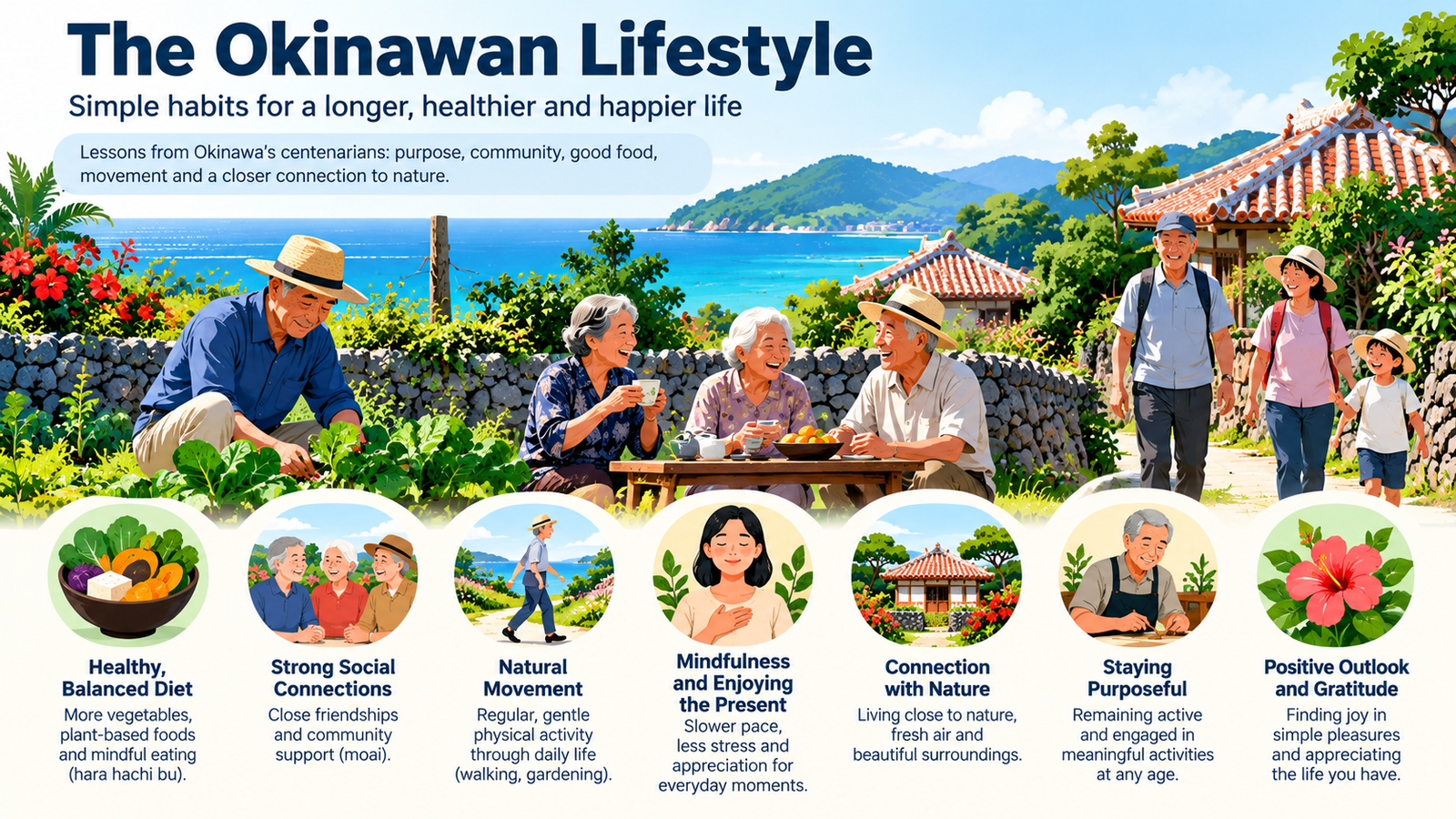
The book discusses the Okinawan principle of hara hachi bu, commonly described as eating until you’re about 80% full.
Rather than eating until you feel completely stuffed, the idea encourages moderation and awareness.
The authors also discuss traditional Okinawan dietary patterns, including vegetables and plant-based foods.
However, it’s important to distinguish cultural practices from medical evidence.
The 80% figure is a traditional rule of thumb, not a scientifically precise fullness measurement. Okinawan longevity also cannot be attributed to diet alone.
How to apply this lesson
Try eating more slowly, paying attention to hunger and fullness, and avoiding automatic overeating.
Focus on balanced, nourishing meals rather than turning a cultural principle into a restrictive diet.
The broader lesson is to build a sustainable relationship with food.
Lesson 5: Build Relationships That Make Life Meaningful
One of the book’s most memorable themes is the importance of community.
The authors describe moai, traditional Okinawan social groups that provide friendship, connection, and sometimes mutual support.
Think about the people you can call when life becomes difficult.
Not the hundreds of contacts on your phone.
The few people who genuinely care about you.
These relationships provide something that professional success alone cannot guarantee: belonging.
Imagine two people with equally demanding jobs.
One goes home and spends every evening scrolling through social media.
The other makes time for family dinners, regular conversations with friends, and occasional community activities.
Over time, their emotional experiences may differ substantially.
The point isn’t that socializing automatically produces happiness.
It’s that meaningful relationships create opportunities for support, joy, and connection.
How to apply this lesson
Make relationships part of your calendar rather than something you attend to only when time remains.
Reconnect with an old friend, share a meal without phones, or build a small circle around a shared interest.
A meaningful life is rarely built in isolation.
Lesson 6: Keep Moving, Even If You Don’t Love Exercise
The book highlights gentle, regular movement rather than focusing exclusively on intense workouts.
Walking, gardening, stretching, and everyday physical activity can all contribute to an active lifestyle.
This is encouraging because many people struggle to maintain complicated fitness routines.
You don’t necessarily need a gym membership to begin moving more.
You need opportunities to make movement part of your day.
How to apply this lesson
Walk during some phone calls, take short movement breaks, stretch after sitting, and choose physical activities you enjoy.
Regular movement supports health, although individual exercise needs vary. It should complement—not replace—appropriate medical care.
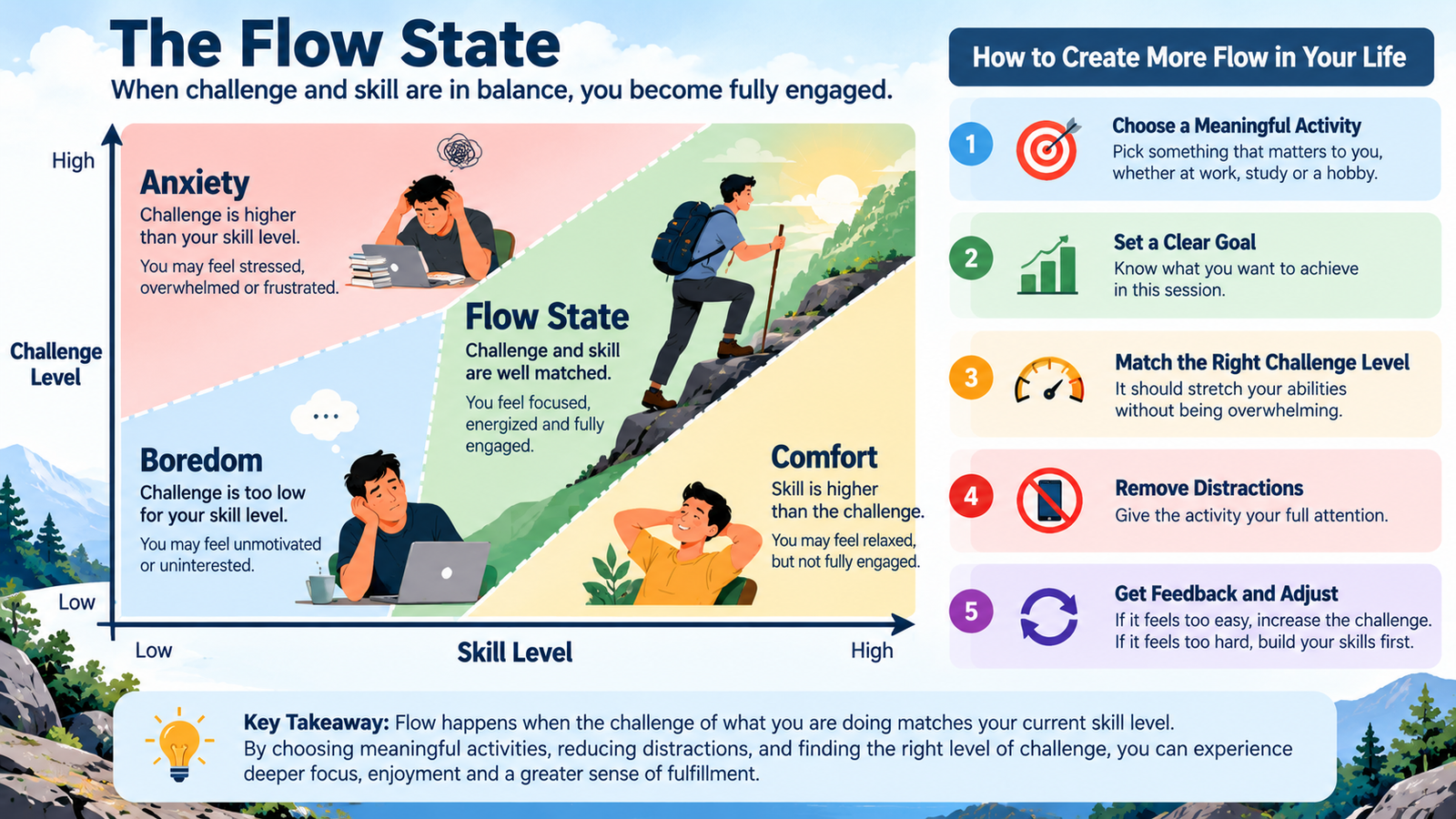
Lesson 7: Find Flow in What You Do
Have you ever become so absorbed in an activity that you forgot to check the time?
Maybe you were writing, designing, coding, painting, solving a difficult problem, or playing music.
That state of deep involvement is called flow, a concept developed by psychologist Mihaly Csikszentmihalyi and explored in the book.
Flow often becomes more likely when an activity offers clear goals, useful feedback, and a good balance between challenge and skill.
If something is too easy, you may become bored.
If it’s far beyond your current abilities, you may feel overwhelmed.
But when the challenge stretches your abilities without completely exceeding them, deep engagement becomes more possible.
Practical example
Imagine a software developer learning a new programming language.
Repeating beginner exercises may feel boring.
Attempting to build a complex production system immediately may feel frustrating.
But building a small application that requires learning a few new skills could create an engaging challenge.
How to apply this lesson
Choose a meaningful activity, remove distractions, define a clear objective, and adjust the difficulty to match your current ability.
Lesson 8: Develop Resilience Without Expecting a Perfect Life
The book explores resilience through Japanese philosophy and ideas associated with acceptance, imperfection, and impermanence.
A meaningful life doesn’t require everything to go according to plan.
Careers change. Relationships evolve. Health and circumstances can shift unexpectedly.
Resilience involves learning to respond to these changes without losing every sense of direction.
Consider someone whose business fails.
They could interpret that failure as proof that their entire life has lost meaning.
Or they could acknowledge the disappointment while recognizing that their relationships, skills, values, and capacity to contribute still exist.
The second response doesn’t erase the pain.
It simply leaves room for rebuilding.
How to apply this lesson
When something goes wrong, separate the event from your identity.
Instead of thinking, “I failed, therefore I am a failure,” ask:
What happened, what can I learn, and what remains within my control?
Acceptance isn’t the same as giving up. It can be the starting point for thoughtful action.
Lesson 9: Reconnect With Nature and Simple Pleasures
The book encourages appreciating everyday experiences rather than depending entirely on major achievements.
A morning walk.
A quiet garden.
A conversation with a neighbor.
A cup of tea enjoyed without rushing.
These moments may appear ordinary, but they can contribute to a satisfying life.
The challenge is that modern life constantly encourages us to look for the next exciting thing.
A new phone, a better car, a bigger house, another vacation.
There is nothing inherently wrong with ambition or material comfort.
But when happiness depends exclusively on what comes next, the present becomes something to rush through.
How to apply this lesson
Spend a little time outdoors, notice your surroundings, and make room for simple activities that don’t need to produce measurable results.
Not every meaningful moment needs to be productive.
Lesson 10: Practice Gratitude and Appreciate the Present
The book concludes with principles that include gratitude, smiling, reconnecting with nature, and living in the moment.
Gratitude doesn’t mean pretending that everything is wonderful.
It means recognizing what remains valuable even when life is imperfect.
You can be grateful for your family while still worrying about your career.
You can appreciate your health while working to improve it.
You can enjoy today’s progress while pursuing tomorrow’s goals.
These feelings can coexist.
How to apply this lesson
At the end of each day, identify one experience you appreciated, one person who made a difference, and one meaningful action you took.
Keep the exercise simple enough to continue.
A Seven-Day Ikigai Challenge
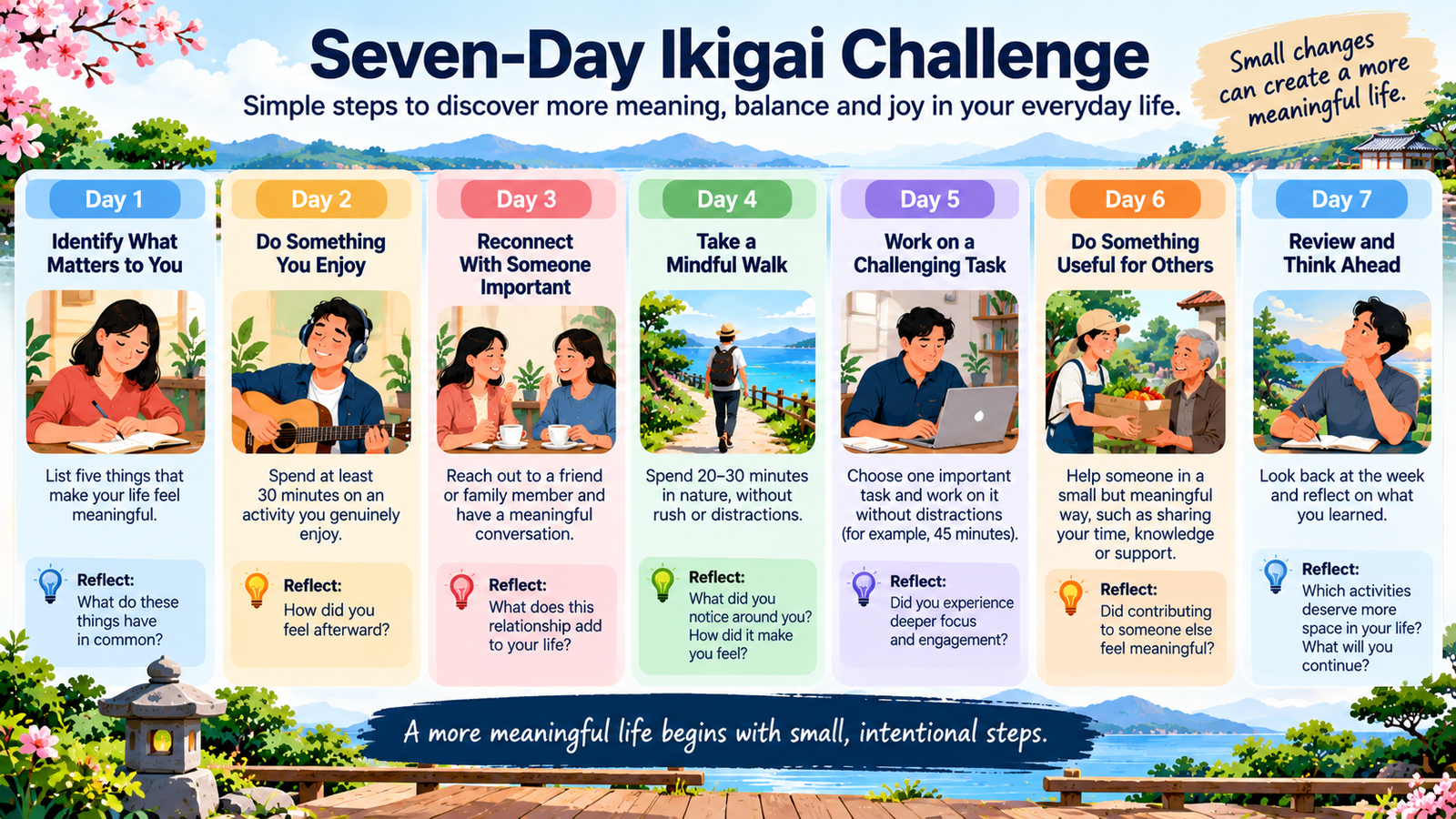
Understanding ikigai is useful. Experimenting with it makes the ideas more personal.
| Day | Activity | Reflection |
|---|---|---|
| 1 | List five things that make life meaningful | What do they have in common? |
| 2 | Spend 30 minutes on an enjoyable activity | How did you feel afterward? |
| 3 | Reconnect with someone important | What does this relationship add to your life? |
| 4 | Take a mindful walk | What did you notice? |
| 5 | Work on one challenging task without distractions | Did you experience deeper engagement? |
| 6 | Do something useful for another person | Did contributing feel meaningful? |
| 7 | Review the week | Which activities deserve more space in your life? |
Ikigai Cheat Sheet
| Principle | Core idea | Everyday application |
|---|---|---|
| Purpose | Have reasons to live | Identify meaningful activities |
| Active living | Remain engaged | Keep learning and contributing |
| Slowing down | Reduce unnecessary urgency | Practice single-tasking |
| Moderation | Eat mindfully | Notice hunger and fullness |
| Community | Maintain social connections | Make time for relationships |
| Movement | Stay physically active | Walk and stretch regularly |
| Flow | Become deeply engaged | Match challenge with skill |
| Resilience | Adapt to difficulties | Focus on controllable actions |
| Simple pleasures | Appreciate ordinary experiences | Spend time outdoors |
| Gratitude | Notice what matters | Reflect on daily positives |
Common Mistakes When Applying Ikigai
Mistake 1: Believing you must discover one perfect purpose. Purpose can be plural, modest, and changeable.
Mistake 2: Assuming your passion must become your profession. Meaningful activities don’t always need to generate income.
Mistake 3: Treating ikigai as another productivity technique. The philosophy concerns the value of living, not merely getting more done.
Mistake 4: Copying Okinawan lifestyle habits without context. Community, history, culture, diet, and environmental conditions interact. There is no guarantee that copying a single habit will reproduce Okinawan longevity.
Mistake 5: Expecting to feel happy every day. A meaningful life can include stress, grief, uncertainty, and disappointment.
Who Should Read Ikigai?
This book is particularly relevant if you’re successful but feel unfulfilled, approaching retirement, reconsidering your priorities, struggling to balance work and life, or simply interested in Japanese perspectives on well-being.
Its greatest strength is accessibility. The authors bring together stories, philosophy, psychological concepts, and lifestyle observations in a way that encourages reflection.
Its main limitation is that it blends cultural observations, self-help advice, and scientific discussions without always providing the depth needed to establish strong causal conclusions.
Readers seeking rigorous longevity science should supplement it with dedicated research.
My Takeaways: What Ikigai Gets Right—and What It Oversimplifies
The most valuable insight in Ikigai is that meaning doesn’t have to be dramatic.
We often associate purpose with starting a company, changing the world, achieving financial independence, or discovering a lifelong calling.
But meaningful living can also involve helping a child learn something, preparing a meal for family, improving a skill, or being present for a friend.
This makes the idea accessible.
You don’t need to wait until you’ve achieved financial freedom or found your dream career to begin building a more meaningful life.
At the same time, we should be careful about treating purpose as a proven explanation for exceptional longevity.
The lives of older Okinawans are shaped by many interacting influences. Observations from a particular community do not establish that one philosophy causes people to live longer.
The popular four-circle diagram also risks reducing ikigai to a career-planning formula.
The more useful interpretation is broader: your life can contain multiple sources of meaning, and not all of them need to be impressive, profitable, or permanent.
Final Takeaway: A Good Life Is More Than a Successful Life
The biggest takeaway from this Ikigai book summary is that happiness doesn’t always come from achieving more. Sometimes, it comes from slowing down, nurturing relationships, finding purpose in everyday activities, and appreciating what you already have.
Many of us spend years asking how to become more successful.
How can I earn more?
How can I achieve more?
How can I move ahead faster?
Ikigai encourages us to ask a different question:
What would make the life I’m already living feel more meaningful?
Perhaps the answer involves changing your career.
But perhaps it begins with a conversation, a hobby, a walk, a contribution, or a few minutes of undivided attention.
You don’t necessarily have to redesign your entire life.
Sometimes, you need to rediscover what makes your ordinary days worth living.
Frequently Asked Questions About Ikigai
What is the main message of Ikigai?
The book argues that a meaningful, satisfying life is supported by having reasons to live, remaining active, nurturing relationships, and appreciating everyday experiences.
What does ikigai mean in English?
Ikigai is commonly translated as a reason for living or something that makes life worth living. No single English phrase captures every nuance of the Japanese concept.
What are the four elements of ikigai?
The popular four-circle diagram includes what you love, what you’re good at, what the world needs, and what you can be paid for. It is a modern framework, not a definitive traditional Japanese explanation of ikigai.
What are the 10 rules of ikigai?
The book’s concluding principles emphasize staying active, slowing down, moderation in eating, friendship, physical fitness, smiling, nature, gratitude, living in the moment, and following your ikigai.
Can ikigai help you live longer?
A sense of purpose and several lifestyle factors discussed in the book have been associated with well-being and health outcomes in research. However, the book does not establish that practicing ikigai directly causes a longer life.
Is Ikigai worth reading?
Yes, particularly for readers seeking an accessible introduction to purpose, meaningful routines, Japanese lifestyle ideas, and healthy aging. It is best approached as reflective popular nonfiction rather than a definitive scientific guide.
How can I find my ikigai?
Start by noticing which activities give you enjoyment, meaning, connection, or a sense of contribution. Experiment with making more time for those activities rather than expecting one sudden discovery.