
What if changing your life starts not with getting more, but with becoming clearer about what you truly want?
Have you ever looked at someone else’s life and wondered how they seem to have everything figured out?
They have a fulfilling career, meaningful relationships, financial stability, and the confidence to pursue what they want.
Meanwhile, you might be working hard, meeting responsibilities, and doing everything you’re supposed to do—yet still feel that something is missing.
You have goals. You have dreams. But somehow, your everyday life doesn’t seem to be moving toward them.
What if the problem isn’t a lack of effort, but a lack of clarity about where that effort should go?
That’s the question at the heart of Manifest: 7 Steps to Living Your Best Life by Roxie Nafousi.
In this Manifest book summary, we’ll explore the seven steps, what they mean, how to apply them in everyday life, and whether manifestation can genuinely help you achieve your goals.
We’ll also examine the science behind some of the practices, common misconceptions, and the limitations of relying on positive thinking alone.
The central lesson is worth remembering:
You cannot always control what happens to you, but you can become more intentional about what you want, what you believe, and what you do next.
Manifest in 60 Seconds
| Book details | Information |
|---|---|
| Book | Manifest: 7 Steps to Living Your Best Life |
| Author | Roxie Nafousi |
| First published | 2022 |
| Genre | Self-Help, Personal Development, Mindset |
| Main concept | Manifestation through vision, self-belief, aligned behavior, gratitude, and trust |
| Best for | People seeking clarity, confidence, direction, and personal growth |
The big idea: Manifestation is not just about imagining the future you want. Nafousi teaches that your vision, beliefs, emotions, and behavior need to work together.
The most practical lesson: Know what you want, challenge what holds you back, and take consistent action toward your goals.
One important caution: Positive thinking may influence your choices and motivation, but it cannot guarantee external outcomes.
What Is Manifest About?
Imagine getting into a taxi and telling the driver, “Take me somewhere nice.”
The driver would probably ask, “Where exactly?”
Without a destination, even the best driver cannot take you where you want to go.
Life can work the same way.
Many people spend years working hard without clearly defining what success means to them.
They chase promotions, follow social expectations, buy things they don’t need, and compare themselves with people whose lives they barely understand.
Yet they rarely stop to ask:
Is this actually the life I want?
Roxie Nafousi believes meaningful change begins by answering that question.
Her book introduces manifestation as a self-development practice that combines clear intentions, visualization, self-belief, emotional awareness, gratitude, and purposeful behavior.
It also includes a spiritual belief that the universe can help bring desired outcomes into your life.
You don’t have to accept every spiritual claim to benefit from the book’s practical exercises.
A useful way to understand the process is:
Clarity gives you direction. Self-belief gives you courage. Action creates progress.
Who Is Roxie Nafousi?
Roxie Nafousi is a British self-development coach, author, and speaker known for popularizing manifestation as a personal growth practice.
Her bestselling book Manifest organizes the concept into seven steps, making it approachable for readers who want to feel more confident, intentional, and empowered.
Unlike productivity books that focus primarily on schedules and systems, Nafousi places significant emphasis on self-worth, emotional patterns, and the relationship between inner beliefs and outward behavior.
Her official website explains the seven steps of manifestation and the philosophy behind her approach.
The 7 Steps Explained: Manifest Book Summary
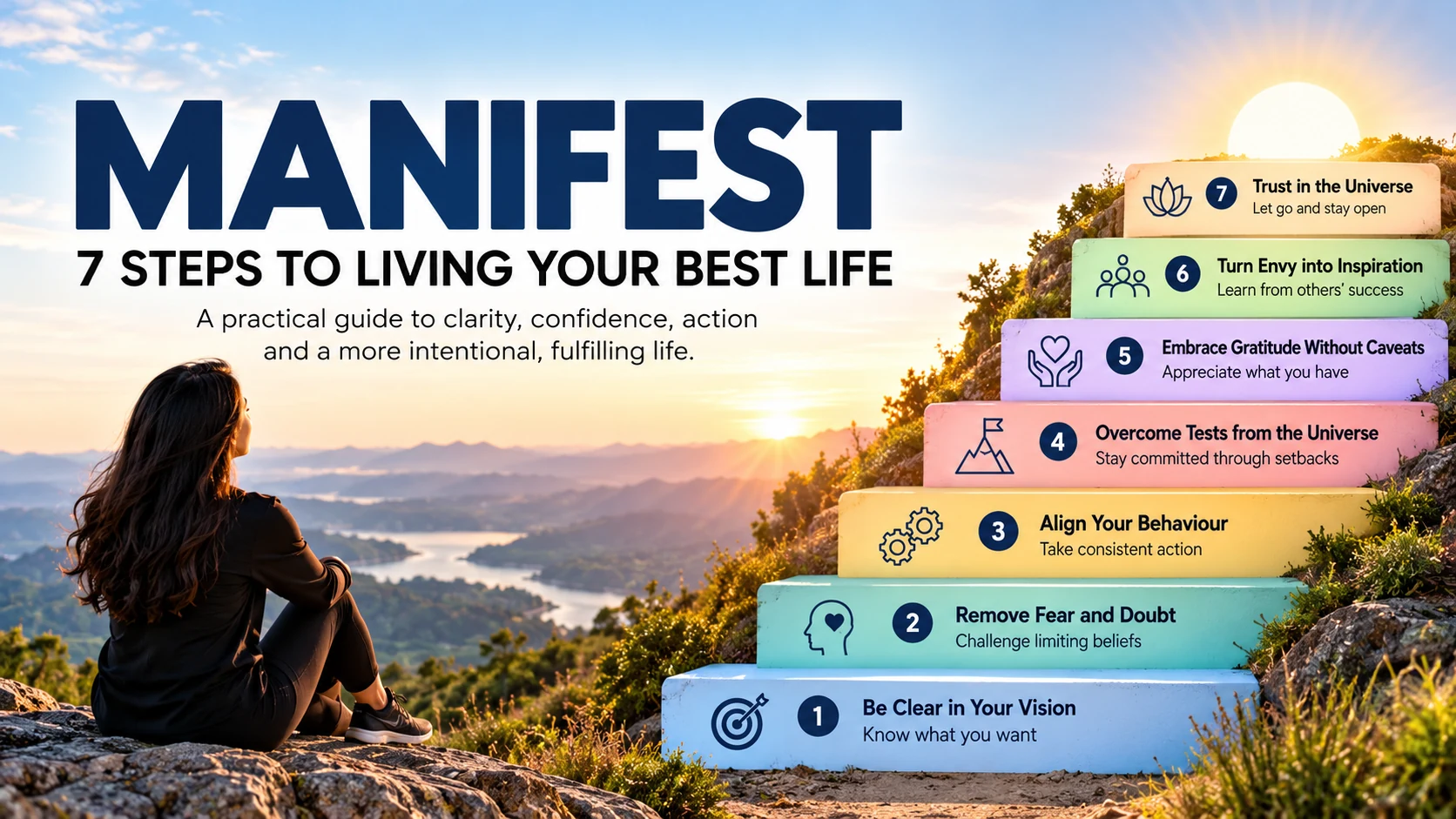
Nafousi’s framework contains seven interconnected steps. Each focuses on a different aspect of pursuing the life you want.
Let’s explore what each step means, why it matters, and how you can apply it.
Step 1: Be Clear in Your Vision
Imagine someone saying, “I want to be successful.”
What does successful mean?
A high-paying job? A profitable business? Financial independence? More time with family? Better health?
Without clarity, success becomes a moving target.
Nafousi’s first step encourages you to define your desires rather than pursue vague ambitions.
Why clarity matters
When your goals are unclear, almost every opportunity looks attractive.
You might accept responsibilities that don’t interest you, chase promotions you don’t want, or spend money on things that don’t improve your life.
Clarity helps you distinguish meaningful opportunities from distractions.
A practical example
Suppose you’re unhappy in your current job.
Your immediate thought might be, “I need a better job.”
But what does better mean?
After reflecting, you might realize that your biggest frustrations aren’t related to salary. You want greater autonomy, opportunities to mentor others, and more time with your family.
Suddenly, your goal changes.
Instead of applying for every higher-paying position, you start looking for roles that offer flexibility and meaningful leadership responsibilities.
The clearer your vision, the more intentional your decisions become.
How to apply Step 1
Write down what you want your life to look like three years from now.
Consider your career, finances, health, relationships, personal growth, and daily routine.
Then ask yourself:
- Why does this matter to me?
- Is this something I genuinely want?
- Am I pursuing it because it matters to me or because others expect it?
- What is one action I can take this week?
Don’t worry about creating a perfect vision.
Start with an honest one.
Remember: A meaningful goal is more useful than an impressive goal that doesn’t belong to you.
Step 2: Remove Fear and Doubt
Sometimes the biggest obstacle isn’t a lack of opportunity.
It’s the belief that you’re not capable of taking advantage of one.
You might think:
“I’m not good enough.”
“I don’t have the right experience.”
“What if I fail?”
“People like me don’t achieve things like that.”
These thoughts can become invisible barriers.
Nafousi emphasizes identifying limiting beliefs and strengthening your sense of self-worth.
Why it matters
Fear can influence decisions long before you recognize its presence.
You might avoid applying for a promotion, starting a business, expressing an opinion, or pursuing a relationship because you’ve already imagined rejection.
You reject yourself before anyone else has the chance.
A practical example
Consider an experienced professional who wants to become a manager.
They have strong technical skills and regularly support colleagues.
But whenever a leadership position opens, they hesitate.
Their internal story is, “I’m not leadership material.”
Instead of treating that thought as a fact, they could ask what evidence supports it.
Perhaps they already mentor junior colleagues, resolve conflicts, and coordinate projects.
They may not have every required skill, but they have a foundation to build on.
The next step could be volunteering to lead a small initiative.
Confidence doesn’t always come before action.
Sometimes action creates confidence.
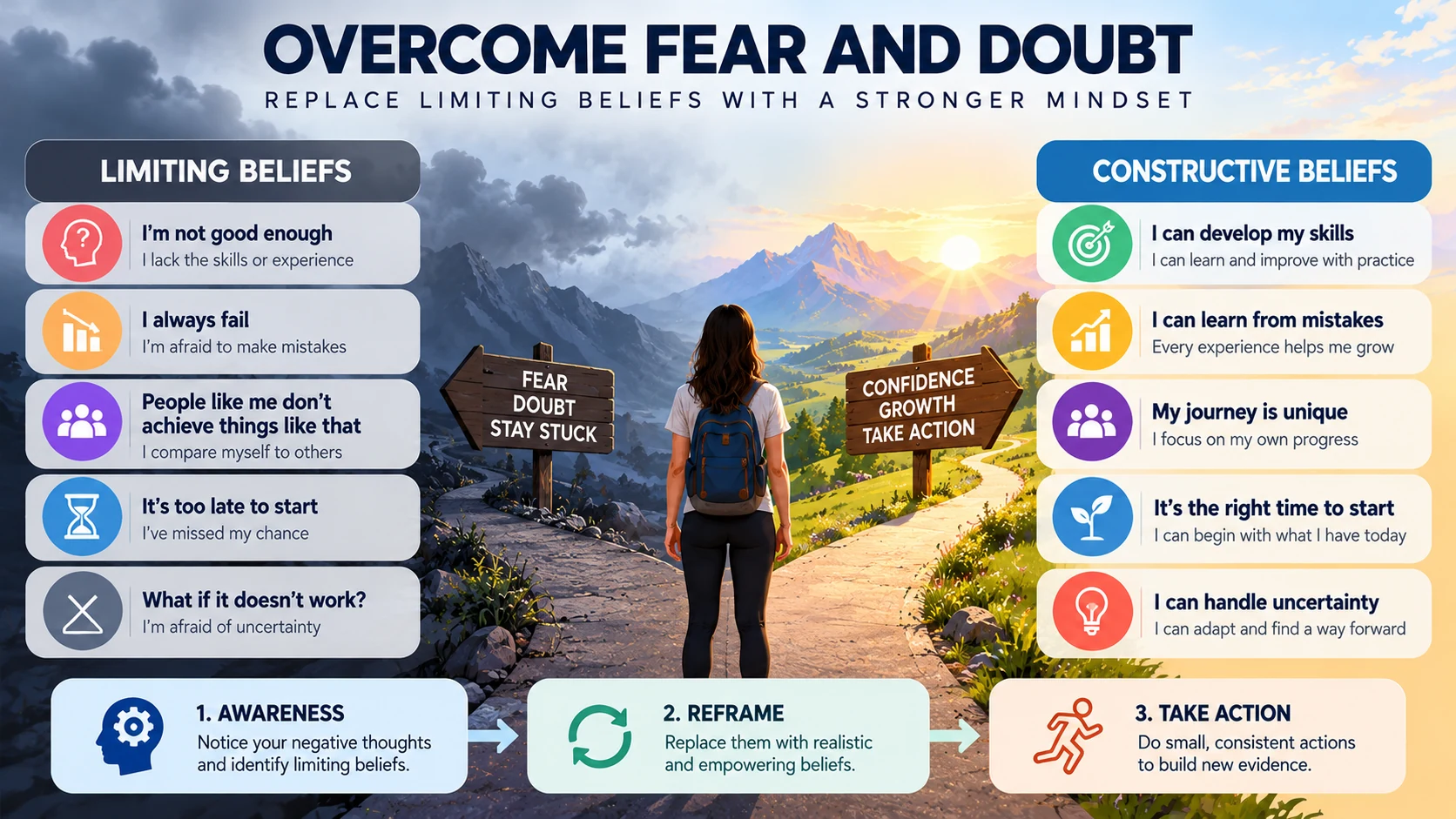
How to apply Step 2
Identify one belief that has been holding you back.
Then replace it with a constructive statement grounded in reality.
| Limiting belief | Constructive alternative |
|---|---|
| I’m not good enough | I can improve through practice and feedback |
| I always fail | I can learn from setbacks |
| I’m too old to begin | I can start with the resources I have |
| Other people are better than me | I can learn from people with more experience |
| What if it doesn’t work? | I can prepare, experiment, and adapt |
The goal isn’t to convince yourself that failure is impossible.
It’s to recognize that uncertainty doesn’t have to prevent you from trying.
Step 3: Align Your Behaviour
This may be the most important practical lesson in the entire book.
You can visualize becoming healthier every morning.
But if your daily habits consistently undermine your health, visualization alone won’t produce the change you want.
You can dream about becoming an entrepreneur.
But if you never speak to potential customers, test ideas, or develop a product, the business remains a dream.
Nafousi’s third step emphasizes behaving in ways that support the future you want.
Why it matters
Your intentions describe where you want to go.
Your behavior determines whether you move in that direction.
When your goals and actions contradict each other, progress becomes difficult.
A practical example
Imagine two professionals who want to become better leaders.
The first spends time imagining a future executive role but avoids responsibility and difficult conversations.
The second also has a clear vision but starts practicing delegation, giving feedback, developing team members, and taking accountability.
Who is more likely to develop leadership skills?
The second person is actively building the capabilities required for the desired role.
Their behavior supports their ambition.
How to apply Step 3
Ask yourself:
If I were becoming the person I want to be, what would I do differently today?
Then identify one small action.
If you want to become a writer, write for 20 minutes.
If you want to improve your finances, review your spending.
If you want to become a better leader, have the conversation you’ve been avoiding.
If you want stronger relationships, give someone your full attention.
Don’t wait for your life to change before changing your behavior.
Remember: Your daily choices should support the future you’re trying to create.
Step 4: Overcome Tests from the Universe
You decide to start exercising regularly, but suddenly your schedule becomes chaotic.
You launch a business, but your first customers aren’t interested.
You apply for your dream job, but you don’t get selected.
What happens next?
Nafousi describes difficult moments like these as tests from the universe.
Within her spiritual framework, challenges can become opportunities to demonstrate commitment and trust.
A more practical interpretation is that setbacks are a normal part of pursuing meaningful goals.
Why it matters
Many people interpret obstacles as proof that they’re on the wrong path.
But difficulty doesn’t always mean your goal is wrong.
Sometimes your approach needs adjustment.
A practical example
An entrepreneur launches an online service and receives very little interest.
They have two choices.
They can conclude that the business will never succeed.
Or they can interview potential customers, understand their problems, improve the offering, and test a different approach.
The second response turns disappointment into information.
That doesn’t guarantee success, but it creates an opportunity to learn.
How to apply Step 4
When something goes wrong, ask:
- What happened, without exaggeration or self-blame?
- What can I learn from this experience?
- What can I change?
- Is this goal still worth pursuing?
Resilience doesn’t mean blindly continuing with a strategy that isn’t working.
Sometimes resilience means adapting. Sometimes it means recognizing that a different direction would serve you better.
Remember: A setback is an event, not a verdict on your future.
Step 5: Embrace Gratitude Without Caveats
Many people postpone happiness until they achieve something.
“I’ll be happy when I get promoted.”
“I’ll relax when I buy a house.”
“I’ll feel successful when I earn more.”
But once they reach that milestone, another one appears.
The finish line keeps moving.
Nafousi encourages readers to appreciate their present circumstances while continuing to pursue their ambitions.
Why it matters
Ambition can help you grow, but constantly focusing on what you lack can make it difficult to appreciate what you already have.
Gratitude creates space for both progress and contentment.
A practical example
Imagine a manager who misses an expected promotion.
They feel disappointed, and that feeling is understandable.
But they can also recognize that they’ve developed valuable skills, built strong relationships, and gained meaningful experience.
Appreciating those things doesn’t erase the disappointment.
It simply prevents one setback from defining their entire situation.
How to apply Step 5
Every evening, write down three things you appreciate.
Make them specific.
Instead of writing, “I’m grateful for my family,” write, “I’m grateful that we had dinner together without distractions.”
Instead of writing, “I’m grateful for my job,” write, “I’m grateful that I learned something valuable from today’s challenging meeting.”
The details make gratitude more meaningful.
Remember: You can appreciate your present life while working to improve it.
Step 6: Turn Envy into Inspiration
You’re scrolling through social media when you see an old colleague announcing an impressive promotion.
You feel happy for them.
Then another thought appears.
Why not me?
Comparison is natural.
But what you do with that feeling matters.
Nafousi encourages readers to transform envy into inspiration.
Why it matters
Envy can reveal desires you haven’t fully acknowledged.
If you’re jealous of someone’s flexible career, perhaps freedom matters deeply to you.
If you’re jealous of someone publishing a book, perhaps you’ve been neglecting your own creative ambitions.
Instead of feeling ashamed of envy, you can examine what it’s trying to tell you.
A practical example
You discover that a former colleague has built a successful business.
Rather than assuming they were simply lucky, you could explore how they developed their skills, found customers, and handled challenges.
You might even ask them for advice.
Their success becomes a source of learning rather than resentment.
How to apply Step 6
The next time you feel envious, complete these statements:
- I feel envious because…
- What I actually want is…
- One thing I admire about this person is…
- One lesson I can learn is…
- One action I can take toward my own goal is…
You don’t need someone else’s life.
You need a clearer understanding of what matters in your own.
Remember: Someone else’s success doesn’t automatically reduce your opportunities.
Step 7: Trust in the Universe
The final step is the most spiritual part of Nafousi’s framework.
She encourages readers to trust the process and release excessive attachment to outcomes.
Within her philosophy, this involves believing that the universe can support your desires.
For readers who prefer a secular interpretation, the lesson can be understood as accepting uncertainty while continuing to act responsibly.
Why it matters
You can control your preparation, effort, choices, and responses.
But you cannot control every outcome.
You can prepare for an interview, but you cannot force the employer to select you.
You can start a business, but you cannot guarantee market demand.
You can invest in a relationship, but you cannot control another person’s feelings.
Trying to control everything can create unnecessary anxiety.
A practical example
A professional applies for a dream job.
They research the organization, prepare carefully, practice interview questions, and communicate their experience confidently.
After the interview, they stop replaying every answer and continue exploring other opportunities.
They remain committed to their career goals without allowing one decision to define their self-worth.
How to apply Step 7
Divide a page into two columns.
| What I can control | What I cannot control |
|---|---|
| My preparation | Other people’s decisions |
| My effort | Market conditions |
| My communication | Everyone’s reactions |
| My daily habits | The exact timing of results |
| My response to setbacks | Unexpected events |
Focus most of your energy on the first column.
Trust doesn’t have to mean believing everything will happen exactly as you imagine.
It can mean believing that you can respond constructively even when life doesn’t follow your plan.
Remember: Commitment and acceptance can exist together.
How to Turn Manifestation into Real Progress
Understanding the seven steps is useful.
Applying them consistently is what makes them meaningful.
A practical approach is to connect your vision with a repeatable action-and-review process.
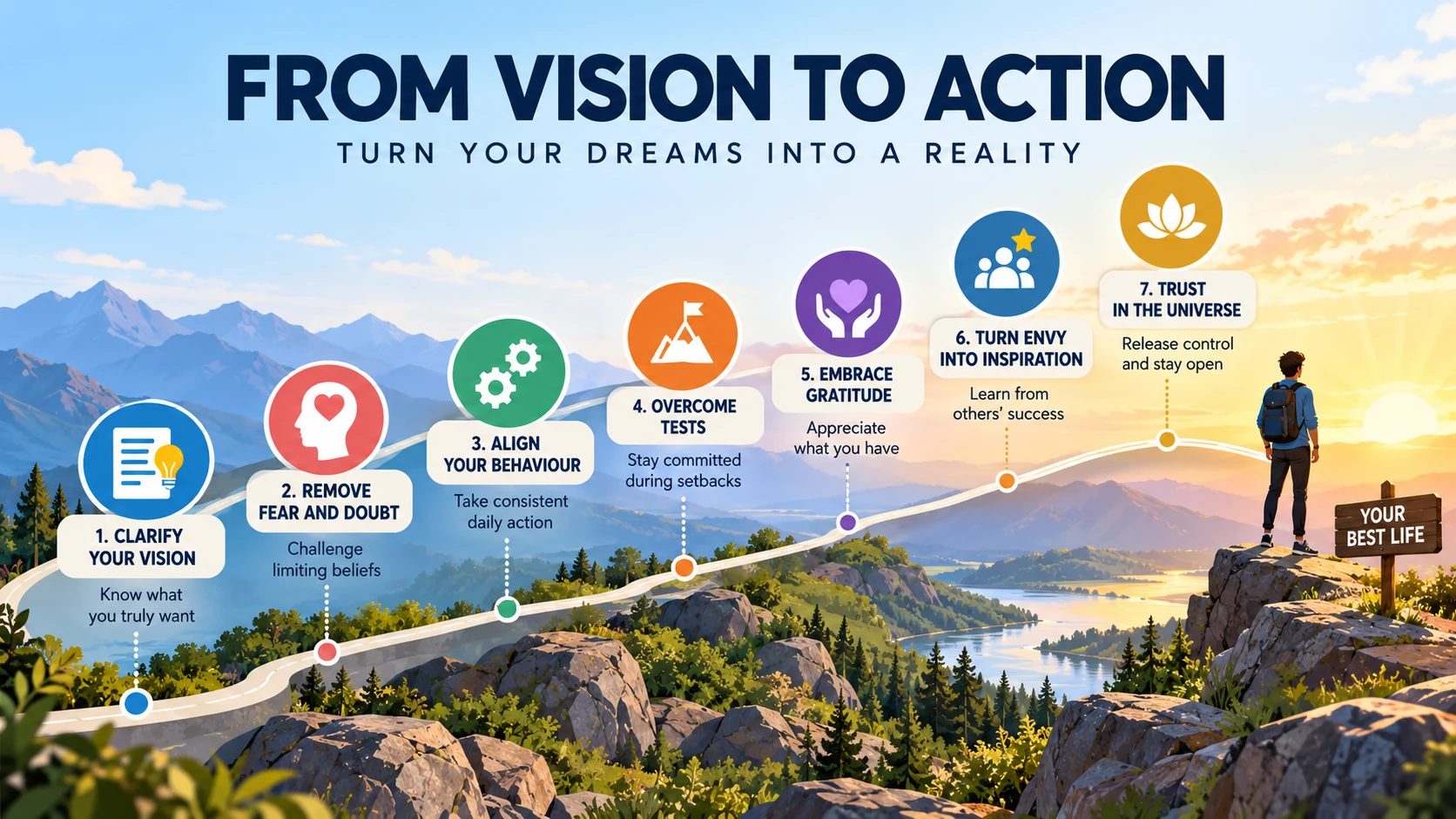
1. Define your desired outcome
Be specific about what you want and why it matters.
For example: “I want to move into a leadership role within the next two years.”
2. Identify your obstacles
What might prevent progress?
Perhaps you lack experience managing people, struggle with difficult conversations, or don’t have opportunities to demonstrate leadership.
3. Create aligned actions
Choose behaviors that address those obstacles.
You could mentor a junior colleague, volunteer to coordinate a project, take a leadership course, or ask your manager for developmental feedback.
4. Review and adapt
At the end of each month, evaluate your progress.
What worked?
What didn’t?
What should you do differently?
This process transforms manifestation from an abstract aspiration into a practical personal development system.
It is an original application of the book’s principles, rather than a separate framework formally introduced by Nafousi.
Does Manifestation Really Work? What Science Says
This is where the discussion becomes especially interesting.
Some practices associated with manifestation overlap with established psychological techniques, including goal setting, mental rehearsal, self-regulation, and action planning.
However, that doesn’t mean every claim about manifestation has scientific support.
There is no convincing scientific evidence that thoughts alone attract specific external events through a universal force.
The distinction matters.
Visualization can help, but action matters
Imagining a desired future can clarify what you want.
But focusing only on an ideal outcome may leave you unprepared for obstacles.
A more useful approach combines positive expectations with realistic planning.
A 2021 meta-analysis published in Frontiers in Psychology examined 21 studies involving 15,907 participants.
The researchers found that combining mental contrasting with implementation intentions had a small-to-moderate positive effect on goal attainment, although they also noted limitations, including possible publication bias.
Mental contrasting means considering both your desired future and the obstacles standing in your way.
Implementation intentions involve creating specific plans for how you’ll respond to situations.
For example:
“If it’s 7 p.m. on a weekday, I will study for my certification for 30 minutes.”
This is more actionable than repeatedly imagining yourself holding the certificate.
You can also review the study through its PubMed research record.
These findings support particular goal-pursuit strategies. They do not prove the law of attraction.
The practical conclusion
Use visualization to clarify direction.
Use gratitude to appreciate your present circumstances.
Use planning to identify your next steps.
Use action and feedback to make progress.
And recognize that external circumstances, available resources, and luck can influence outcomes.
A positive mindset can support your efforts, but it cannot replace them.
Five Common Manifestation Mistakes to Avoid
Mistake 1: Believing visualization is enough
Imagining success may feel motivating, but it doesn’t replace learning, preparation, or effort.
Better approach: Pair every important goal with a specific next action.
Mistake 2: Trying to eliminate negative emotions
Feeling anxious, disappointed, or uncertain doesn’t mean you’ve failed.
Those emotions are part of ordinary human experience.
Better approach: Acknowledge your feelings and choose a constructive response.
Mistake 3: Ignoring real-world obstacles
Some challenges require money, skills, support, professional guidance, or changes in circumstances.
Positive thinking cannot eliminate every barrier.
Better approach: Identify obstacles honestly and build realistic plans around them.
Mistake 4: Comparing your timeline with others
Someone else’s progress doesn’t mean you’re behind.
Different people have different resources, responsibilities, and opportunities.
Better approach: Measure progress against your own goals and circumstances.
Mistake 5: Blaming yourself when things don’t work out
This is one of the most harmful misunderstandings of manifestation.
Not getting a promotion, experiencing illness, or facing financial hardship doesn’t mean you failed to think positively enough.
Better approach: Take responsibility for what you can influence without blaming yourself for everything beyond your control.
The Seven-Day Manifestation Challenge
Reading about personal development can make you feel inspired.
But inspiration fades unless you turn it into behavior.
This original seven-day challenge translates Nafousi’s ideas into small, practical exercises.
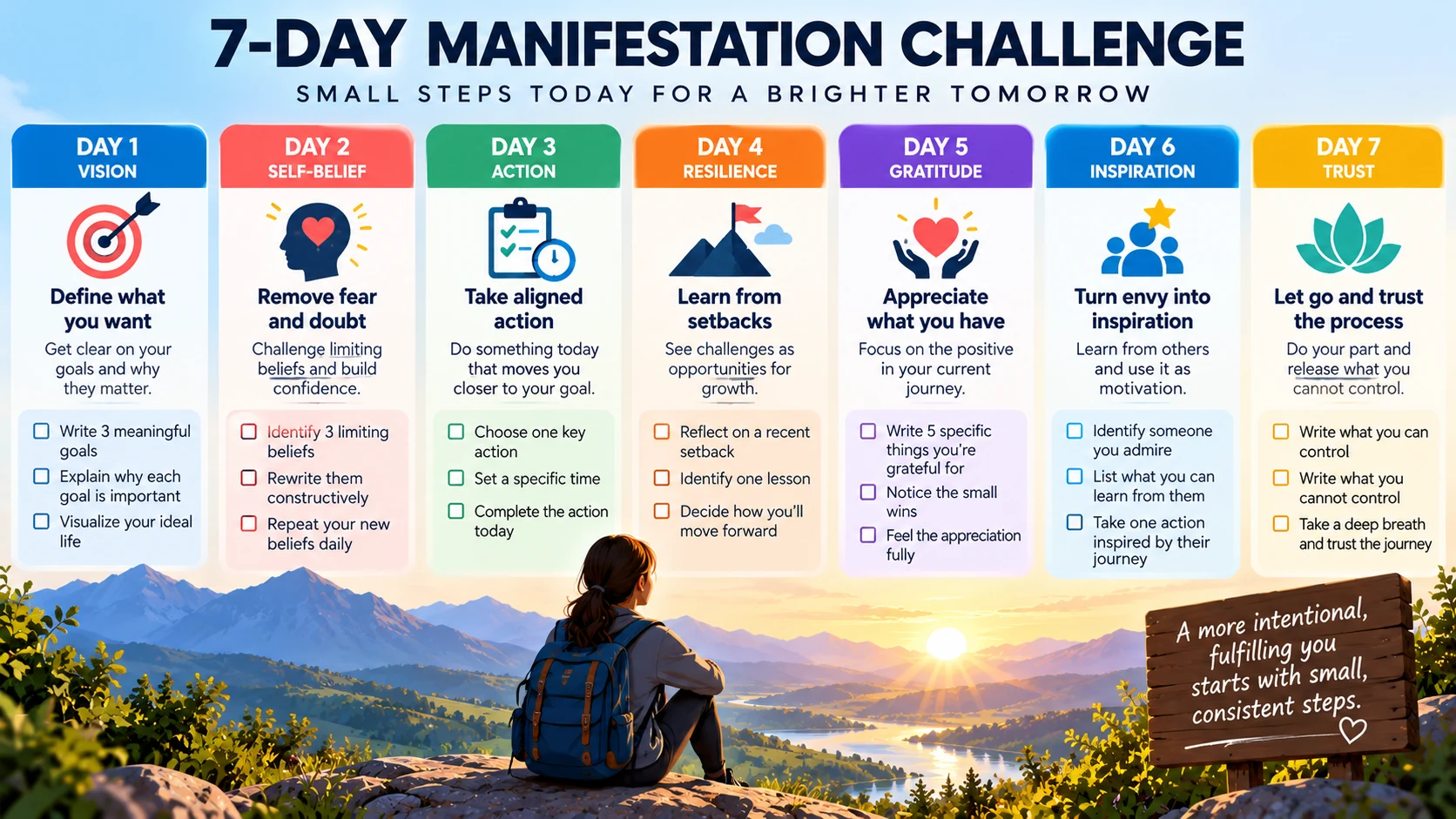
| Day | Focus | Your action |
|---|---|---|
| Day 1 | Vision | Write three meaningful goals and explain why they matter |
| Day 2 | Self-belief | Identify three limiting beliefs and reframe them |
| Day 3 | Action | Complete one meaningful action toward your most important goal |
| Day 4 | Resilience | Reflect on a setback and identify what you learned |
| Day 5 | Gratitude | Write five specific things you appreciate |
| Day 6 | Inspiration | Identify someone you admire and one lesson you can learn |
| Day 7 | Trust | Separate what you can control from what you cannot |
Your Personal Manifestation Exercise
Choose one meaningful goal and answer the following questions.
My goal: What do I want to achieve?
My reason: Why does this matter to me?
My obstacle: What is currently holding me back?
My next action: What is one step I can take?
My commitment: When exactly will I take that step?
Here’s an example.
Goal: Become more confident speaking in meetings.
Reason: I want to contribute more effectively and develop my leadership skills.
Obstacle: I’m afraid of making mistakes in front of others.
Next action: Prepare one thoughtful question or suggestion before every team meeting.
Commitment: Practice this in my next three meetings.
Notice what changed.
A vague desire became a specific plan.
That’s how you begin turning intention into action.
Manifest Cheat Sheet: The Seven Steps at a Glance
| Step | Main lesson | Daily practice |
|---|---|---|
| 1. Be Clear in Your Vision | Know what you want | Review one meaningful goal |
| 2. Remove Fear and Doubt | Challenge limiting beliefs | Take one small courageous action |
| 3. Align Your Behaviour | Match actions with intentions | Complete one goal-related task |
| 4. Overcome Tests from the Universe | Learn from challenges | Reflect and adapt |
| 5. Embrace Gratitude Without Caveats | Appreciate the present | Write three specific things you’re grateful for |
| 6. Turn Envy into Inspiration | Learn from others’ success | Identify one useful lesson |
| 7. Trust in the Universe | Accept uncertainty | Focus on what you can control |
Who Should Read Manifest?
Manifest is particularly suitable for readers who feel stuck, lack direction, or want to strengthen their confidence and self-worth.
You may find it useful if:
- You’re going through a career or personal transition.
- You struggle with self-doubt or comparison.
- You want to become more intentional about your goals.
- You enjoy reflective self-help books.
- You’re curious about manifestation and the law of attraction.
The book is approachable for beginners because its seven-step structure is simple to understand and remember.
What the Book Does Well
1. It encourages self-reflection.
The book invites readers to question whether their goals genuinely reflect their values.
2. It emphasizes self-worth.
Nafousi recognizes that fear, insecurity, and limiting beliefs can influence behavior.
3. It connects mindset with action.
The third step makes the framework more practical than approaches focused exclusively on visualization.
4. It encourages gratitude and emotional awareness.
These themes help broaden the conversation beyond external achievements.
Where the Book Falls Short
1. Some spiritual claims lack scientific evidence.
The idea that the universe responds directly to thoughts and desires is not scientifically established.
2. The framework can underestimate external barriers.
Mindset matters, but circumstances, access to opportunities, and available resources also influence success.
3. Readers may need more detailed planning tools.
The book offers inspiration and reflection, but people seeking structured productivity systems may want additional resources.
4. The language of universal tests can be misunderstood.
Not every setback has a hidden purpose, and not every outcome reflects a person’s beliefs or worthiness.
These limitations don’t make the entire book unhelpful.
They simply mean its lessons are most useful when combined with critical thinking and realistic action.
Manifest vs. Atomic Habits vs. Deep Work
If you enjoy personal development books, it’s useful to understand how Manifest differs from other popular titles.
| Book | Main focus | Best for |
|---|---|---|
| Manifest — Roxie Nafousi | Vision, self-belief, gratitude, aligned behavior | Building clarity and confidence |
| Atomic Habits — James Clear | Habit formation and behavioral systems | Creating consistent daily routines |
| Deep Work — Cal Newport | Concentration and distraction management | Improving focus and producing meaningful work |
These books can complement one another.
Manifest helps you reflect on what you want.
Atomic Habits helps you build behaviors that support your goals.
Deep Work helps you protect the concentration needed for demanding tasks.
If you’re interested in developing consistent routines, explore our Atomic Habits book summary.
If your biggest challenge is distraction and lack of focus, our Deep Work book summary offers another useful perspective.
My Biggest Takeaway from Manifest
The most valuable lesson from Manifest isn’t that you can attract anything you want simply by believing hard enough.
It’s that you can become more intentional about the direction of your life.
Many people spend years responding to other people’s expectations.
They choose careers because those careers appear respectable.
They pursue promotions because everyone else seems to want them.
They measure success using standards they never consciously selected.
And sometimes, after achieving what they thought they wanted, they discover that it doesn’t make them happy.
Nafousi’s first step challenges that pattern.
What do you actually want?
It’s a simple question.
But answering it honestly can change how you make decisions.
The remaining steps encourage you to examine the beliefs, behaviors, emotions, and expectations that shape your pursuit of that vision.
For me, the strongest practical interpretation is:
Clarity gives you direction. Self-belief gives you courage. Action creates momentum. Resilience helps you continue.
You don’t need certainty that the universe will deliver your dream.
You need enough clarity to begin, enough courage to try, and enough flexibility to learn along the way.
Final Thoughts: Manifest Book Summary
Manifest: 7 Steps to Living Your Best Life offers an encouraging approach to personal growth.
Its greatest strength is the reminder that a meaningful life requires more than simply reacting to whatever happens around you.
It asks you to become deliberate about what you want, how you think, and how you behave.
You may connect with Nafousi’s spiritual interpretation of manifestation.
Or you may prefer to approach her lessons through psychology, goal setting, and everyday decision-making.
Either way, several ideas are worth applying.
Define what matters to you.
Challenge beliefs that hold you back.
Build behaviors that support your goals.
Learn from setbacks.
Appreciate what you already have.
Turn comparison into curiosity.
And stop expecting to control every outcome.
If there’s one lesson to take from this Manifest book summary, it’s this:
You cannot control everything that happens in your life, but you can become more intentional about how you live it.
Start with one meaningful goal.
Then take one small step toward it today.
Frequently Asked Questions About Manifest
1. What are the seven steps of manifestation by Roxie Nafousi?
The seven steps are:
- Be clear in your vision.
- Remove fear and doubt.
- Align your behaviour.
- Overcome tests from the universe.
- Embrace gratitude without caveats.
- Turn envy into inspiration.
- Trust in the universe.
Together, they form Nafousi’s approach to developing self-belief, clarifying desires, and pursuing a more fulfilling life.
2. What is the main message of Manifest?
The main message is that understanding your desires, developing self-worth, aligning your behavior with your goals, and cultivating trust can help you pursue meaningful personal change.
3. Is manifestation scientifically proven?
Certain related practices, such as goal setting, mental contrasting, and implementation intentions, have scientific support. However, there is no convincing evidence that thoughts alone attract specific external events through a universal force.
4. Can manifestation work without believing in the universe?
Yes, many practical exercises associated with manifestation can be used without accepting its spiritual explanation. Clarifying goals, challenging limiting beliefs, practicing gratitude, and creating action plans can be valuable independently.
5. How long does manifestation take?
There is no established timeline. Progress toward goals depends on your actions, circumstances, resources, and factors beyond your control. It’s more useful to measure concrete progress than wait for a promised result.
6. Is Manifest worth reading?
Yes, particularly if you enjoy accessible self-help books about mindset, confidence, and personal growth. Readers who prefer strictly evidence-based approaches should treat the spiritual claims critically.
7. What is the difference between Manifest and The Secret?
Both books explore manifestation and the law of attraction. Manifest places particular emphasis on self-worth, emotional awareness, and behavior aligned with personal goals, while The Secret is more closely associated with the belief that thoughts attract corresponding experiences.
8. Can manifestation help with career goals?
Manifestation-related practices can help you clarify your career ambitions, identify limiting beliefs, and commit to useful actions. However, career success also depends on skills, opportunities, workplace conditions, and other factors.
9. What is the most important step in Manifest?
All seven steps contribute to Nafousi’s framework, but Step 3—Align Your Behaviour—is especially practical because it connects aspirations with everyday actions.
10. How can beginners start manifesting?
Begin by identifying one meaningful goal, writing down why it matters, recognizing potential obstacles, and choosing a specific action you can take this week. Review your progress and adapt as needed.
Your Next Step
Choose one goal you’ve been postponing.
Write it down.
Identify what’s holding you back.
Then take one small action toward it today.
You don’t have to change your entire life overnight.
You just have to begin moving in a direction that matters to you.