
Imagine having everything you once dreamed of.
A successful career. A luxury car. A beautiful home. A bank account that allows you to buy almost anything you want.
From the outside, your life looks perfect.
But every morning, you wake up exhausted. Your calendar is full, your mind is restless, and your relationships receive whatever little time remains after work.
You have achieved success, yet you are not sure you are happy.
This is the uncomfortable reality at the heart of Robin Sharma’s The Monk Who Sold His Ferrari.
In this The Monk Who Sold His Ferrari Summary, we explore the story of Julian Mantle, a wealthy lawyer whose pursuit of professional success nearly destroys his health, and the seven life-changing principles he discovers after leaving his old life behind.
The book raises a question worth asking, regardless of your age or profession:
What is the point of becoming successful if you lose yourself in the process?
The Monk Who Sold His Ferrari in 60 Seconds
| Book details | Information |
|---|---|
| Book | The Monk Who Sold His Ferrari |
| Author | Robin Sharma |
| Genre | Self-Help, Personal Development, Inspirational Fiction |
| Main character | Julian Mantle |
| Core message | True fulfillment comes from mastering your mind, living with purpose, and balancing ambition with inner peace |
| Best for | Professionals, entrepreneurs, managers, students, and anyone seeking a more meaningful life |
The big idea: You do not have to abandon your ambitions to find happiness. You need to stop allowing external achievements to become the only measure of your worth.
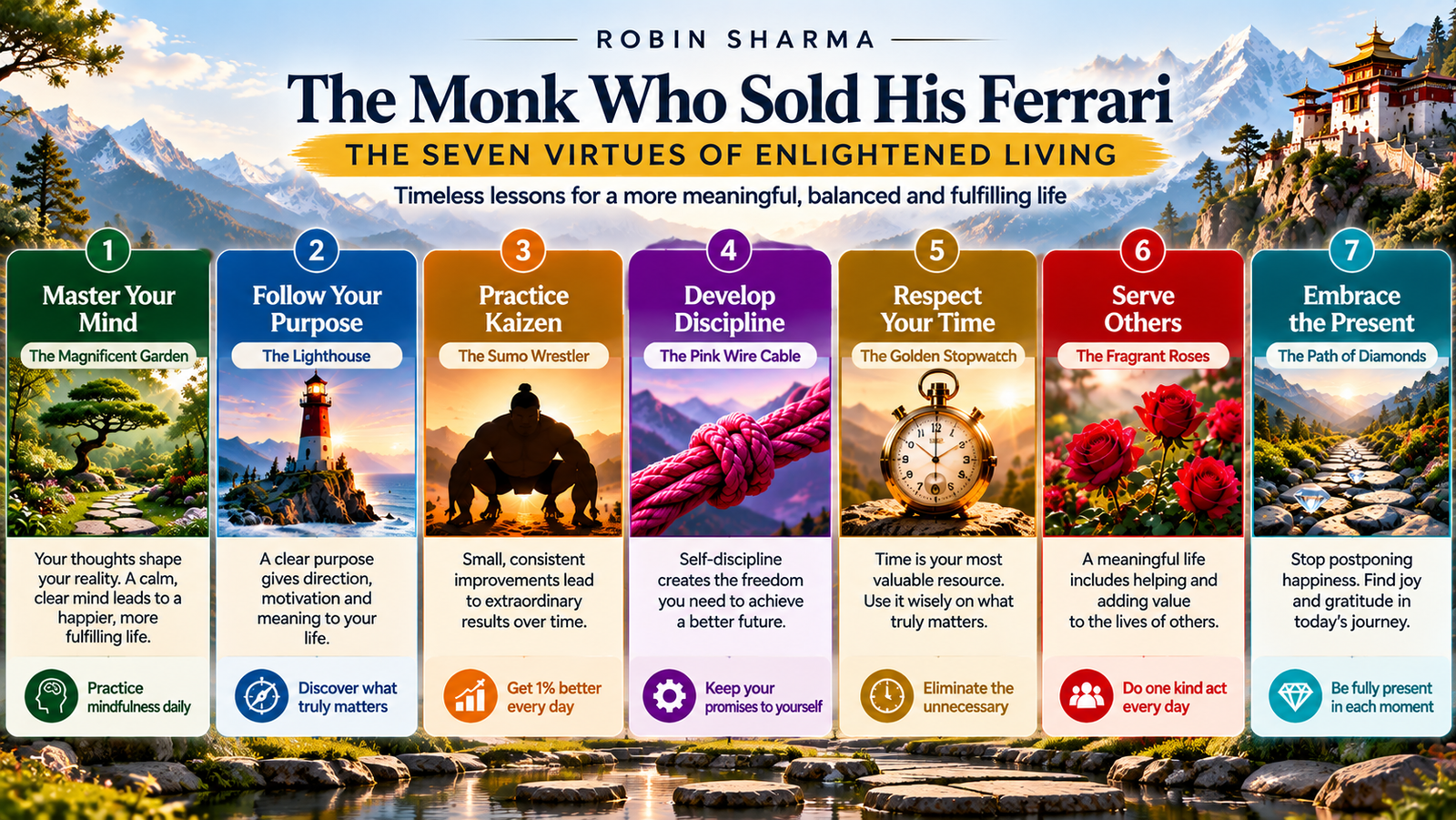
The book introduces seven virtues of enlightened living through a memorable story involving a garden, lighthouse, sumo wrestler, pink wire cable, golden stopwatch, fragrant roses, and a path of diamonds.
Each symbol represents a principle that can help us live more deliberately.
What Is The Monk Who Sold His Ferrari About?
Julian Mantle is the kind of person many professionals aspire to become.
He is a highly successful lawyer with an impressive reputation, expensive possessions, and an extraordinary work ethic.
He has spent years building his career, winning cases, and accumulating wealth.
But behind his professional achievements lies a very different reality.
Julian is physically exhausted, emotionally drained, and increasingly disconnected from the things that make life meaningful.
Then, during a courtroom appearance, he suffers a heart attack.
The incident forces him to confront a difficult truth: the life he has worked so hard to build is no longer serving him.
Julian makes a dramatic decision.
He leaves his legal career, sells his possessions, including his beloved Ferrari, and travels to India searching for a different way of living.
His journey eventually takes him to the Himalayas, where he learns from the Sages of Sivana, a fictional group of spiritual teachers.
When Julian returns, he is a changed man.
He shares what he has learned with his former colleague, John, through a series of conversations about purpose, discipline, happiness, and the meaning of success.
According to the official description from Jaico Publishing House, the story follows Julian’s confrontation with the spiritual crisis created by his unbalanced life.
Who is Robin Sharma?
Robin Sharma is a former lawyer who became an internationally known author and leadership speaker.
His work focuses on personal mastery, purposeful living, discipline, and professional excellence.
On his official author biography, Sharma explains how he moved from law into writing and initially self-published his work.
That career transition gives the story of Julian Mantle an interesting context, although Julian himself is a fictional character.
The 7 Powerful Lessons from The Monk Who Sold His Ferrari Summary
The book’s most memorable teaching device is a symbolic fable.
Picture a magnificent garden containing a lighthouse. A sumo wrestler emerges, wearing a pink wire cable, and discovers a golden stopwatch. Nearby are fragrant roses and a path of diamonds.
It sounds unusual, but that is precisely why it works.
Each image represents a different virtue, making the principles easier to remember.
Lesson 1: Master Your Mind Before It Masters You
Symbol: The Magnificent Garden
Imagine you own a beautiful garden.
You plant flowers, water them regularly, remove weeds, and protect the soil.
But what happens if you stop looking after it?
Weeds begin to spread. Healthy plants struggle. Eventually, the garden loses its beauty.
Robin Sharma uses this garden as a metaphor for the human mind.
Just as a garden needs regular care, our minds need attention.
Every day, we experience thousands of thoughts, including worries, expectations, judgments, and memories.
Some help us move forward. Others keep us trapped in fear, anger, or self-doubt.
The book encourages us to become more conscious of what we repeatedly focus on.
Why it matters
Consider two employees who receive the same critical feedback from their manager.
The first thinks, “I am terrible at my job. I will never succeed.”
The second thinks, “This feedback is uncomfortable, but it shows me where I can improve.”
The situation is identical, but their interpretations lead to different responses.
The first employee may become discouraged. The second is more likely to take constructive action.
We cannot prevent every negative thought from appearing. But we can learn to examine our thoughts rather than accepting them as facts.
How to apply it
Try a three-step mental reset:
- Notice the thought causing stress.
- Ask whether it is a fact, assumption, or prediction.
- Identify one constructive action you can take.
For example, instead of repeatedly thinking, “This project is going to fail,” ask, “What is the biggest risk, and what can I do today to reduce it?”
This approach does not eliminate real problems. It helps you respond to them more effectively.
Key takeaway: You cannot control everything that happens around you, but you can develop greater control over how you interpret and respond to events.
Lesson 2: Find Your Purpose Before Chasing More Goals
Symbol: The Lighthouse
A lighthouse helps ships navigate difficult waters.
Without a clear destination, even a powerful ship can drift in the wrong direction.
Sharma uses the lighthouse to represent purpose.
Many people spend years pursuing goals without questioning why those goals matter.
They want a promotion, a higher salary, a bigger house, or a successful business.
There is nothing wrong with these ambitions.
But what happens when you achieve them and still feel dissatisfied?
Often, the problem is not a lack of achievement. It is a lack of clarity about what achievement is supposed to provide.
Why it matters
Imagine spending fifteen years climbing a ladder.
You work hard, make sacrifices, and overcome countless obstacles.
Finally, you reach the top.
Only then do you realize the ladder was leaning against the wrong wall.
This is what can happen when we pursue society’s definition of success without considering our own values.
A practical example
A manager wants to become a company director.
Instead of stopping at that goal, they ask why the position matters.
Perhaps they want financial security, the opportunity to develop future leaders, and greater influence over important decisions.
Once those reasons become clear, they can evaluate whether the director role genuinely supports their values.
They may discover that some of those goals can be achieved without sacrificing their health or family life.
How to apply it
Complete these sentences:
- The three things I value most are __________.
- I want my life to stand for __________.
- The kind of person I want to become is __________.
- Over the next twelve months, I want to make meaningful progress in __________.
Review your answers before making major decisions.
Key takeaway: Goals tell you what to achieve. Purpose helps you understand why the achievement matters.
Lesson 3: Improve Yourself a Little Every Day
Symbol: The Sumo Wrestler
The sumo wrestler represents Kaizen, the Japanese concept commonly associated with continuous improvement.
Sharma encourages readers to pursue personal growth through consistent effort.
Most people approach self-improvement with enormous expectations.
They decide to wake up at 5 a.m., exercise every day, read fifty books, meditate, eat perfectly, and become highly productive.
All at once.
Within a few weeks, the routine becomes overwhelming.
The problem is not necessarily a lack of motivation.
It is trying to change too much too quickly.
Why it matters
Small improvements may appear insignificant, but repeated actions can produce meaningful progress over time.
Reading ten pages a day may not seem impressive.
Yet across a year, that habit can expose you to thousands of pages of new ideas.
Spending fifteen minutes improving a skill each day may also lead to substantial progress.
Consistency creates opportunities for learning that occasional bursts of enthusiasm cannot reliably provide.
A practical example
Suppose you want to become a better leader.
Instead of trying to transform your leadership style overnight, begin with one weekly practice.
Every Friday, spend ten minutes reflecting on your team’s performance.
Ask:
What went well this week?
Where did people struggle?
What could I have done differently?
Then implement one improvement the following week.
Over time, this creates a regular cycle of reflection and learning.
How to apply it
Choose one area of growth and commit to a small daily action for thirty days.
| Area | Daily improvement |
|---|---|
| Health | Walk for 15 minutes |
| Knowledge | Read 10 pages |
| Leadership | Offer one thoughtful piece of feedback |
| Relationships | Have one distraction-free conversation |
| Mental clarity | Reflect quietly for 5 minutes |
| Productivity | Complete one meaningful task before checking messages |
If you want a more detailed approach to building consistent routines, James Clear’s Atomic Habits explores how small behavioral changes can become lasting habits.
Key takeaway: You do not need to improve everything today. You need a sustainable way to keep improving.
Lesson 4: Discipline Is the Foundation of Personal Freedom
Symbol: The Pink Wire Cable
The pink wire cable represents self-discipline.
A cable consists of many individual strands.
One strand may be weak, but when many strands are woven together, the cable becomes strong.
The same principle applies to discipline.
It develops through repeated choices.
Many people associate discipline with restriction.
They imagine rigid schedules, constant sacrifice, and a life without enjoyment.
But consider the opposite.
If you spend every rupee you earn, you lose financial flexibility.
If you constantly procrastinate, your unfinished responsibilities begin controlling your schedule.
If you repeatedly neglect your health, you may eventually face limitations that reduce your choices.
Discipline can help create freedom by supporting long-term priorities.
Why it matters
Motivation is unpredictable.
Some mornings, you feel excited to exercise, study, or work on an important goal.
Other mornings, you do not.
If your progress depends entirely on enthusiasm, consistency becomes difficult.
Discipline helps you continue even when motivation fades.
A practical example
An entrepreneur wants to write a book but struggles to find time.
Instead of waiting for a completely free weekend, they schedule thirty minutes of writing every morning.
Some days, they write several pages.
Other days, they produce only a paragraph.
But the project continues moving forward.
How to apply it
Start with one small promise.
For example, “I will read for five minutes before sleeping.”
Keep that promise consistently.
Once the behavior becomes comfortable, gradually increase the effort.
The goal is not to prove how much discomfort you can tolerate.
It is to build a routine you can sustain.
Key takeaway: Discipline is not about controlling every minute of your life. It is about making choices that protect the future you want.
Lesson 5: Respect Your Time Because You Cannot Recover It
Symbol: The Golden Stopwatch
Money can be earned again.
A failed project can be restarted.
A missed opportunity may sometimes be replaced.
But time that has passed cannot be recovered.
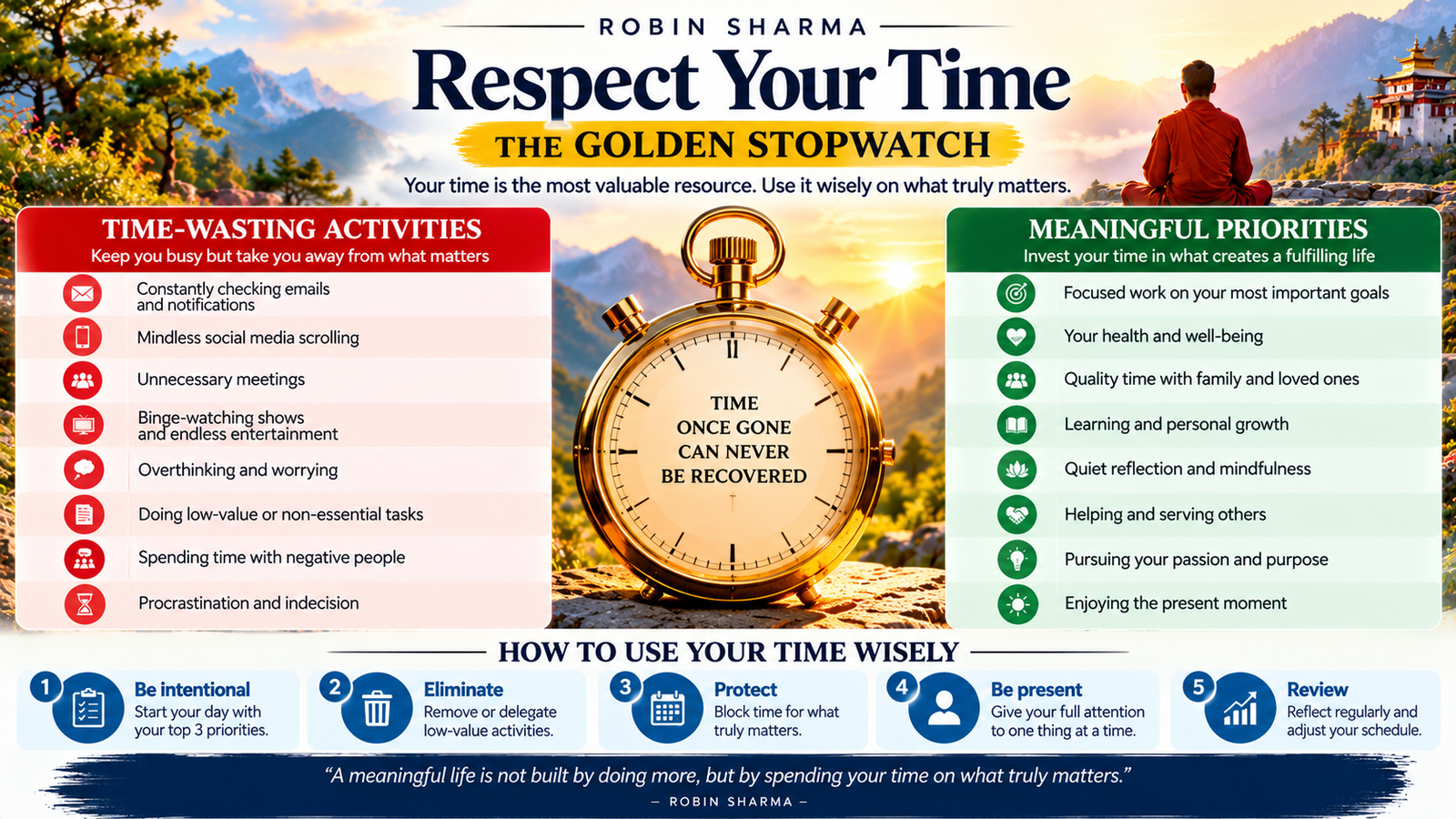
The golden stopwatch represents the value of time.
Sharma encourages readers to recognize that a meaningful life requires thoughtful choices about how we spend our days.
Why it matters
Being busy is not the same as being productive.
You can spend an entire day answering emails, attending meetings, and responding to notifications without making progress on anything important.
At the end of the day, you feel exhausted but cannot identify what you accomplished.
The solution is not always to work faster.
Sometimes, it is to stop doing activities that do not deserve your attention.
A practical example
A project manager spends three hours every day attending status meetings.
After reviewing the meeting structure, they discover that several updates could be shared asynchronously.
They replace unnecessary meetings with concise written updates and reserve live discussions for decisions and obstacles.
The recovered time can be invested in planning, solving problems, and supporting the team.
How to apply it
Each morning, identify:
- One task that will create meaningful progress.
- One activity you can eliminate, simplify, or delegate.
- One personal commitment that deserves protected time.
Then organize your schedule around those priorities.
Remember that effective time management is not about squeezing more work into every hour.
It is about making space for what matters.
Key takeaway: A meaningful life is built by using your time intentionally, not by keeping yourself constantly occupied.
Lesson 6: A Meaningful Life Includes Serving Others
Symbol: The Fragrant Roses
The fragrant roses represent contribution and service.
Sharma argues that personal fulfillment involves more than accumulating achievements.
It also involves making a positive difference in other people’s lives.
You do not need extraordinary wealth or influence to contribute.
Sometimes, the smallest actions matter.
A manager helps an employee develop confidence.
A parent gives their child undivided attention.
A colleague shares knowledge without expecting recognition.
A business owner treats customers fairly even when taking shortcuts might increase profits.
Why it matters
When every achievement is measured only by what it brings us, success can become an endless pursuit.
Contribution gives our efforts a wider purpose.
Instead of asking only, “What can I gain?” we also begin asking, “What value can I create for someone else?”
A practical example
A senior professional spends thirty minutes each week mentoring a junior colleague.
Over time, the colleague develops stronger skills and greater confidence.
The mentor also experiences the satisfaction of helping someone grow.
Both benefit from the relationship.
How to apply it
Every morning, ask yourself:
“Whose day can I make a little better today?”
Then choose one action.
Help a colleague, thank someone sincerely, share useful knowledge, or spend quality time with a loved one.
Key takeaway: Achievement becomes more meaningful when it contributes to something beyond yourself.
Lesson 7: Stop Postponing Happiness Until Tomorrow
Symbol: The Path of Diamonds
The path of diamonds represents embracing the present.
Many people live as though happiness exists somewhere in the future.
They tell themselves:
“I will be happy when I get promoted.”
“I will enjoy life when I earn more money.”
“I will spend time with my family after this project.”
“I will finally relax when I retire.”
But when one milestone arrives, another often takes its place.
The finish line keeps moving.
Sharma encourages readers to appreciate the present rather than treating today merely as preparation for tomorrow.
Why it matters
Ambition can be valuable.
The problem begins when we make happiness entirely dependent on future achievements.
You can work toward a better future while appreciating the life you already have.
These are not opposing choices.
A practical example
A business owner is preparing for a major product launch.
The work is demanding, and there is pressure to succeed.
Instead of allowing the launch to consume every waking hour, they protect family dinners, maintain a reasonable sleep routine, and occasionally disconnect from work.
They remain ambitious without putting their entire personal life on hold.
How to apply it
At the end of each day, write down three things you appreciated.
They do not need to be extraordinary.
A meaningful conversation, a completed task, a peaceful walk, or a moment with someone you love is enough.
Key takeaway: You can pursue a better tomorrow without sacrificing everything good about today.
How to Apply These Lessons in Modern Life
The principles in The Monk Who Sold His Ferrari may sound philosophical, but their real value appears when we apply them to everyday decisions.
For Working Professionals
If your job involves constant deadlines, meetings, and responsibilities, begin by examining how you spend your time.
Identify which activities create meaningful results and which simply keep you occupied.
Protect time for focused work, health, family, and rest.
The objective is not to eliminate ambition.
It is to make ambition sustainable.
For Entrepreneurs
Building a business can become an all-consuming responsibility.
You may begin with the goal of achieving financial independence, only to discover that your business now controls every hour of your life.
The book encourages you to examine whether your daily decisions support the freedom you originally wanted.
That might mean delegating responsibilities, establishing boundaries, or protecting time for relationships.
For Students and Lifelong Learners
Academic performance and professional qualifications matter, but they are not the only ingredients of a meaningful life.
Curiosity, emotional resilience, healthy routines, and strong relationships are also valuable.
Study consistently, pursue meaningful goals, and remember that your identity is larger than any examination result.
Common Mistakes When Applying The Monk Who Sold His Ferrari
The book’s lessons are useful, but they can easily be misunderstood.
Mistake 1: Thinking money is the enemy.
The book challenges excessive attachment to wealth, not responsible financial ambition.
Money can provide security, opportunity, and freedom.
The problem begins when accumulating wealth becomes more important than everything else.
Mistake 2: Believing positive thinking solves every problem.
A constructive mindset can improve how we respond to challenges.
But it cannot eliminate illness, financial hardship, workplace injustice, or other external difficulties.
Practical action and appropriate support remain essential.
Mistake 3: Trying to change your entire life overnight.
Julian’s transformation is dramatic because it makes an engaging story.
Real-world change is usually slower.
Sustainable improvement requires patience, experimentation, and adjustment.
Mistake 4: Confusing discipline with constant productivity.
Rest, recovery, and leisure are not failures of discipline.
A healthy routine should create room for them.
Mistake 5: Treating happiness as a permanent emotional state.
Living meaningfully does not mean feeling joyful every moment.
Difficult emotions are a normal part of life.
A Practical 7-Day Challenge Inspired by the Book
You do not need to travel to the Himalayas to begin improving your life.
Start with seven days of small, deliberate actions.
| Day | Focus | Your action |
|---|---|---|
| Day 1 | Master your mind | Spend 10 minutes noticing and questioning unhelpful thoughts |
| Day 2 | Discover your purpose | Write down your five most important life priorities |
| Day 3 | Practice Kaizen | Choose one skill and spend 15 minutes improving it |
| Day 4 | Build discipline | Keep one small promise to yourself |
| Day 5 | Respect time | Eliminate one unnecessary activity and protect 30 minutes |
| Day 6 | Serve others | Help someone without expecting anything in return |
| Day 7 | Appreciate the present | Spend an hour enjoying life without digital distractions |
At the end of the week, reflect on three questions:
- Which activity improved my day the most?
- Which habit was hardest to maintain?
- What one practice would I like to continue for the next thirty days?
The purpose is not to achieve a perfect week.
It is to discover which changes are genuinely useful for your life.
The Monk Who Sold His Ferrari Cheat Sheet
| Principle | Remember this | Start doing |
|---|---|---|
| Master your mind | Thoughts influence your responses | Question unhelpful assumptions |
| Follow your purpose | Direction matters more than busyness | Define meaningful goals |
| Practice Kaizen | Improvement comes through repetition | Learn something daily |
| Develop discipline | Small promises build consistency | Establish one sustainable habit |
| Respect time | Your time is limited | Protect your priorities |
| Serve others | Contribution adds meaning | Help someone regularly |
| Embrace the present | Life is happening now | Practice gratitude and attention |
Is The Monk Who Sold His Ferrari Worth Reading?
Yes, particularly if you are ambitious, professionally successful, or constantly busy but feel that something important is missing.
The book is accessible, memorable, and built around a story rather than complicated theory.
Its strongest feature is the way it turns abstract principles into simple symbols that are easy to recall.
However, it also has limitations.
What the Book Does Well
The symbolic framework makes its lessons memorable.
The story encourages readers to question their assumptions about success.
And the emphasis on purpose, discipline, and relationships remains relevant.
It is especially useful as a starting point for personal reflection.
Where the Book Falls Short
Some advice is presented with more certainty than the supporting evidence justifies.
The story also simplifies personal transformation. Julian’s journey is inspiring, but most people cannot abandon their responsibilities or dramatically redesign their lives.
Some readers may find the dialogue overly instructional or the spiritual elements less convincing than the practical lessons.
And while the book promotes positive thinking, readers should not mistake its inspirational philosophy for a scientifically validated psychological treatment.
Who Should Read It?
This book is particularly suitable for people who feel trapped in an endless cycle of work and achievement, want to reconnect with their personal priorities, or enjoy personal-development ideas presented through stories.
Readers seeking detailed scientific research or structured behavior-change methods may prefer a more evidence-focused book.
For further information, you can explore Robin Sharma’s official book collection.
My Take: The Ferrari Is Not the Real Problem
The most interesting part of this story is not that Julian sells his Ferrari.
It is why he feels the need to sell it.
The Ferrari represents a version of success that has gradually taken control of his life.
That distinction matters.
A luxury car is not inherently harmful.
Neither is a demanding career, a large business, or an ambitious financial goal.
The real question is whether these things support the life you want—or whether your life has become organized entirely around maintaining them.
There is also an important limitation to Julian’s story.
Most people cannot walk away from their jobs, sell their possessions, and travel in search of enlightenment.
They have families, financial obligations, employees, mortgages, and responsibilities.
Fortunately, the book’s most useful lessons do not require a dramatic escape.
You can become more mindful while continuing your career.
You can build discipline without waking up at an extreme hour.
You can pursue wealth without making wealth your identity.
And you can live with purpose without having every detail of your future figured out.
The real transformation is not necessarily changing your lifestyle. It is changing the relationship you have with your lifestyle.
That is the lesson worth remembering.
Frequently Asked Questions
What is the main message of The Monk Who Sold His Ferrari?
The central message is that lasting fulfillment comes from living with purpose, mastering your thoughts, developing discipline, nurturing relationships, and appreciating the present—not from material success alone.
What are the seven virtues in The Monk Who Sold His Ferrari?
The seven virtues are mastering your mind, following your purpose, practicing Kaizen, living with discipline, respecting your time, serving others, and embracing the present.
Is The Monk Who Sold His Ferrari based on a true story?
No. The book is an inspirational fictional fable, not a factual biography of Julian Mantle. Its themes reflect Robin Sharma’s interest in personal development and his career transition from law to writing.
What does the Ferrari symbolize?
The Ferrari represents material wealth, professional status, and external achievement. Selling it symbolizes Julian’s decision to reconsider what truly matters in his life.
Is The Monk Who Sold His Ferrari good for beginners?
Yes. Its conversational storytelling and memorable symbols make it accessible to readers who are new to self-help and personal-development books.
Do you need to become a monk to follow the book’s teachings?
No. The lessons can be applied while maintaining a career, family, and ordinary responsibilities. The emphasis is on changing priorities and habits rather than abandoning modern life.
How is The Monk Who Sold His Ferrari different from Atomic Habits?
Robin Sharma focuses on purpose, spiritual fulfillment, and a philosophy of balanced living.
James Clear’s Atomic Habits concentrates more specifically on how habits form and how to change behavior through practical systems.
The two books complement each other: one encourages you to consider what kind of life you want, while the other helps you develop repeatable behaviors that support it.
Final Thoughts: Build a Life You Do Not Need to Escape From
The most powerful lesson from The Monk Who Sold His Ferrari Summary is that success and happiness do not have to compete.
You can pursue ambitious goals while protecting your health.
You can work hard while making time for people you love.
You can build wealth without allowing possessions to define your worth.
And you can prepare for tomorrow without forgetting to experience today.
Julian Mantle’s transformation is dramatic because it takes a personal crisis to make him reconsider his priorities.
You do not need to wait for such a crisis.
Start by asking yourself one question:
If my life continues exactly as it is today for the next ten years, will I be happy with where it takes me?
If the answer is no, you do not necessarily need to change everything.
Start with one priority, one boundary, or one habit.
Because the ultimate goal is not to become the richest, busiest, or most admired person in the room.
It is to build a life that feels meaningful while you are actually living it.