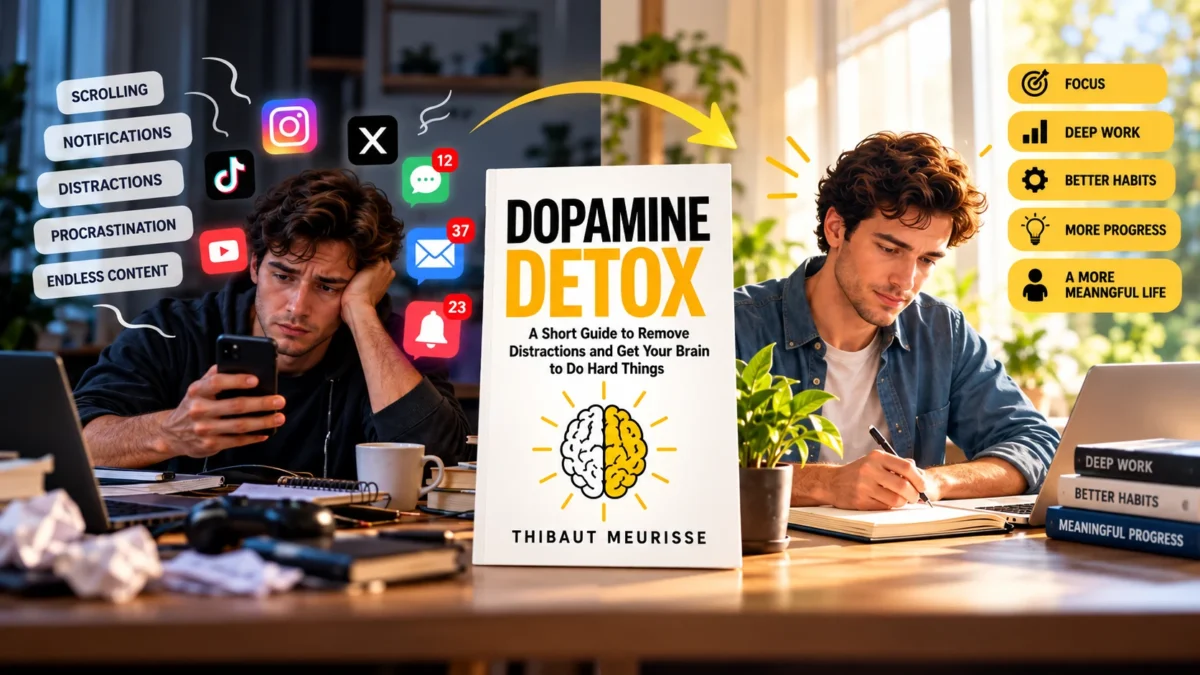
You sit down to work on something important.
You open your laptop. You know exactly what needs to be done. But before you begin, you check one notification.
That notification leads to a message. The message reminds you of something on social media. You open the app, watch a video, and scroll through a few more posts.
Twenty minutes disappear.
When you finally return to your work, the task suddenly feels harder than before.
You know it’s important. You know you should finish it. Yet your mind keeps looking for something easier and more interesting.
Sound familiar?
This is the problem Thibaut Meurisse explores in Dopamine Detox: A Short Guide to Remove Distractions and Get Your Brain to Do Hard Things.
In this Dopamine Detox Book Summary, we’ll explore seven powerful lessons from the book, its three-step method, practical techniques to overcome procrastination, and a seven-day challenge to help you reclaim your attention.
We’ll also answer an important question: Does dopamine detox actually work, or is it simply a popular name for changing distracting habits?
Dopamine Detox in 60 Seconds
| Book details | Information |
|---|---|
| Book | Dopamine Detox: A Short Guide to Remove Distractions and Get Your Brain to Do Hard Things |
| Author | Thibaut Meurisse |
| Published | 2021 |
| Length | 74 pages (2021 independently published edition) |
| Genre | Productivity, Self-Improvement |
| Core idea | Reduce unnecessary stimulation to make meaningful work easier to start |
| Best for | Professionals, students, entrepreneurs, and anyone struggling with distractions |
| Biggest takeaway | Stop letting instant gratification control how you spend your attention |
The book in one sentence: By temporarily reducing distracting activities and building more intentional habits, you can create better conditions for concentration, productivity, and meaningful work.
What Is Dopamine Detox About?
We live in a world where stimulation is available almost everywhere.
Your phone delivers notifications throughout the day. Social media offers endless content. Streaming platforms automatically recommend the next episode. News websites refresh continuously.
Even when we aren’t actively looking for entertainment, something is competing for our attention.
None of these activities is necessarily harmful.
The problem begins when we use them automatically to escape boredom, uncertainty, stress, or difficult work.
Imagine a project manager preparing an important presentation for senior leadership.
The presentation requires careful analysis, clear thinking, and important decisions.
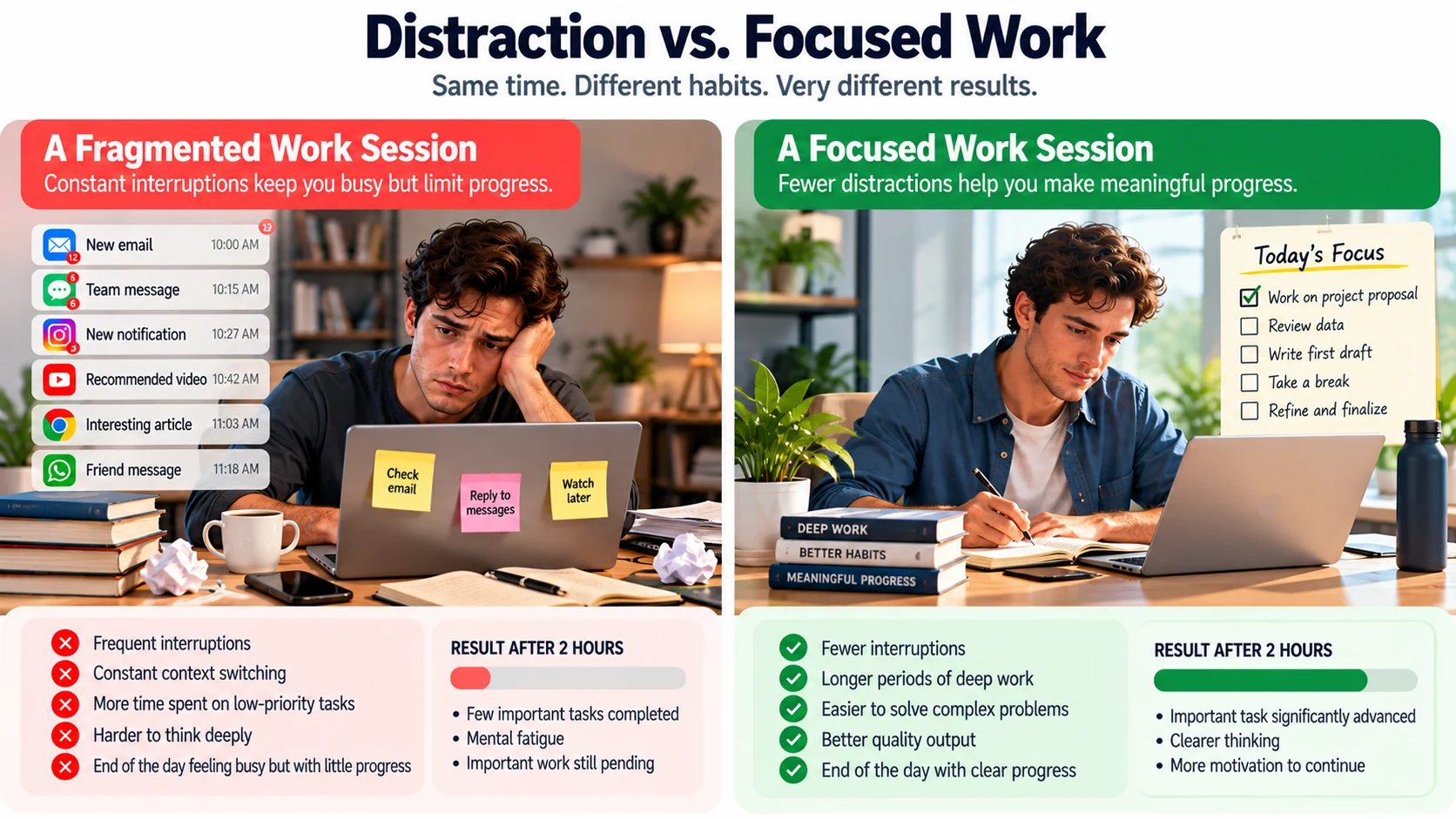
But every few minutes, the manager checks email, responds to a message, or opens another browser tab.
By the end of the day, they have been busy for eight hours but made little progress on the presentation.
Meurisse argues that repeated exposure to easy stimulation can make slower, effortful activities seem less appealing.
His proposed solution is to temporarily reduce distracting activities, interrupt automatic habits, and redirect attention toward important goals.
The book is organized into six parts, covering dopamine, overstimulation, detox benefits, the three-step method, overcoming procrastination, and preventing a return to distracting habits.
The 2021 edition is listed in Google Books. It is a short, action-oriented productivity guide rather than an extensive scientific textbook.
First, Understand What Dopamine Actually Does
Before exploring the lessons, we need to clear up a common misconception.
Dopamine is often called the brain’s pleasure chemical.
But that description is incomplete.
Dopamine is a neurotransmitter involved in motivation, reward-related learning, movement, and other important functions.
It helps us pursue things that may be rewarding, but pleasure and motivation involve several interacting brain systems.
Consider what happens when your phone vibrates.
You don’t know whether the notification contains something exciting, important, or completely ordinary.
That uncertainty may encourage you to check.
Over time, checking your phone can become an automatic response, even when most notifications are unimportant.
However, a dopamine detox does not remove dopamine from your brain.
As Cleveland Clinic explains in its medical review of dopamine detox, dopamine is essential for normal functioning. The idea that avoiding stimulation literally flushes dopamine out of the brain is scientifically inaccurate.
The useful part of Meurisse’s approach is behavioral.
You identify activities that repeatedly interrupt your attention, temporarily reduce them, and practice responding differently.
That distinction is important.
The goal is not to eliminate dopamine or pleasure. It is to regain control over your habits.
7 Powerful Lessons from Dopamine Detox
Lesson 1: Constant Stimulation Can Make Important Work Feel Less Appealing
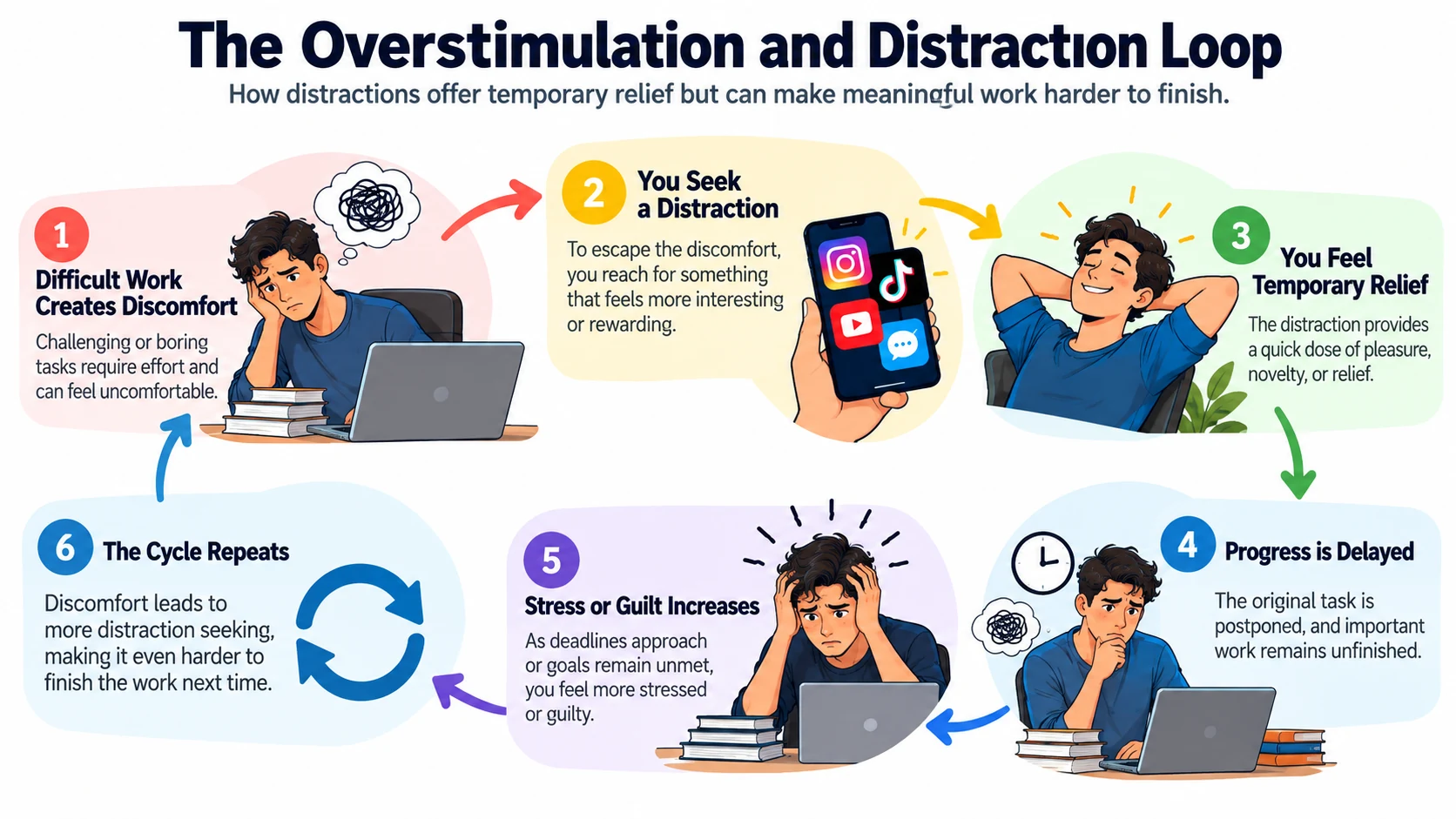
Have you ever noticed how easy it is to watch entertaining videos for thirty minutes but difficult to spend the same amount of time studying?
One activity offers immediate novelty with little effort.
The other requires concentration, patience, and repetition before producing a meaningful reward.
Meurisse uses this contrast to explain why people often struggle to begin demanding work.
When we repeatedly turn to easy entertainment whenever a task becomes uncomfortable, we may strengthen the habit of escaping effort.
Consider an entrepreneur working on a business plan.
The first few sections are easy. But when the financial projections become complicated, the entrepreneur opens YouTube.
The video provides a convenient escape.
Ten minutes later, another video starts. The financial projections remain unfinished.
The problem isn’t necessarily a lack of ambition.
It may be a learned pattern of avoiding discomfort.
How to apply this lesson
For the next three days, notice when you reach for your phone, open social media, or browse unrelated websites.
Ask yourself:
Am I intentionally choosing this activity, or am I trying to avoid something difficult?
You don’t need to judge yourself.
Simply recognizing the pattern can help you make more deliberate choices.
Lesson 2: Identify Your Biggest Sources of Distraction
Not everyone is distracted by the same things.
One person spends hours scrolling social media.
Another constantly checks work messages.
Someone else watches videos late into the night or repeatedly browses shopping websites.
Meurisse’s approach begins with identifying your personal distractions.
Instead of assuming that every enjoyable activity is a problem, focus on behaviors that interfere with your priorities.
Try this distraction audit:
| Distraction | Common trigger | Better alternative |
|---|---|---|
| Social media | Boredom | Take a short walk |
| Email checking | Fear of missing something | Schedule email-checking windows |
| Short videos | Avoiding difficult work | Start with five minutes of the task |
| News browsing | Curiosity or uncertainty | Read during a planned period |
| Online shopping | Stress | Pause before opening the app |
Now identify your three biggest distractions.
Estimate how much time you spend on them each day and when you’re most likely to engage in them.
You may discover that the real issue isn’t the activity itself.
It’s the habit of reaching for it automatically.
Lesson 3: Make Distractions Harder to Access
We often believe that becoming more disciplined means developing stronger willpower.
But Meurisse emphasizes a more practical approach: change your environment.
Imagine keeping a bowl of sweets on your desk.
You may eat them without thinking.
Now imagine moving the bowl into another room.
Eating a sweet requires you to get up, walk to another room, and make a deliberate choice.
The temptation hasn’t disappeared.
But you’ve created friction.
The same principle applies to digital distractions.
Suppose a software developer needs two uninterrupted hours to solve a complicated technical problem.
Instead of relying entirely on willpower, the developer:
- Places the phone outside the room.
- Closes unrelated browser tabs.
- Disables nonessential notifications.
- Uses a website blocker during the work session.
These small changes make distraction less convenient.
How to apply this lesson
Choose one recurring distraction and make it harder to access.
Remove an app shortcut, log out of an account, or keep your phone somewhere you cannot reach it automatically.
The goal isn’t to make distraction impossible.
It’s to create enough friction for you to choose intentionally.
Lesson 4: Choose the Right Type of Dopamine Detox
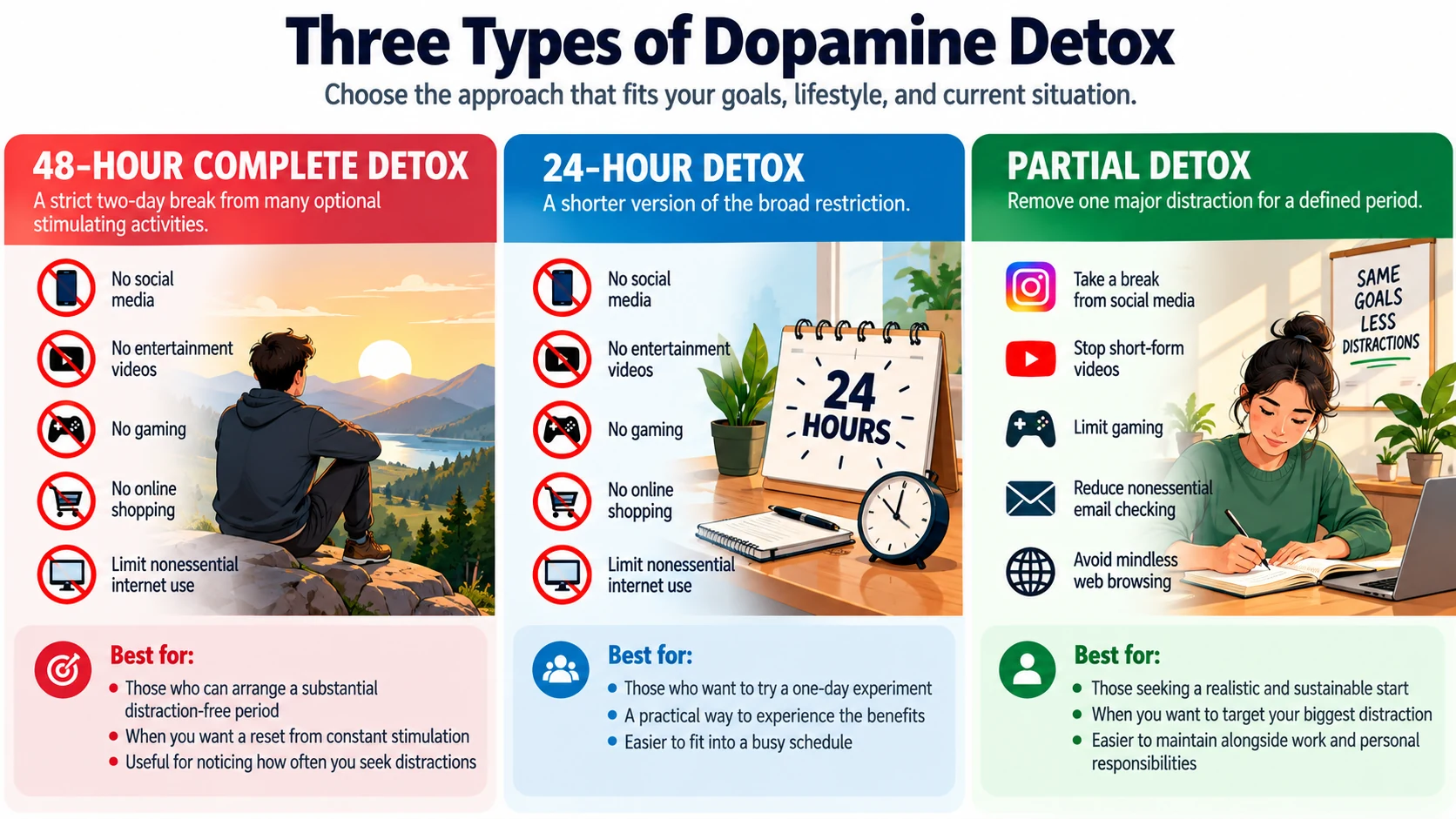
One of the book’s distinctive ideas is that a detox doesn’t have to follow a single format.
Meurisse describes three approaches to temporarily reducing stimulation.
| Approach | Description | Best suited for |
|---|---|---|
| 48-hour complete detox | A strict two-day break from many optional stimulating activities | Someone able to arrange a substantial distraction-free period |
| 24-hour detox | A shorter version of the broad restriction | Someone wanting a one-day experiment |
| Partial detox | Removing one major distraction for a defined period | Someone seeking a realistic starting point |
The complete detox is relatively restrictive and may involve avoiding social media, entertainment videos, gaming, and other optional sources of stimulation.
The 24-hour version follows a similar idea over a shorter period.
A partial detox targets a particular activity that repeatedly interferes with your goals.
For most people, I recommend starting with the partial approach.
For example, stop watching short-form videos for seven days while continuing your normal work, exercise, family time, and essential communication.
You can observe whether the change helps without unnecessarily disrupting your life.
Importantly, these durations are the author’s suggested behavioral experiments, not scientifically validated periods for resetting dopamine.
Lesson 5: Protect the Beginning of Your Day
Think about how you normally begin your morning.
Do you wake up and immediately check your phone?
Do you read messages, scroll social media, or respond to emails before deciding what matters most?
If so, your day may begin with other people’s priorities rather than your own.
Meurisse emphasizes starting the day deliberately.
Consider two mornings.
Morning A: You wake up, check notifications, browse social media, read the news, and respond to messages.
Before beginning meaningful work, your attention has already moved through several unrelated activities.
Morning B: You wake up, follow your usual morning routine, review your priorities, and begin one meaningful task before opening optional entertainment apps.
The second approach doesn’t guarantee productivity.
But it gives you an opportunity to direct your attention rather than react automatically.
How to apply this lesson
For one week, avoid optional social media and entertainment apps during the first 30 minutes after waking.
Use that time to plan your day, read, exercise, journal, or begin something important.
If your responsibilities require early communication, keep essential channels available.
The goal is intentional behavior, not rigid avoidance.
Lesson 6: Make Difficult Work Easier to Start
Reducing distractions creates more room for focused work.
But what happens if you don’t know what to do with that time?
You may simply replace one distraction with another.
Meurisse moves beyond detoxing to discuss planning, overcoming procrastination, and doing meaningful work.
This is one of the book’s most valuable lessons.
You need to connect your distraction-free time to a clear task.
Imagine a manager who needs to prepare a quarterly performance review.
The manager writes:
“Work on performance review.”
That sounds like a task, but it’s vague.
A better instruction would be:
“Analyze last quarter’s revenue and identify three reasons for the variance.”
Now the manager knows exactly where to begin.
Try this focused-work method:
- Choose one important task.
- Define the first visible action.
- Set a realistic work period, such as 30–45 minutes.
- Remove unnecessary distractions.
- Work until the session ends, then take a short break.
If you feel resistance, commit to just five minutes.
Starting is often easier when the first step is small and clear.
Lesson 7: Build Habits That Prevent Distractions from Returning
A temporary detox may help you recognize how often you seek stimulation.
But what happens when the detox ends?
Your phone is still there.
Social media still offers endless content.
Notifications continue to arrive.
Without a long-term strategy, old habits can return.
Meurisse addresses this challenge in the final part of the book.
The objective isn’t to avoid enjoyable activities forever.
It’s to create boundaries that help you use them intentionally.
Imagine a student who completes a 24-hour break from social media.
The next morning, the student turns every notification back on and returns to unrestricted scrolling.
The temporary break hasn’t changed the environment that supported the original habit.
A more sustainable approach might involve keeping nonessential notifications disabled, setting specific entertainment periods, and studying with the phone out of reach.
How to apply this lesson
Create a simple recovery rule for moments when you slip.
For example:
“When I notice myself scrolling during study time, I will close the app, write down my next study action, and work for five minutes.”
A slip doesn’t have to become a complete return to the old routine.
The goal is to recover quickly and continue.
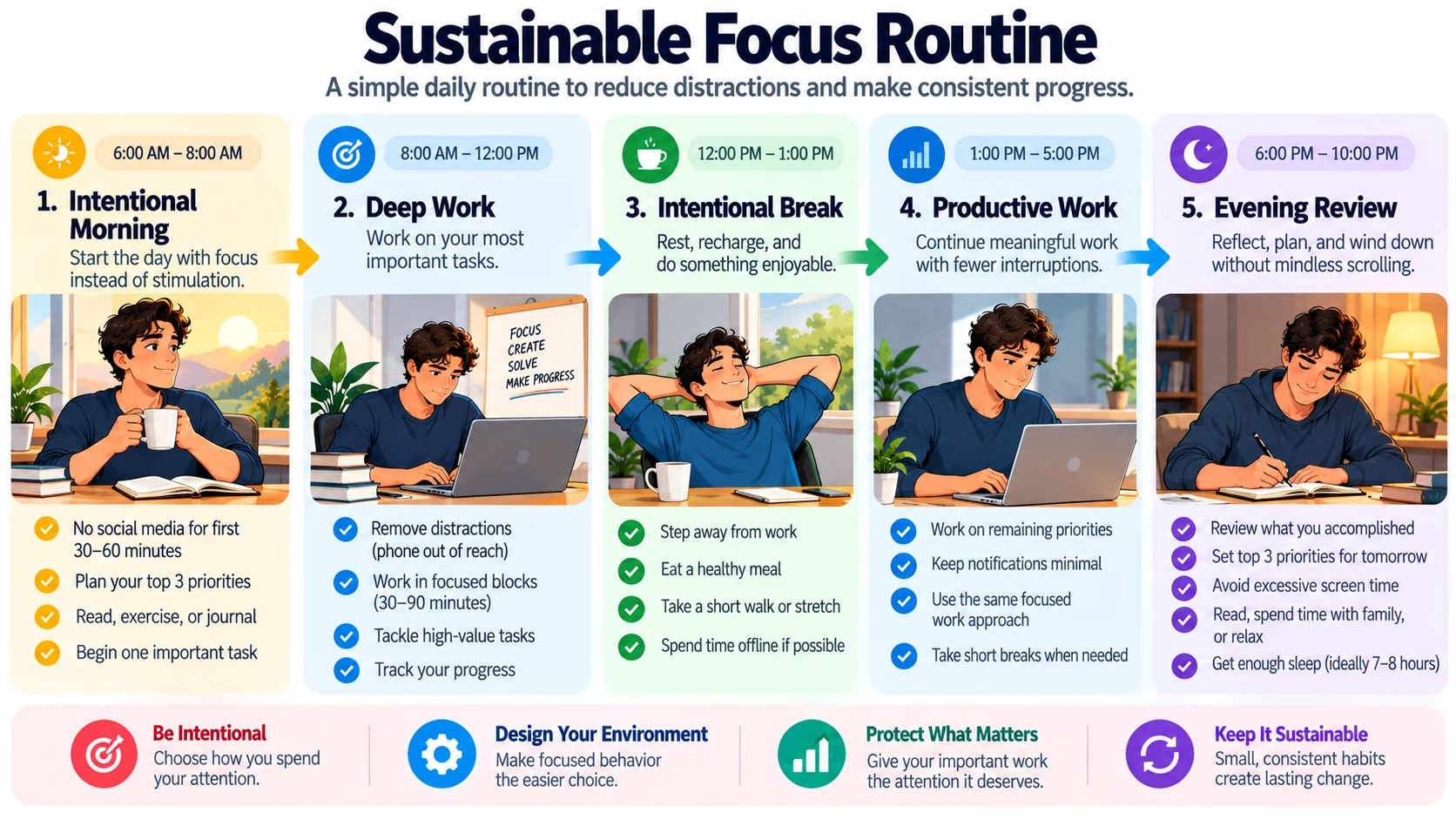
The Three-Step Dopamine Detox Method Explained
The book’s central practical framework has three steps.
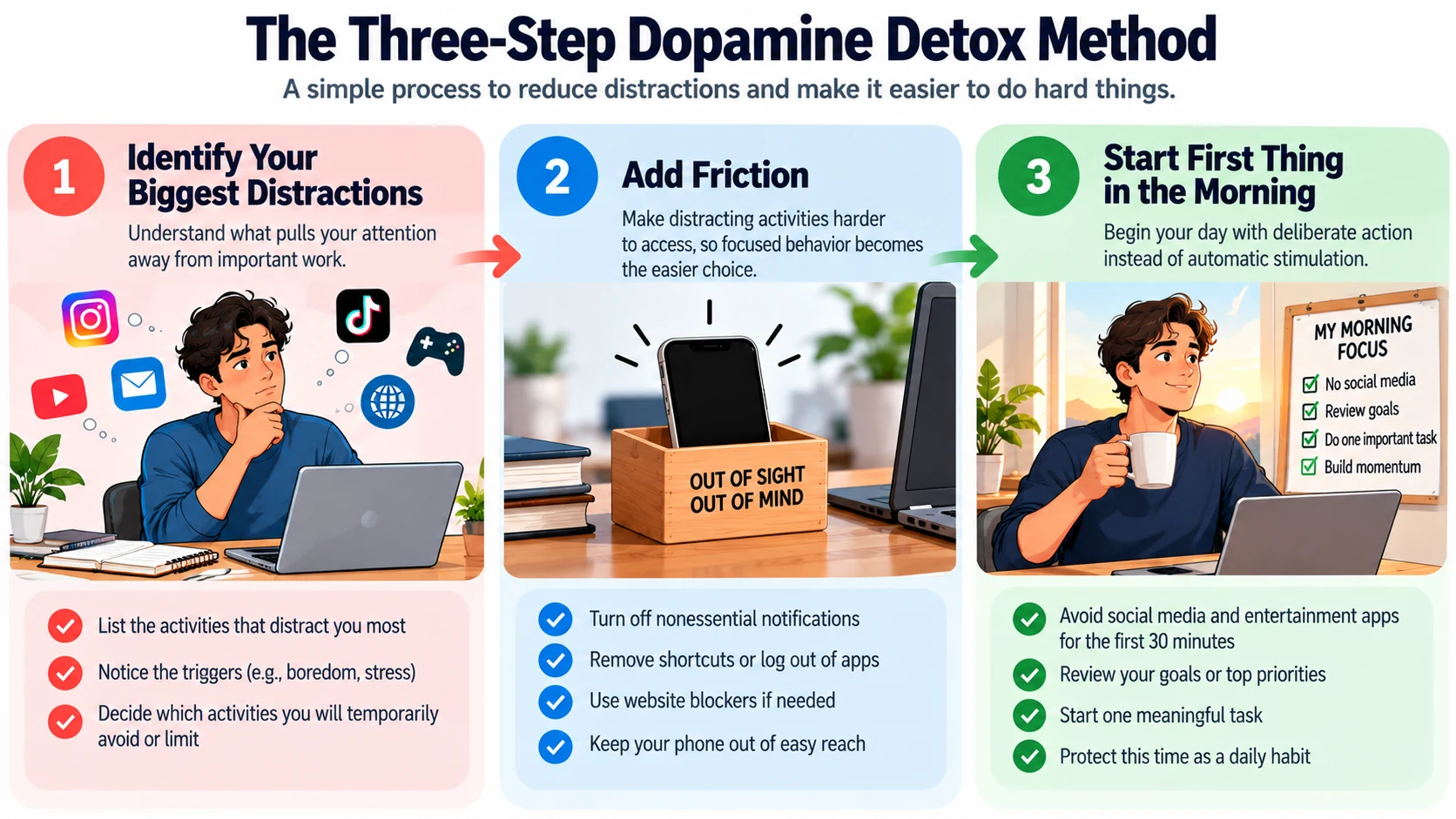
Step 1: Identify Your Biggest Distractions
List the activities that repeatedly pull your attention away from important work.
Decide which ones you will temporarily avoid and which remain necessary.
For example, you might avoid social media while continuing to use your phone for work calls, navigation, and family communication.
Step 2: Add Friction
Make unwanted behaviors less convenient.
Turn off notifications, remove app shortcuts, log out of distracting accounts, or place your phone outside your workspace.
The more deliberate effort required to access a distraction, the easier it may become to reconsider the choice.
Step 3: Start First Thing in the Morning
Begin your day with a deliberate routine before exposing yourself to optional digital stimulation.
You might review your priorities, read, exercise, or start one meaningful task.
The objective is to establish a more intentional pattern at the beginning of the day.
Together, these steps change the question from:
“How can I force myself to be more disciplined?”
to:
“How can I make focused behavior easier to follow?”
A Practical Seven-Day Dopamine Detox Challenge
Understanding the book is useful.
Applying it is what creates the opportunity for change.
The following seven-day challenge is an original application plan inspired by Meurisse’s ideas. It is not an official seven-day program from the book.
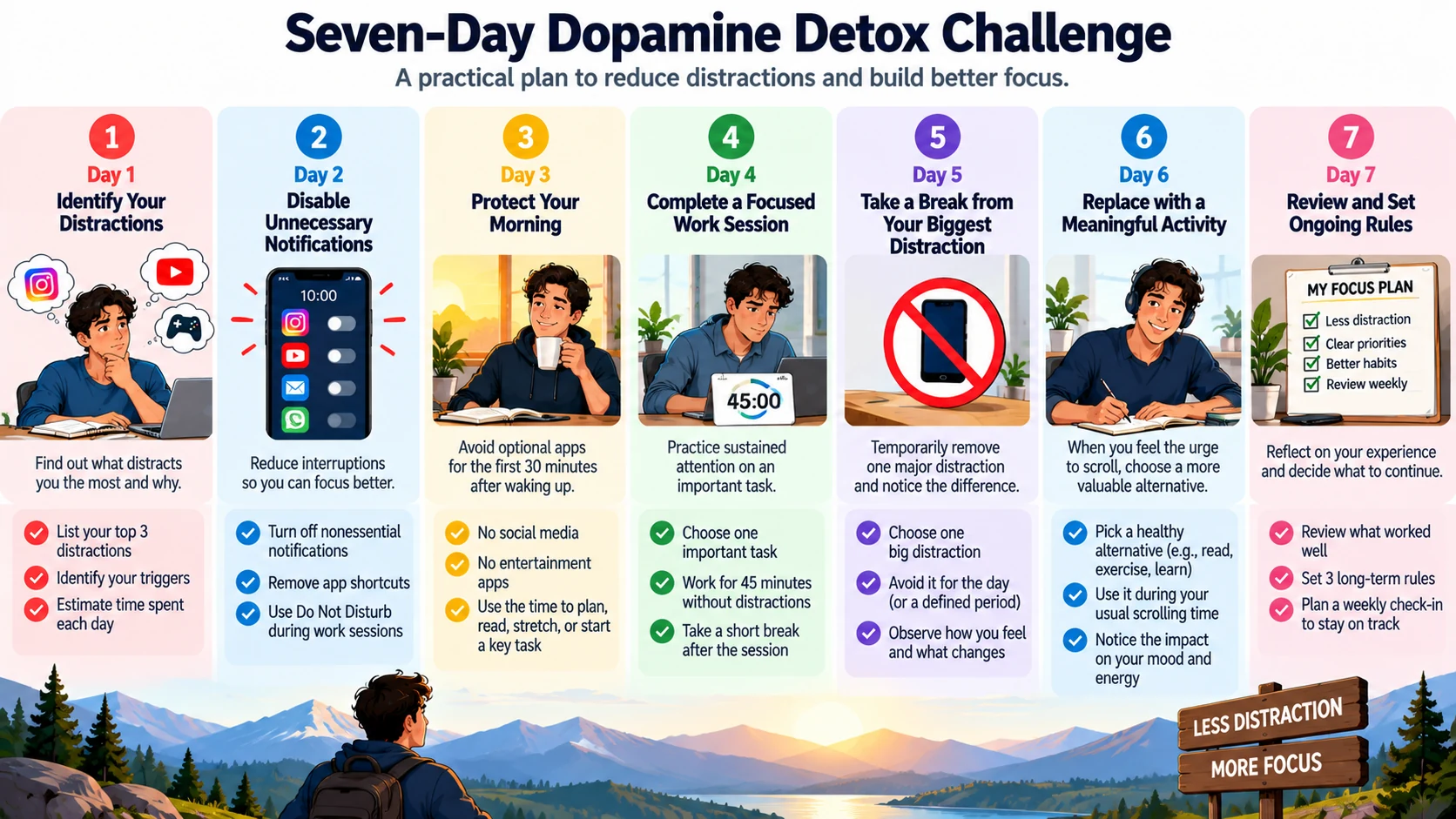
| Day | Challenge | Goal |
|---|---|---|
| Day 1 | Identify your three biggest distractions | Build awareness |
| Day 2 | Disable nonessential notifications | Reduce interruptions |
| Day 3 | Avoid optional entertainment apps for the first 30 minutes of the day | Protect your morning |
| Day 4 | Complete one 45-minute focused work session | Practice sustained attention |
| Day 5 | Take a planned break from your biggest distraction | Test your habits |
| Day 6 | Replace one scrolling session with reading, exercise, or another meaningful activity | Create a better alternative |
| Day 7 | Review your experience and establish three ongoing rules | Make progress sustainable |
You don’t need to complete every challenge perfectly.
Instead, observe what changes.
Did you interrupt yourself less frequently?
Was it easier to begin important work?
Did you accomplish something you had been postponing?
Which habits were practical enough to continue?
Those observations are more useful than simply completing seven days.
Common Dopamine Detox Mistakes to Avoid
Mistake 1: Believing Dopamine Is Harmful
Dopamine is essential for normal brain and body functioning.
The goal is to change distracting behaviors, not eliminate a neurotransmitter.
Mistake 2: Avoiding Every Enjoyable Activity
Exercise, reading, spending time with family, and enjoying music are not automatically problems.
A useful detox focuses on activities that interfere with your goals or well-being.
Mistake 3: Making the Detox Too Restrictive
Extreme restrictions may become difficult to maintain.
Start with manageable changes that fit your responsibilities.
Mistake 4: Removing Distractions Without Planning Important Work
Less screen time doesn’t automatically mean more productivity.
Decide what meaningful activity will replace the time you recover.
Mistake 5: Expecting a Permanent Transformation After 48 Hours
A temporary break may reveal patterns and help you practice new responses.
It does not guarantee a permanent neurological reset.
Long-term improvement requires consistent habits, realistic boundaries, and a supportive environment.
Dopamine Detox Cheat Sheet
| Principle | What it means | Practical action |
|---|---|---|
| Awareness | Recognize your distraction patterns | Track triggers |
| Intentional restriction | Target activities that interfere with your goals | Try a partial detox |
| Friction | Make unwanted behaviors inconvenient | Remove shortcuts and notifications |
| Morning focus | Begin your day deliberately | Delay optional apps |
| Task clarity | Know what you want to accomplish | Define one important action |
| Focused execution | Protect your attention | Use uninterrupted work sessions |
| Sustainability | Prepare for old habits to return | Establish ongoing rules |
Dopamine Detox vs. Deep Work vs. Atomic Habits
These three productivity books address related but different challenges.
| Book | Main question | Most useful idea |
|---|---|---|
| Dopamine Detox — Thibaut Meurisse | How can I reduce unnecessary stimulation? | Remove distracting inputs |
| Deep Work — Cal Newport | How can I concentrate on demanding tasks? | Schedule uninterrupted cognitive work |
| Atomic Habits — James Clear | How can I build consistent behaviors? | Design small, repeatable habits |
These approaches can complement one another.
Use Dopamine Detox to identify and reduce distractions.
Use Deep Work to organize demanding work.
Use Atomic Habits to make your preferred routines easier to repeat.
For related reading, explore our Deep Work and Atomic Habits summaries. (Add the verified internal article links in WordPress.)
Does Dopamine Detox Actually Work? The Science Explained
This is where we need to separate useful productivity advice from scientific claims.
The term “dopamine detox” can be misleading.
You cannot flush dopamine out of your brain by avoiding social media for a weekend.
There is also no established evidence that a specific 24-hour or 48-hour break resets the brain’s dopamine system.
Dopamine isn’t a toxin.
It supports essential biological functions.
However, temporarily stepping away from a problematic activity can help you notice triggers, interrupt automatic behavior, and practice different responses.
These ideas overlap with established behavioral techniques, including stimulus control and approaches associated with cognitive behavioral therapy.
The Cleveland Clinic’s explanation of dopamine detox emphasizes changing specific unwanted behaviors rather than trying to eliminate every pleasurable experience.
So, does dopamine detox work?
It can be a useful behavior-change experiment, but it is not a scientifically proven biochemical reset.
That distinction makes the practical lessons more credible.
Who Should Read Dopamine Detox?
This book is especially suitable for people who want a short, accessible introduction to reducing distractions.
Professionals may appreciate its ideas for managing notifications, protecting work sessions, and concentrating on demanding tasks.
Students can use the techniques to establish distraction-conscious study routines.
Entrepreneurs may find the book useful when working on long-term goals that require patience and sustained effort.
People struggling with digital distractions may benefit from identifying triggers and creating clearer boundaries around entertainment.
However, readers looking for detailed neuroscience or an extensive evidence-based treatment of attention problems may find the book too brief.
Persistent difficulty concentrating can have several causes, including stress, inadequate sleep, mental health conditions, and neurodevelopmental differences. A self-help detox is not a substitute for professional assessment when needed.
My Review: Strengths and Limitations of Dopamine Detox
What the Book Does Well
It is practical. Meurisse focuses on actions readers can try rather than presenting productivity as an abstract concept.
It is short and accessible. The book is easy to approach for readers who prefer straightforward advice.
It connects distraction reduction to meaningful work. The strongest message isn’t simply to stop consuming digital content. It’s to use the attention you reclaim for something important.
It addresses long-term maintenance. The book recognizes that temporary changes are not enough if old habits return immediately.
Where the Book Falls Short
The neuroscience framing can be oversimplified. Readers should not interpret dopamine as something harmful that must be removed.
Some restrictions may be unnecessarily broad. Avoiding every stimulating activity may interfere with healthy routines and responsibilities.
The book offers limited depth. Its brevity makes it accessible, but readers seeking detailed behavioral science may want additional resources.
A detox alone cannot solve every productivity problem. Excessive workload, unclear priorities, poor sleep, and unrealistic expectations also affect concentration.
My Biggest Takeaway
The most useful idea isn’t that modern life contains too much dopamine.
It’s that low-priority activities can consume the attention needed for high-priority work.
The solution begins with deciding what deserves your attention, making distractions less convenient, and repeatedly practicing the behaviors you want to strengthen.
Final Thoughts: Reclaim Your Attention, Not Just Your Time
You can have an entire afternoon available and still accomplish very little.
You can also have one uninterrupted hour and make meaningful progress on something you’ve postponed for weeks.
The difference isn’t always how much time you have.
It’s how intentionally you use your attention.
The central message of this Dopamine Detox Book Summary is that reducing unnecessary stimulation can create better conditions for meaningful work.
You don’t need to abandon technology, avoid every pleasure, or follow an extreme routine.
Start with one distraction.
Create one boundary.
Finish one important task.
Then repeat.
The goal isn’t to live a less enjoyable life. It’s to stop sacrificing what matters most for distractions that matter least.
Frequently Asked Questions About Dopamine Detox
1. What is the main message of Dopamine Detox by Thibaut Meurisse?
The book encourages readers to temporarily reduce distracting activities, establish deliberate routines, and redirect their attention toward meaningful work.
2. Does a dopamine detox really work?
A temporary break from distracting activities may help people recognize and change habits. However, it does not literally remove dopamine or reset the brain’s reward system.
3. How long should a dopamine detox last?
Meurisse describes 48-hour, 24-hour, and partial detox approaches. There is no scientifically established ideal duration. A manageable break from one problematic activity is a sensible starting point.
4. Can I use my phone during a dopamine detox?
Yes, depending on your chosen approach. A partial detox might involve avoiding social media while continuing to use your phone for essential communication, work, and other practical needs.
5. What should I avoid during a dopamine detox?
Focus on activities that repeatedly interfere with your priorities, such as compulsive scrolling, excessive gaming, or unnecessary browsing. Healthy and enjoyable activities do not need to be eliminated simply because they are pleasurable.
6. Is dopamine detox good for students?
Students may benefit from reducing distracting notifications, establishing dedicated study periods, and creating clearer boundaries around entertainment. These benefits do not require a literal dopamine detox.
7. Is Dopamine Detox worth reading?
Yes, if you want a brief, practical introduction to reducing distractions and improving work habits. Its neuroscience claims should be interpreted critically.
8. What is the difference between dopamine detox and digital detox?
A digital detox focuses on reducing the use of digital devices or services. Dopamine detox, as described in the book, may include a wider range of stimulating activities. Neither method literally removes dopamine from the brain.