You open your laptop at 9am. By noon, you’ve replied to 30 messages, sat in two meetings, and scrolled through three news feeds. And the one thing you actually needed to do? Still untouched.
Sound familiar? That’s not a you problem. That’s what modern work does to everyone.
Cal Newport wrote Deep Work to name this problem and fix it. His argument is simple: the ability to focus — really focus, without checking your phone every four minutes — is becoming rare. And rare things that also happen to be valuable? That’s where careers are made.
This Deep Work summary covers the key ideas, the common mistakes people make trying to apply them, and what I honestly think after sitting with this book for years.
What is Deep Work about — and who is it really for?
Think about the last time you worked on something hard without any interruptions. Not “mostly focused.” Truly locked in. Phone face-down, door closed, brain fully on one thing.
If you have to think hard to remember that moment, this book is for you.
Newport wrote Deep Work for anyone who does knowledge work — writing, coding, designing, thinking, creating — and feels like they’re always busy but rarely making real progress. That’s most of us. The book doesn’t promise shortcuts. It offers something more useful: a clear explanation of why your best work keeps getting crowded out, and what to do about it.
Who is Cal Newport — and why does his opinion matter?
Cal Newport is a computer science professor at Georgetown University. He’s published academic research while also writing six books that millions of people have read. Here’s the thing that sets him apart: he has never had a social media account. Not as a stunt — as a principled choice backed by his own research.
Newport doesn’t just write about avoiding distraction. He’s built a serious career by actually avoiding it. That’s rare enough to pay attention to.
The big idea in Deep Work — said plainly
Deep work means focusing hard on something difficult without getting distracted. Cal Newport argues this skill is disappearing — because most workplaces reward looking busy over doing meaningful work. The people who protect time for real focus will produce better results and build stronger careers than those who don’t.
Here’s a way to think about it. Imagine two graphic designers. They both have the same skills and tools. Designer A works in a quiet room for three uninterrupted hours. Designer B spends those same three hours jumping between their project, a group chat, email, and a Zoom call.
Designer A’s work will be better. Not a little better. A lot better.
Newport calls this the quality gap. And he says it’s growing — because fewer people are willing to protect the conditions that make deep work possible. The ones who do? They stand out.
Why Deep Work hits different in 2026
Newport wrote this in 2016. He couldn’t have known how right he’d turn out to be.
AI tools now handle most shallow work faster and cheaper than any human can. Writing basic copy, summarising documents, formatting reports — machines do all of that. What they can’t do is think originally for hours about a hard, ambiguous problem. That’s still yours. But only if you protect time to actually do it.
Remote work made things harder too. Offices at least had physical separation between work and distraction. Now your workspace is your sofa, and your phone is always within reach. Focus won’t just happen. You have to build it deliberately.
And if you’re building any kind of audience — as a writer, creator, or independent professional — quality is your only real advantage. Anyone can publish content. Very few people can publish something that makes readers stop and think. Deep work is how you get there.
The ideas inside Deep Work — broken down simply
Shallow work fills your day — but it doesn’t build your career
What it means: Newport splits all work into two types. Deep work: focused, hard, valuable. Shallow work: quick, reactive, replicable. Most professional days are 80% shallow — emails, admin, meetings, messages.
Why it matters more than it sounds: You can spend an entire career doing shallow work and feel productive every single day. But shallow work doesn’t compound. It doesn’t build skills. It doesn’t produce the kind of output that gets you noticed or promoted or hired.
A real example: A junior content writer who spends mornings editing with full focus and afternoons on emails grows faster than a colleague who does both tasks at the same time all day. In six months, the gap is visible. In two years, it’s career-defining.
Every time you switch tasks, you leave a mental residue behind
What it means: When you stop working on Task A to check a message, your brain doesn’t fully switch off Task A. A portion of your attention stays stuck on it. Researcher Sophie Leroy calls this “attention residue.” The more you switch, the more residue piles up — and the worse your thinking gets.
Why it matters more than it sounds: This is why “I’ll just check this quickly” is a trap. The check takes 30 seconds. The mental cleanup takes 15 minutes. That quick message didn’t just cost you 30 seconds — it quietly degraded the next hour of work.
A real example: A developer who checks Slack between coding sessions doesn’t just lose the time spent reading messages. They lose the mental thread they were holding. Rebuilding it takes real effort — and sometimes it doesn’t fully come back until the next day.
You need a structure for deep work — not just good intentions
What it means: Newport identifies four ways to structure deep work into real life. Daily rituals at the same time every morning. Longer blocks a few days a week. Dropping into focus whenever a gap appears. Or going almost completely off-grid. Most people use none of these. They just plan to “focus more.”
Why it matters more than it sounds: “I’ll focus when things calm down” is not a plan. Things don’t calm down. The structure is the plan. Without it, shallow work always fills the space.
A real example: A freelance designer who blocks 7–10am every day as non-negotiable deep work — before email, before client messages — will finish better work faster than one who tries to fit focus into the gaps between requests. The gaps never come.
Boredom is not the enemy. Reaching for your phone is.
What it means: If you grab your phone every time you feel the smallest mental discomfort, you’re training your brain to need constant stimulation. That’s the opposite of what deep work requires. Newport says you have to practise tolerating boredom — on purpose.
Why it matters more than it sounds: Your phone isn’t just stealing time. It’s retraining your brain’s tolerance for hard thinking. Every idle moment you fill with scrolling makes it harder to sit still and focus when it counts.
A real example: Try commuting without headphones or a screen for one week. Just sit with your thoughts. It feels uncomfortable at first. By day five, most people notice they’re arriving at work in a calmer, sharper mental state. That’s the focus muscle waking up.
How you end your day shapes how the next one starts
What it means: Newport recommends ending every workday with a shutdown ritual. Check your task list. Capture anything unfinished. Say the words “shutdown complete” out loud. Then stop. Don’t check email again until morning.
Why it matters more than it sounds: Unfinished tasks stay active in your brain even when you’re “done.” This is called the Zeigarnik effect. If you don’t consciously close the loop, your brain keeps rehearsing those open tasks during dinner, during your evening, during sleep.
A real example: Try writing down your three most important unfinished tasks at 5pm, along with the next specific action for each one. Then close the laptop. Most people find they sleep better and start the next morning with more clarity — not because the work is done, but because the brain has been told it’s been handled.
How to actually use Deep Work in your life
If you’re a founder or entrepreneur
- Your first 2 hours every day are your most valuable. Use them to build — write, think, create, decide. Do not open email until that block is done. Not even once.
- Look at every recurring meeting and ask: what would actually break if this didn’t happen? You’ll find that most meetings exist out of habit, not necessity.
- During big pushes — fundraising, product launches, hiring — try separating your week into “build days” and “meeting days.” Running both at the same time means doing neither well.
If you’re a creator or writer
- Create first, distribute later. Write or build in the morning when your brain is fresh. Check comments, reply to messages, and post on social media in the afternoon. Never mix the two in the same session.
- Build a small pre-work ritual — make coffee, put on a specific playlist, sit in the same spot. After a few weeks, the ritual itself will trigger focus before you’ve even started working.
- Stop measuring hours worked. Measure what you actually finished. One strong piece of work in two focused hours beats four mediocre ones churned out across a distracted day.
If you’re a student or early-career professional
- Put your phone in another room when you study. Not face-down on your desk. Another room. The research on this is clear — just seeing your phone reduces cognitive performance, even when it’s off.
- At work, figure out the one or two tasks that require real thinking. Protect at least 60–90 minutes for those before anything else gets your attention.
- Ask your manager what 20% of shallow work would be fine to batch or skip. Most managers have never been asked this. Most will give you a real answer — and the permission that follows can change your whole working week.
Where people go wrong with Deep Work
Mistake 1 — scheduling the time but not training the skill
People block two hours in their calendar, sit down, and stare at the screen. Their mind wanders. They check one message. Then another. They conclude deep work doesn’t work for them.
Why it happens: Focus is a muscle. You can’t decide to run a marathon without training first. Blocking time creates the container — but the capacity has to be built gradually.
What to do instead: Start with 45-minute blocks. Build to 90 minutes over four weeks. Depth first. Duration later. A fully focused 45 minutes is worth more than a distracted two hours every single time.
Mistake 2 — using deep work as an excuse to go off-grid completely
Some people read this book and disappear. They don’t reply to messages for days. They skip meetings entirely. Their team gets frustrated. Their manager gets worried. The backlash undoes any benefit.
Why it happens: Newport is a tenured professor with a lot of scheduling freedom. Most of us aren’t. Applying his most extreme ideas without adapting them to your actual situation creates more problems than it solves.
What to do instead: Protect focused blocks, but communicate clearly. Tell your team your focused hours. Reply in batches. Being predictably available at certain times is very different from being always on.
Mistake 3 — trying to change everything at once
Inspired after reading, people delete every app, restructure their calendar, quit social media, and set up a deep work cave — all in one weekend. By week two, everything has reverted.
Why it happens: Big sudden changes feel exciting but don’t stick. Habits change through small consistent actions, not dramatic gestures.
What to do instead: Pick one thing. Just one. Protect your mornings for three weeks. Once that’s solid, add the next change. Build the architecture slowly and it actually holds.
Mistake 4 — thinking busyness and depth are the same thing
People end a hectic day and tell themselves they worked hard. And they did — just not on anything that required real thinking. A full inbox doesn’t equal a productive day.
Why it happens: Shallow work creates a feeling of productivity because it’s visible, social, and rewarded in most workplaces. Deep work is quieter — but it’s where the real value gets made.
What to do instead: At the end of each day, ask yourself one question: what did I create or solve today that required real thinking? If you can’t answer it, your day was shallow — no matter how tired you feel.
The lessons from Deep Work that actually stick
01 — Focused work is rare. That’s exactly why it’s valuable.
Most people spend their days reacting. The ones who protect time to think deeply produce work that stands out — not because they’re smarter, but because almost nobody else is doing it.
02 — Your environment shapes your focus more than your willpower does.
You won’t out-discipline a phone sitting on your desk. Change your environment first. Move the phone. Close the tabs. Build conditions that make distraction harder, not just less tempting.
03 — One hour of real focus beats four hours of half-attention.
This isn’t about working less. It’s about working at your actual ceiling instead of your distracted average. The quality gap is bigger than most people realise until they experience it.
04 — Boredom is practice. Protect some of it every day.
Every time you sit with a thought instead of reaching for stimulation, you’re building the mental stamina that deep work needs. It feels odd at first. It pays off fast.
05 — A deep life is a good life — and that’s a bigger idea than it sounds.
Newport isn’t just making a productivity argument. He’s saying that doing meaningful, hard work with your full attention is one of the few reliable sources of satisfaction in modern professional life. Shallow work might fill the day. It doesn’t fill the year.
Lines from Deep Work worth keeping
“Deep work is the ability to focus without distraction on a cognitively demanding task.”
— Cal Newport, Deep Work
Most people read this and realise they haven’t actually done this in weeks. That realisation alone is worth the book.
“A deep life is a good life.”
— Cal Newport, Deep Work
Simple. But it reframes the whole argument. This isn’t just about being more productive. It’s about living and working in a way that actually means something.
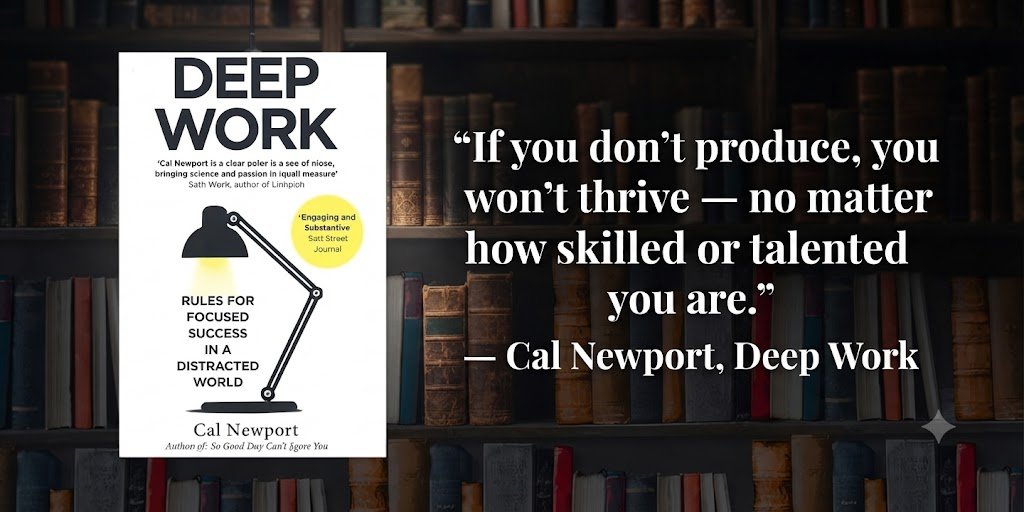
“If you don’t produce, you won’t thrive — no matter how skilled or talented you are.”
— Cal Newport, Deep Work
A direct challenge to anyone who knows they’re capable of more but keeps letting the day get away from them.
Key idea: The people who learn to focus on hard things will keep pulling ahead — not because they work longer, but because fewer and fewer people are willing to work deeply at all.
In 2026, with AI eating shallow work daily, this has never been more true.
Who should actually read Deep Work?
Founders and entrepreneurs — If you feel perpetually busy but rarely build anything that reflects your real capability, this book will show you exactly where your best hours are going and how to reclaim them.
Creators, writers, and independent professionals — Your competitive advantage is the quality of what you produce. Deep Work is the operating manual for producing at your actual ceiling, not your distracted average.
Students preparing for high-stakes outcomes — Two hours of genuine deep study consistently outperforms six distracted hours. This book will change your relationship with studying permanently.
Knowledge workers trapped in meeting culture — If your calendar is owned by other people and your best thinking happens, if ever, after 6pm — this book gives you both the argument and the language to change it.
What I personally took from Deep Work
I expected a productivity book. What I found was a quiet argument for a different relationship with work itself. Newport’s claim that a deep life is a good life isn’t a motivational footnote — it’s the book’s real thesis. He’s arguing that the practice of concentrating deeply on meaningful work is one of the few remaining sources of genuine professional satisfaction. That’s a far more ambitious idea than most productivity writers dare to make.
Where I’d push back: Newport is a tenured professor at a research university. His career structure gives him a level of scheduling autonomy that most founders, freelancers, and early-career professionals simply don’t have. The Monastic philosophy — retreating almost entirely from shallow obligations — is not available to someone who needs clients, needs a manager satisfied, or needs to be discoverable online to survive. My advice: extract the principles, apply them to your actual life, and don’t feel guilty for not matching Newport’s ideal.
The one change I made: I stopped checking my phone for the first 90 minutes of every working day. That’s it. No dramatic life overhaul. Just 90 minutes where I work on one thing before the world gets access to my attention. The quality difference in what I produce during those 90 minutes compared to the rest of my day is not small. It is embarrassingly large.
Newport didn’t give me more time. He showed me I’d been spending my sharpest hours on my least important tasks.
Here’s my challenge to you: when did you last spend 90 consecutive minutes on your most important work — truly uninterrupted, fully focused? If you can’t remember, you already know what to fix.
Quick answers about Deep Work
Q: Is Deep Work by Cal Newport worth reading?
A: Yes — especially now. With AI handling more routine work, the ability to think deeply and originally is becoming the most valuable skill a knowledge worker can have. This book explains why, and gives you a practical system for building that skill. Most people who read it change how they structure their day within a week.
Q: What is the main message of Deep Work?
A: The core message is this: real focus — the kind where you work on something hard without any distraction — is getting rarer and more valuable at the same time. The professionals who protect time for it will produce better work and build stronger careers than those who don’t. Most of us have let this ability quietly atrophy. The book shows you how to get it back.
Q: How long does it take to read Deep Work?
A: Deep Work is 296 pages. Most readers finish it in 4–6 hours. The first half makes the case for why deep work matters. The second half gives you practical strategies to apply it. You can start using the ideas before you even finish the book — the morning deep work block alone is worth trying from day one.